


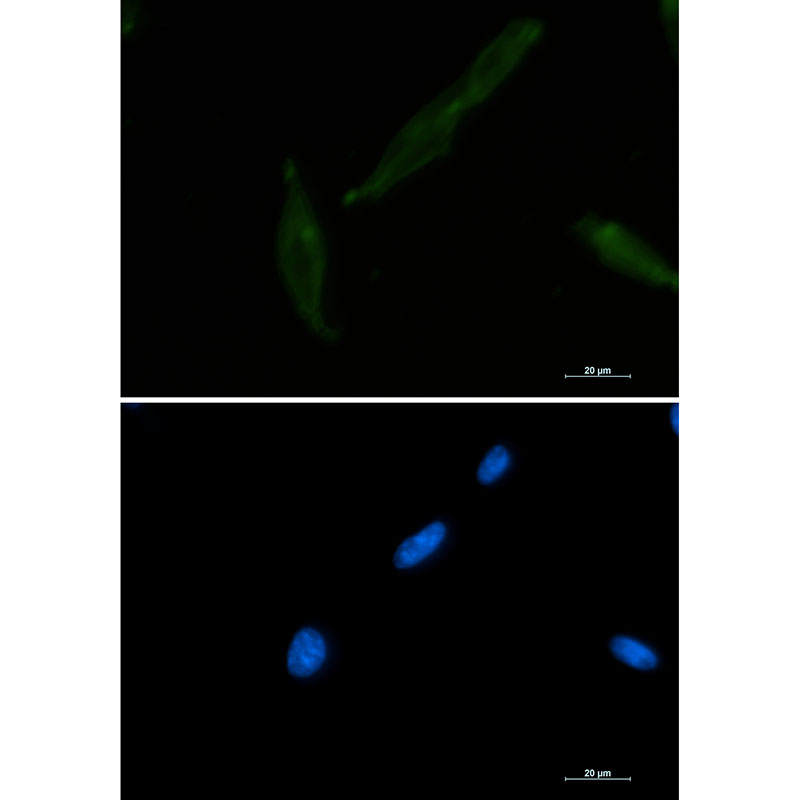
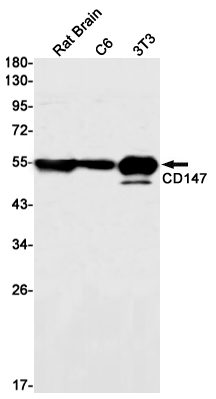

Anti-CD147 antibody [R03-7C3] (STJA0034128)
SPECIFICATIONS
ClonalityMonoclonal
HostRabbit
ConjugationUnconjugated
IsotypeIgG
ImmunogenRecombinant protein of mouse CD147
General Information
| Short Description | Rabbit monoclonal anti-CD147 for use in WB, ICC, IF and IP in Mouse and Rat samples. Datasheet included with dilution recommendations, and related reagents. |
| Applications | WB/ICC/IF/IP |
| Host | Rabbit |
| Reactivity | Mouse/Rat |
| Note | STRICTLY FOR FURTHER SCIENTIFIC RESEARCH USE ONLY (RUO). MUST NOT TO BE USED IN DIAGNOSTIC OR THERAPEUTIC APPLICATIONS. |
Product Properties
| Clonality | Monoclonal |
| Clone ID | R03-7C3 |
| Isotype | IgG |
| Conjugation | Unconjugated |
| Concentration | 0.3 mg/mL |
| Purification | Affinity Purified |
| Dilution Range | WB 1:500-1:1000IF 1:50-1:200IP 1:20 |
| Formulation | 50mM Tris-Glycine (pH 7.4) , 0.15M NaCl, 40% Glycerol, 0.01% Sodium azide and 0.05% BSA |
| Storage Instruction | Store at 4°C short term. Aliquot and store at-20°C long term. Avoid freeze/thaw cycles. |
Target Information
| Gene Symbol | Bsg |
| Gene ID | 12215 |
| Uniprot ID | BASI_MOUSE |
| Immunogen | Recombinant protein of mouse CD147 |
Additional Info
| Tissue Specificity | Isoform 1: Retina-specific. Expressed in both rods and cones (at protein level). Isoform 2: Testis and caput, corpus and cauda epididymides (at protein level). Expressed in the brain, lung, liver, kidney, heart, spleen, uterus, retina and skeletal muscle. |
| Post Translational Modifications | Isoform 1: N-glycosylated. Isoform 2: N-glycosylated. During spermatogenesis, probably deglycosylated during epididymal transit. |
| Function | Isoform 1: Essential for normal retinal maturation and development. Acts as a retinal cell surface receptor for NXNL1 and plays an important role in NXNL1-mediated survival of retinal cone photoreceptors. In association with glucose transporter SLC16A1/GLUT1 and NXNL1, promotes retinal cone survival by enhancing aerobic glycolysis and accelerating the entry of glucose into photoreceptors. Isoform 2: Signaling receptor for cyclophilins, essential for PPIA/CYPA and PPIB/CYPB-dependent signaling related to chemotaxis and adhesion of immune cells. Plays an important role in targeting the monocarboxylate transporters SLC16A1, SLC16A3 and SLC16A8 to the plasma membrane. Acts as a coreceptor for vascular endothelial growth factor receptor 2 (KDR/VEGFR2) in endothelial cells enhancing its VEGFA-mediated activation and downstream signaling. Promotes angiogenesis through EPAS1/HIF2A-mediated up-regulation of VEGFA and KDR/VEGFR2 in endothelial cells. Plays an important role in spermatogenesis.mediates interactions between germ cells and Sertoli cell and is essential for the development/differentiation of germ cells to round spermatids. |
| Protein Name | BasiginBasic Immunoglobulin SuperfamilyHt7 AntigenMembrane Glycoprotein Gp42Cd Antigen Cd147 |
| Database Links | Reactome: R-MMU-1474228Reactome: -MMU-210991Reactome: -MMU-216083Reactome: -MMU-433692Reactome: -MMU-9749641 |
| Cellular Localisation | Isoform 1: Cell MembraneSingle-Pass Type I Membrane ProteinPhotoreceptor Inner SegmentCell ProjectionCiliumPhotoreceptor Outer SegmentIsoform 2: Cell MembraneEndoplasmic Reticulum MembraneBasolateral Cell Membrane |
| Alternative Antibody Names | Anti-Basigin antibodyAnti-Basic Immunoglobulin Superfamily antibodyAnti-Ht7 Antigen antibodyAnti-Membrane Glycoprotein Gp42 antibodyAnti-Cd Antigen Cd147 antibodyAnti-Bsg antibody |
Information sourced from Uniprot.org