

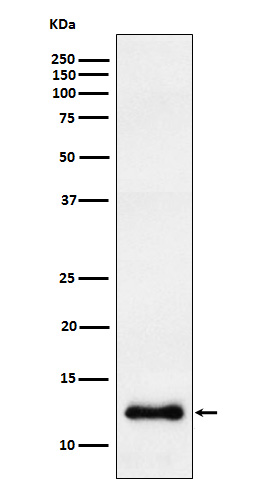

Anti-CCL23 antibody [R03-4N8] (STJA0037421)
SPECIFICATIONS
ClonalityMonoclonal
HostRabbit
ConjugationUnconjugated
IsotypeIgG
ImmunogenA synthesized peptide derived from human CCL23
General Information
| Short Description | Rabbit monoclonal anti-CCL23 for use in WB, ICC and IF in Human samples. Datasheet included with dilution recommendations, and related reagents. |
| Applications | WB/ICC/IF |
| Host | Rabbit |
| Reactivity | Human |
| Note | STRICTLY FOR FURTHER SCIENTIFIC RESEARCH USE ONLY (RUO). MUST NOT TO BE USED IN DIAGNOSTIC OR THERAPEUTIC APPLICATIONS. |
Product Properties
| Clonality | Monoclonal |
| Clone ID | R03-4N8 |
| Isotype | IgG |
| Conjugation | Unconjugated |
| Purification | Affinity Purified |
| Dilution Range | WB 1:500-1:1000IF 1:50-1:200 |
| Formulation | Rabbit IgG in phosphate buffered saline, pH 7.4, 150mM NaCl, 0.02% sodium azide and 50% glycerol. |
| Storage Instruction | Store at 4°C short term. Aliquot and store at-20°C long term. Avoid freeze/thaw cycles. |
Target Information
| Gene Symbol | CCL23 |
| Gene ID | 6368 |
| Uniprot ID | CCL23_HUMAN |
| Immunogen | A synthesized peptide derived from human CCL23 |
Additional Info
| Tissue Specificity | High levels in adult lung, liver, skeletal muscle and pancreas. Moderate levels in fetal liver, adult bone marrow and placenta. The short form is the major species and the longer form was detected only in very low abundance. CCL23(19-99), CCL23(22-99), CCL23(27-99), CCL23(30-99) are found in high levels in synovial fluids from rheumatoid patients. |
| Post Translational Modifications | The N-terminal is proteolytically cleaved by proteases associated with inflammatory responses. The processed forms, CCL23(19-99), CCL23(22-99), CCL23(27-99) and CCL23(30-99) exhibit increase in CCR1-mediated signaling and chemotaxis assays in vitro. |
| Function | Shows chemotactic activity for monocytes, resting T-lymphocytes, and neutrophils, but not for activated lymphocytes. Inhibits proliferation of myeloid progenitor cells in colony formation assays. This protein can bind heparin. Binds CCR1. CCL23(19-99), CCL23(22-99), CCL23(27-99), CCL23(30-99) are more potent chemoattractants than CCL23. |
| Protein Name | C-C Motif Chemokine 23Ck-Beta-8Ckb-8Macrophage Inflammatory Protein 3Mip-3Myeloid Progenitor Inhibitory Factor 1Mpif-1Small-Inducible Cytokine A23 Cleaved Into - Ccl23(19-99 - Ccl23(22-99 - Ccl23(27-99 - Ccl23(30-99 |
| Database Links | Reactome: R-HSA-416476 P55773-2Reactome: R-HSA-418594 P55773-2Reactome: R-HSA-444473 P55773-2 |
| Cellular Localisation | Secreted |
| Alternative Antibody Names | Anti-C-C Motif Chemokine 23 antibodyAnti-Ck-Beta-8 antibodyAnti-Ckb-8 antibodyAnti-Macrophage Inflammatory Protein 3 antibodyAnti-Mip-3 antibodyAnti-Myeloid Progenitor Inhibitory Factor 1 antibodyAnti-Mpif-1 antibodyAnti-Small-Inducible Cytokine A23 Cleaved Into - Ccl23(19-99 - Ccl23(22-99 - Ccl23(27-99 - Ccl23(30-99 antibodyAnti-CCL23 antibodyAnti-MIP3 antibodyAnti-MPIF1 antibodyAnti-SCYA23 antibody |
Information sourced from Uniprot.org