

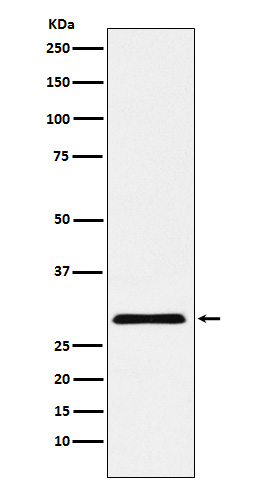

Anti-CBX7 antibody [R01-2S8] (STJA0036606)
SPECIFICATIONS
ClonalityMonoclonal
HostRabbit
ConjugationUnconjugated
IsotypeIgG
ImmunogenA synthesized peptide derived from human cbx7
General Information
| Short Description | Rabbit monoclonal anti-CBX7 for use in WB and FC in Human samples. Datasheet included with dilution recommendations, and related reagents. |
| Applications | WB/FC |
| Host | Rabbit |
| Reactivity | Human |
| Note | STRICTLY FOR FURTHER SCIENTIFIC RESEARCH USE ONLY (RUO). MUST NOT TO BE USED IN DIAGNOSTIC OR THERAPEUTIC APPLICATIONS. |
Product Properties
| Clonality | Monoclonal |
| Clone ID | R01-2S8 |
| Isotype | IgG |
| Conjugation | Unconjugated |
| Purification | Affinity Chromatography |
| Dilution Range | WB 1:500-1:1000FC 1:50-1:100 |
| Formulation | Rabbit IgG in phosphate buffered saline, pH 7.4, 150mM NaCl, 0.02% sodium azide and 50% glycerol. |
| Storage Instruction | Store at 4°C short term. Aliquot and store at-20°C long term. Avoid freeze/thaw cycles. |
Target Information
| Gene Symbol | CBX7 |
| Gene ID | 23492 |
| Uniprot ID | CBX7_HUMAN |
| Immunogen | A synthesized peptide derived from human cbx7 |
Additional Info
| Function | Component of a Polycomb group (PcG) multiprotein PRC1-like complex, a complex class required to maintain the transcriptionally repressive state of many genes, including Hox genes, throughout development. PcG PRC1 complex acts via chromatin remodeling and modification of histones.it mediates monoubiquitination of histone H2A 'Lys-119', rendering chromatin heritably changed in its expressibility. Promotes histone H3 trimethylation at 'Lys-9' (H3K9me3). Binds to trimethylated lysine residues in histones, and possibly also other proteins. Regulator of cellular lifespan by maintaining the repression of CDKN2A, but not by inducing telomerase activity. |
| Protein Name | Chromobox Protein Homolog 7 |
| Database Links | |
| Cellular Localisation | Nucleus |
| Alternative Antibody Names | Anti-Chromobox Protein Homolog 7 antibodyAnti-CBX7 antibody |
Information sourced from Uniprot.org