
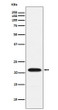
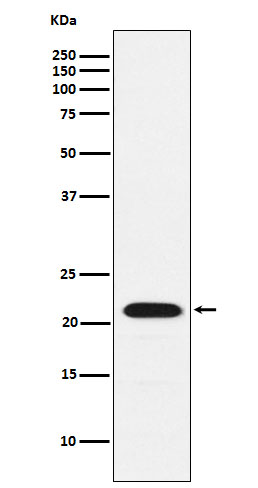

Anti-CBFB antibody [R05-9P6] (STJA0036963)
SPECIFICATIONS
ClonalityMonoclonal
HostRabbit
ConjugationUnconjugated
IsotypeIgG
ImmunogenA synthesized peptide derived from human CBFb
General Information
| Short Description | Rabbit monoclonal anti-CBFB for use in WB, IHC-P, ICC, IF and FC in Human, Mouse and Rat samples. Datasheet included with dilution recommendations, and related reagents. |
| Applications | WB/IHC-P/ICC/IF/FC |
| Host | Rabbit |
| Reactivity | Human/Mouse/Rat |
| Note | STRICTLY FOR FURTHER SCIENTIFIC RESEARCH USE ONLY (RUO). MUST NOT TO BE USED IN DIAGNOSTIC OR THERAPEUTIC APPLICATIONS. |
Product Properties
| Clonality | Monoclonal |
| Clone ID | R05-9P6 |
| Isotype | IgG |
| Conjugation | Unconjugated |
| Purification | Affinity Chromatography |
| Dilution Range | WB 1:500-1:1000IHC 1:50-1:100IF 1:50-1:200FC 1:50-1:100 |
| Formulation | Rabbit IgG in phosphate buffered saline, pH 7.4, 150mM NaCl, 0.02% sodium azide and 50% glycerol. |
| Storage Instruction | Store at 4°C short term. Aliquot and store at-20°C long term. Avoid freeze/thaw cycles. |
Target Information
| Gene Symbol | CBFB |
| Gene ID | 865 |
| Uniprot ID | PEBB_HUMAN |
| Immunogen | A synthesized peptide derived from human CBFb |
Additional Info
| Function | Forms the heterodimeric complex core-binding factor (CBF) with RUNX family proteins (RUNX1, RUNX2, and RUNX3). RUNX members modulate the transcription of their target genes through recognizing the core consensus binding sequence 5'-TGTGGT-3', or very rarely, 5'-TGCGGT-3', within their regulatory regions via their runt domain, while CBFB is a non-DNA-binding regulatory subunit that allosterically enhances the sequence-specific DNA-binding capacity of RUNX. The heterodimers bind to the core site of a number of enhancers and promoters, including murine leukemia virus, polyomavirus enhancer, T-cell receptor enhancers, LCK, IL3 and GM-CSF promoters. CBF complexes repress ZBTB7B transcription factor during cytotoxic (CD8+) T cell development. They bind to RUNX-binding sequence within the ZBTB7B locus acting as transcriptional silencer and allowing for cytotoxic T cell differentiation. (Microbial infection) Following infection, hijacked by the HIV-1 Vif protein, leading to the formation a cullin-5-RING E3 ubiquitin-protein ligase complex (ECS complex) that catalyzes ubiquitination and degradation of APOBEC3F and APOBEC3G. The complex can also ubiquitinate APOBEC3H to some extent. Association with HIV-1 Vif protein also inhibits the transcription coactivator activity of CBFB/CBF-beta. |
| Protein Name | Core-Binding Factor Subunit BetaCbf-BetaPolyomavirus Enhancer-Binding Protein 2 Beta SubunitPea2-BetaPebp2-BetaSl3-3 Enhancer Factor 1 Subunit BetaSl3/Akv Core-Binding Factor Beta Subunit |
| Database Links | Reactome: R-HSA-8877330Reactome: R-HSA-8878166Reactome: R-HSA-8931987Reactome: R-HSA-8934593Reactome: R-HSA-8935964Reactome: R-HSA-8936459Reactome: R-HSA-8939236Reactome: R-HSA-8939242Reactome: R-HSA-8939243Reactome: R-HSA-8939245Reactome: R-HSA-8939246Reactome: R-HSA-8939247Reactome: R-HSA-8939256Reactome: R-HSA-8939902Reactome: R-HSA-8940973Reactome: R-HSA-8941284Reactome: R-HSA-8941326Reactome: R-HSA-8941332Reactome: R-HSA-8941333Reactome: R-HSA-8941858Reactome: R-HSA-8949275Reactome: R-HSA-8951911Reactome: R-HSA-8951936Reactome: R-HSA-9018519Reactome: R-HSA-9616222 |
| Cellular Localisation | Nucleus |
| Alternative Antibody Names | Anti-Core-Binding Factor Subunit Beta antibodyAnti-Cbf-Beta antibodyAnti-Polyomavirus Enhancer-Binding Protein 2 Beta Subunit antibodyAnti-Pea2-Beta antibodyAnti-Pebp2-Beta antibodyAnti-Sl3-3 Enhancer Factor 1 Subunit Beta antibodyAnti-Sl3/Akv Core-Binding Factor Beta Subunit antibodyAnti-CBFB antibody |
Information sourced from Uniprot.org