

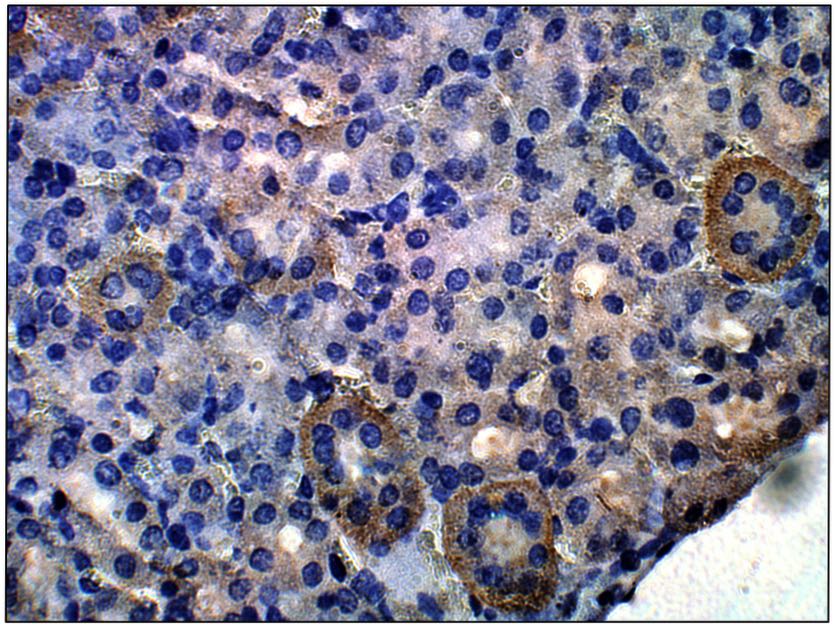

Anti-CASR antibody (47-69) (STJ500366)
SPECIFICATIONS
ClonalityPolyclonal
HostRabbit
ConjugationUnconjugated
IsotypeIgG
ImmunogenSynthetic peptide corresponding to amino acids 47-69 on human CASR gene.
General Information
| Short Description | Rabbit polyclonal antibody anti-CASR (47-69) is suitable for use in ELISA, Immunohistochemistry, Immunoprecipitation and Western Blot research applications. |
| Applications | ELISA/IHC/IP/WB |
| Host | Rabbit |
| Reactivity | Human/Mouse/Rat |
| Note | STRICTLY FOR FURTHER SCIENTIFIC RESEARCH USE ONLY (RUO). MUST NOT TO BE USED IN DIAGNOSTIC OR THERAPEUTIC APPLICATIONS. |
Product Properties
| Clonality | Polyclonal |
| Isotype | IgG |
| Conjugation | Unconjugated |
| Concentration | 0.7 µg/µl |
| Purification | Affinity Purified |
| Dilution Range | WB: 1:500DB: 1:10, 000ELISA: 1:10, 000IP: 1:150IHC: 1:50-1:150 |
| Formulation | Contains Tris, HCl/Glycine buffer pH 7.4-7.8, 30% Glycerol and 0.5% BSA, along with cryo-protective agents, Hepes, and long-term preservatives (0.02% Sodium Azide). |
| Storage Instruction | Store at-20°C for long term storage. Avoid freeze-thaw cycles. |
Target Information
| Gene Symbol | CASR |
| Gene ID | 846 |
| Uniprot ID | CASR_HUMAN |
| Immunogen | Synthetic peptide corresponding to amino acids 47-69 on human CASR gene. |
| Immunogen Region | 47-69 |
Additional Info
| Tissue Specificity | Expressed in the temporal lobe, frontal lobe, parietal lobe, hippocampus, and cerebellum. Also found in kidney, lung, liver, heart, skeletal muscle, placenta. |
| Post Translational Modifications | N-glycosylated. Ubiquitinated by RNF19A.which induces proteasomal degradation. |
| Function | G-protein-coupled receptor that senses changes in the extracellular concentration of calcium ions and plays a key role in maintaining calcium homeostasis. Senses fluctuations in the circulating calcium concentration and modulates the production of parathyroid hormone (PTH) in parathyroid glands. The activity of this receptor is mediated by a G-protein that activates a phosphatidylinositol-calcium second messenger system. The G-protein-coupled receptor activity is activated by a co-agonist mechanism: aromatic amino acids, such as Trp or Phe, act concertedly with divalent cations, such as calcium or magnesium, to achieve full receptor activation. |
| Protein Name | Extracellular Calcium-Sensing ReceptorCarCasrHcasrParathyroid Cell Calcium-Sensing Receptor 1Pcar1 |
| Database Links | Reactome: R-HSA-416476Reactome: R-HSA-418594Reactome: R-HSA-420499 |
| Cellular Localisation | Cell MembraneMulti-Pass Membrane Protein |
| Alternative Antibody Names | Anti-Extracellular Calcium-Sensing Receptor antibodyAnti-Car antibodyAnti-Casr antibodyAnti-Hcasr antibodyAnti-Parathyroid Cell Calcium-Sensing Receptor 1 antibodyAnti-Pcar1 antibodyAnti-CASR antibodyAnti-GPRC2A antibodyAnti-PCAR1 antibody |
Information sourced from Uniprot.org