

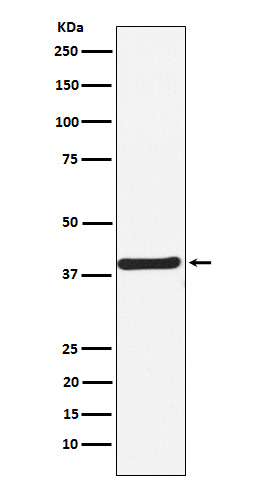

Anti-CaMK1 antibody [R02-2B8] (STJA0036890)
SPECIFICATIONS
ClonalityMonoclonal
HostRabbit
ConjugationUnconjugated
IsotypeIgG
ImmunogenA synthesized peptide derived from human CaMKI
General Information
| Short Description | Rabbit monoclonal anti-CaMK1 for use in WB, IHC-P, ICC and IF in Human, Mouse and Rat samples. Datasheet included with dilution recommendations, and related reagents. |
| Applications | WB/IHC-P/ICC/IF |
| Host | Rabbit |
| Reactivity | Human/Mouse/Rat |
| Note | STRICTLY FOR FURTHER SCIENTIFIC RESEARCH USE ONLY (RUO). MUST NOT TO BE USED IN DIAGNOSTIC OR THERAPEUTIC APPLICATIONS. |
Product Properties
| Clonality | Monoclonal |
| Clone ID | R02-2B8 |
| Isotype | IgG |
| Conjugation | Unconjugated |
| Purification | Affinity Chromatography |
| Dilution Range | WB 1:500-1:1000IHC 1:50-1:100IF 1:50-1:200 |
| Formulation | Rabbit IgG in phosphate buffered saline, pH 7.4, 150mM NaCl, 0.02% sodium azide and 50% glycerol. |
| Storage Instruction | Store at 4°C short term. Aliquot and store at-20°C long term. Avoid freeze/thaw cycles. |
Target Information
| Gene Symbol | CAMK1 |
| Gene ID | 8536 |
| Uniprot ID | KCC1A_HUMAN |
| Immunogen | A synthesized peptide derived from human CaMKI |
Additional Info
| Tissue Specificity | Widely expressed. Expressed in cells of the zona glomerulosa of the adrenal cortex. |
| Post Translational Modifications | Phosphorylated by CaMKK1 and CaMKK2 on Thr-177. Polybiquitinated by the E3 ubiquitin-protein ligase complex SCF(FBXL12), leading to proteasomal degradation. |
| Function | Calcium/calmodulin-dependent protein kinase that operates in the calcium-triggered CaMKK-CaMK1 signaling cascade and, upon calcium influx, regulates transcription activators activity, cell cycle, hormone production, cell differentiation, actin filament organization and neurite outgrowth. Recognizes the substrate consensus sequence MVLIF-x-R-x(2)-ST-x(3)-MVLIF. Regulates axonal extension and growth cone motility in hippocampal and cerebellar nerve cells. Upon NMDA receptor-mediated Ca(2+) elevation, promotes dendritic growth in hippocampal neurons and is essential in synapses for full long-term potentiation (LTP) and ERK2-dependent translational activation. Downstream of NMDA receptors, promotes the formation of spines and synapses in hippocampal neurons by phosphorylating ARHGEF7/BETAPIX on 'Ser-694', which results in the enhancement of ARHGEF7 activity and activation of RAC1. Promotes neuronal differentiation and neurite outgrowth by activation and phosphorylation of MARK2 on 'Ser-91', 'Ser-92', 'Ser-93' and 'Ser-294'. Promotes nuclear export of HDAC5 and binding to 14-3-3 by phosphorylation of 'Ser-259' and 'Ser-498' in the regulation of muscle cell differentiation. Regulates NUMB-mediated endocytosis by phosphorylation of NUMB on 'Ser-276' and 'Ser-295'. Involved in the regulation of basal and estrogen-stimulated migration of medulloblastoma cells through ARHGEF7/BETAPIX phosphorylation. Is required for proper activation of cyclin-D1/CDK4 complex during G1 progression in diploid fibroblasts. Plays a role in K(+) and ANG2-mediated regulation of the aldosterone synthase (CYP11B2) to produce aldosterone in the adrenal cortex. Phosphorylates EIF4G3/eIF4GII. In vitro phosphorylates CREB1, ATF1, CFTR, MYL9 and SYN1/synapsin I. |
| Protein Name | Calcium/Calmodulin-Dependent Protein Kinase Type 1Cam Kinase ICam-KiCam Kinase I AlphaCamki-Alpha |
| Database Links | Reactome: R-HSA-9617324Reactome: R-HSA-9619229 |
| Cellular Localisation | CytoplasmNucleusPredominantly Cytoplasmic |
| Alternative Antibody Names | Anti-Calcium/Calmodulin-Dependent Protein Kinase Type 1 antibodyAnti-Cam Kinase I antibodyAnti-Cam-Ki antibodyAnti-Cam Kinase I Alpha antibodyAnti-Camki-Alpha antibodyAnti-CAMK1 antibody |
Information sourced from Uniprot.org