



Anti-Calnexin antibody (N-Term) [M437] (STJA0041125)
SPECIFICATIONS
ClonalityMonoclonal
HostMouse
ConjugationUnconjugated
IsotypeIgG1
ImmunogenClone M437 was generated from a recombinant protein corresponding to amino acid residues in the N-terminal region of human calnexin. This sequence has high homology to similar regions in rat and mouse Calnexin.
General Information
| Short Description | Mouse monoclonal anti-Calnexin (N-Term) for use in ELISA, WB and ICC in Human, Mouse and Rat samples. Datasheet included with dilution recommendations, and related reagents. |
| Applications | ELISA/WB/ICC |
| Host | Mouse |
| Reactivity | Human/Mouse/Rat |
| Note | STRICTLY FOR FURTHER SCIENTIFIC RESEARCH USE ONLY (RUO). MUST NOT TO BE USED IN DIAGNOSTIC OR THERAPEUTIC APPLICATIONS. |
Product Properties
| Clonality | Monoclonal |
| Clone ID | M437 |
| Isotype | IgG1 |
| Conjugation | Unconjugated |
| Purification | Protein A Purified |
| Dilution Range | WB 1:1000ICC 1:50 |
| Formulation | PBS + 1 mg/ml BSA, 0.05% NaN3 and 50% glycerol |
| Storage Instruction | Storage at-20°C is recommended, as aliquots may be taken without freeze/thawing due to presence of 50% glycerol. Stable for at least 1 year at-20°C. |
Target Information
| Gene Symbol | CANX |
| Gene ID | 821 |
| Uniprot ID | CALX_HUMAN |
| Immunogen | Clone M437 was generated from a recombinant protein corresponding to amino acid residues in the N-terminal region of human calnexin. This sequence has high homology to similar regions in rat and mouse Calnexin. |
| Immunogen Region | N-Term |
| Immunogen Sequence | Human |
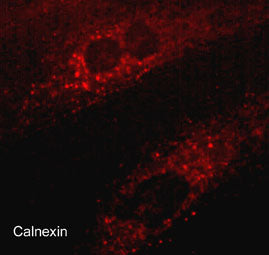
| Specificity | This antibody detects a 90 kDa* protein corresponding to the apparent molecular mass of Calnexin on SDS-PAGE immunoblots of human HeLa and rat A7r5 cells. In immunocytochemistry, anti-Calnexin specifically stains endoplasmic reticulum and related ves |
Additional Info
| Post Translational Modifications | Phosphorylated at Ser-564 by MAPK3/ERK1. Phosphorylation by MAPK3/ERK1 increases its association with ribosomes. Palmitoylation by DHHC6 leads to the preferential localization to the perinuclear rough ER. It mediates the association of calnexin with the ribosome-translocon complex (RTC) which is required for efficient folding of glycosylated proteins. Ubiquitinated, leading to proteasomal degradation. Probably ubiquitinated by ZNRF4. |
| Function | Calcium-binding protein that interacts with newly synthesized monoglucosylated glycoproteins in the endoplasmic reticulum. It may act in assisting protein assembly and/or in the retention within the ER of unassembled protein subunits. It seems to play a major role in the quality control apparatus of the ER by the retention of incorrectly folded proteins. Associated with partial T-cell antigen receptor complexes that escape the ER of immature thymocytes, it may function as a signaling complex regulating thymocyte maturation. Additionally it may play a role in receptor-mediated endocytosis at the synapse. |
| Protein Name | CalnexinIp90Major Histocompatibility Complex Class I Antigen-Binding Protein P88P90 |
| Database Links | Reactome: R-HSA-168316Reactome: R-HSA-2132295Reactome: R-HSA-8984722Reactome: R-HSA-901042Reactome: R-HSA-9020956Reactome: R-HSA-9683686Reactome: R-HSA-9694548Reactome: R-HSA-983170 |
| Cellular Localisation | Endoplasmic Reticulum MembraneSingle-Pass Type I Membrane ProteinMitochondrion MembraneMelanosome MembraneIdentified By Mass Spectrometry In Melanosome Fractions From Stage I To Stage IvThe Palmitoylated Form Preferentially Localizes To The Perinuclear Rough ErLocalizes To Endoplasmic Reticulum Mitochondria-Associated Membrane (Mams) That Connect The Endoplasmic Reticulum And The Mitochondria |
| Alternative Antibody Names | Anti-Calnexin antibodyAnti-Ip90 antibodyAnti-Major Histocompatibility Complex Class I Antigen-Binding Protein P88 antibodyAnti-P90 antibodyAnti-CANX antibody |
Information sourced from Uniprot.org