

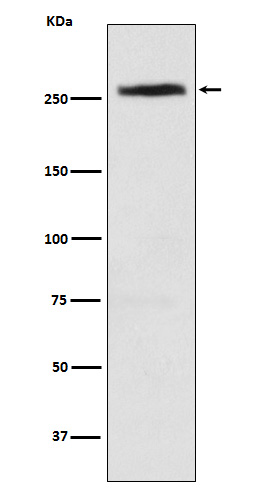

Anti-CAD antibody [R02-8I2] (STJA0037199)
SPECIFICATIONS
ClonalityMonoclonal
HostRabbit
ConjugationUnconjugated
IsotypeIgG
ImmunogenA synthesized peptide derived from human CAD
General Information
| Short Description | Rabbit monoclonal anti-CAD for use in WB, ICC, IF, IP and FC in Human samples. Datasheet included with dilution recommendations, and related reagents. |
| Applications | WB/ICC/IF/IP/FC |
| Host | Rabbit |
| Reactivity | Human |
| Note | STRICTLY FOR FURTHER SCIENTIFIC RESEARCH USE ONLY (RUO). MUST NOT TO BE USED IN DIAGNOSTIC OR THERAPEUTIC APPLICATIONS. |
Product Properties
| Clonality | Monoclonal |
| Clone ID | R02-8I2 |
| Isotype | IgG |
| Conjugation | Unconjugated |
| Purification | Affinity Purified |
| Dilution Range | WB 1:500-1:1000IF 1:50-1:200IP 1:30FC 1:50-1:100 |
| Formulation | Rabbit IgG in phosphate buffered saline, pH 7.4, 150mM NaCl, 0.02% sodium azide and 50% glycerol. |
| Storage Instruction | Store at 4°C short term. Aliquot and store at-20°C long term. Avoid freeze/thaw cycles. |
Target Information
| Gene Symbol | CAD |
| Gene ID | 790 |
| Uniprot ID | PYR1_HUMAN |
| Immunogen | A synthesized peptide derived from human CAD |
Additional Info
| Post Translational Modifications | Activated by MAP kinase (Erk1/2) phosphorylation just prior to the S phase of the cell cycle, when the demand for pyrimidine nucleotides is greatest, and down-regulated as the cells emerge from S phase by protein kinase A (PKA) phosphorylation. Phosphorylation at Ser-1859 by RPS6KB1 downstream of MTOR promotes oligomerization and stimulates dihydroorotase activity. Phosphorylation at Ser-1406 reduces sensitivity to feedback inhibition by UTP. |
| Function | Multifunctional protein that encodes the first 3 enzymatic activities of the de novo pyrimidine pathway: carbamoylphosphate synthetase (CPSase.EC 6.3.5.5), aspartate transcarbamylase (ATCase.EC 2.1.3.2) and dihydroorotase (DHOase.EC 3.5.2.3). The CPSase-function is accomplished in 2 steps, by a glutamine-dependent amidotransferase activity (GATase) that binds and cleaves glutamine to produce ammonia, followed by an ammonium-dependent carbamoyl phosphate synthetase, which reacts with the ammonia, hydrogencarbonate and ATP to form carbamoyl phosphate. The endogenously produced carbamoyl phosphate is sequestered and channeled to the ATCase active site. ATCase then catalyzes the formation of carbamoyl-L-aspartate from L-aspartate and carbamoyl phosphate. In the last step, DHOase catalyzes the cyclization of carbamoyl aspartate to dihydroorotate. |
| Protein Name | Multifunctional Protein CadCarbamoyl Phosphate Synthetase 2-Aspartate Transcarbamylase-Dihydroorotase Includes - Glutamine-Dependent Carbamoyl Phosphate Synthase - Glutamine AmidotransferaseGataseGlnase - Ammonium-Dependent Carbamoyl Phosphate SynthaseCpsCpsase - Aspartate Carbamoyltransferase - Dihydroorotase |
| Database Links | Reactome: R-HSA-500753 |
| Cellular Localisation | CytoplasmNucleusCytosolic And Unphosphorylated In Resting CellsTranslocates To The Nucleus In Response To Egf StimulationNuclear Import Promotes Optimal Cell Growth |
| Alternative Antibody Names | Anti-Multifunctional Protein Cad antibodyAnti-Carbamoyl Phosphate Synthetase 2-Aspartate Transcarbamylase-Dihydroorotase Includes - Glutamine-Dependent Carbamoyl Phosphate Synthase - Glutamine Amidotransferase antibodyAnti-Gatase antibodyAnti-Glnase - Ammonium-Dependent Carbamoyl Phosphate Synthase antibodyAnti-Cps antibodyAnti-Cpsase - Aspartate Carbamoyltransferase - Dihydroorotase antibodyAnti-CAD antibody |
Information sourced from Uniprot.org