

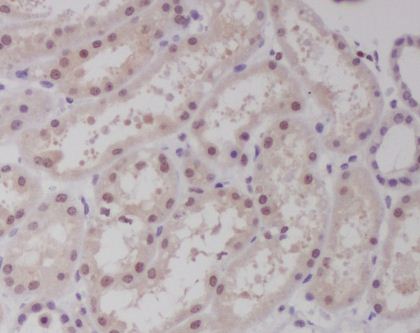

Anti-c-Maf antibody [R04-6K7] (STJA0035942)
SPECIFICATIONS
ClonalityMonoclonal
HostRabbit
ConjugationUnconjugated
IsotypeIgG
ImmunogenA synthesized peptide derived from human c-Maf
General Information
| Short Description | Rabbit monoclonal anti-c-Maf for use in IHC-P in Human, Mouse and Rat samples. Datasheet included with dilution recommendations, and related reagents. |
| Applications | IHC-P |
| Host | Rabbit |
| Reactivity | Human/Mouse/Rat |
| Note | STRICTLY FOR FURTHER SCIENTIFIC RESEARCH USE ONLY (RUO). MUST NOT TO BE USED IN DIAGNOSTIC OR THERAPEUTIC APPLICATIONS. |
Product Properties
| Clonality | Monoclonal |
| Clone ID | R04-6K7 |
| Isotype | IgG |
| Conjugation | Unconjugated |
| Purification | Affinity Chromatography |
| Dilution Range | IHC 1:50-1:100 |
| Formulation | Rabbit IgG in phosphate buffered saline, pH 7.4, 150mM NaCl, 0.02% sodium azide and 50% glycerol. |
| Storage Instruction | Store at 4°C short term. Aliquot and store at-20°C long term. Avoid freeze/thaw cycles. |
Target Information
| Gene Symbol | MAF |
| Gene ID | 4094 |
| Uniprot ID | MAF_HUMAN |
| Immunogen | A synthesized peptide derived from human c-Maf |
Additional Info
| Tissue Specificity | Expressed in endothelial cells. |
| Post Translational Modifications | Ubiquitinated, leading to its degradation by the proteasome. Ubiquitination is triggered by glucocorticoids. Phosphorylated by GSK3 and MAPK13 on serine and threonine residues (Probable). The phosphorylation status can serve to either stimulate or inhibit transcription. |
| Function | Acts as a transcriptional activator or repressor. Involved in embryonic lens fiber cell development. Recruits the transcriptional coactivators CREBBP and/or EP300 to crystallin promoters leading to up-regulation of crystallin gene during lens fiber cell differentiation. Activates the expression of IL4 in T helper 2 (Th2) cells. Increases T-cell susceptibility to apoptosis by interacting with MYB and decreasing BCL2 expression. Together with PAX6, transactivates strongly the glucagon gene promoter through the G1 element. Activates transcription of the CD13 proximal promoter in endothelial cells. Represses transcription of the CD13 promoter in early stages of myelopoiesis by affecting the ETS1 and MYB cooperative interaction. Involved in the initial chondrocyte terminal differentiation and the disappearance of hypertrophic chondrocytes during endochondral bone development. Binds to the sequence 5'-GTGGCNGTNCTCAGNN-3' in the L7 promoter. Binds to the T-MARE (Maf response element) sites of lens-specific alpha- and beta-crystallin gene promoters. Binds element G1 on the glucagon promoter. Binds an AT-rich region adjacent to the TGC motif (atypical Maf response element) in the CD13 proximal promoter in endothelial cells. When overexpressed, represses anti-oxidant response element (ARE)-mediated transcription. Involved either as an oncogene or as a tumor suppressor, depending on the cell context. Binds to the ARE sites of detoxifying enzyme gene promoters. |
| Protein Name | Transcription Factor MafProto-Oncogene C-MafV-Maf Musculoaponeurotic Fibrosarcoma Oncogene Homolog |
| Database Links | Reactome: R-HSA-8940973 |
| Cellular Localisation | Nucleus |
| Alternative Antibody Names | Anti-Transcription Factor Maf antibodyAnti-Proto-Oncogene C-Maf antibodyAnti-V-Maf Musculoaponeurotic Fibrosarcoma Oncogene Homolog antibodyAnti-MAF antibody |
Information sourced from Uniprot.org