


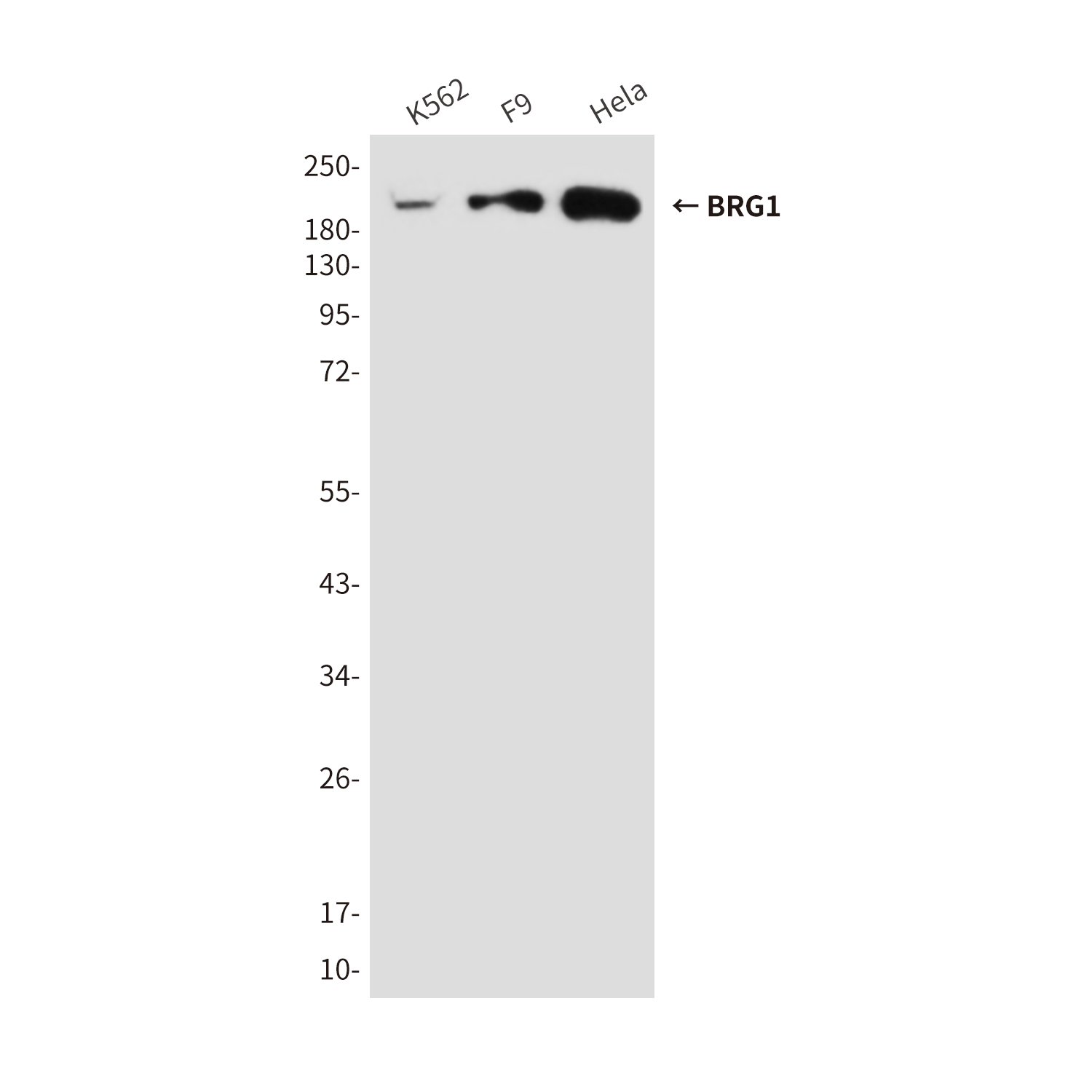

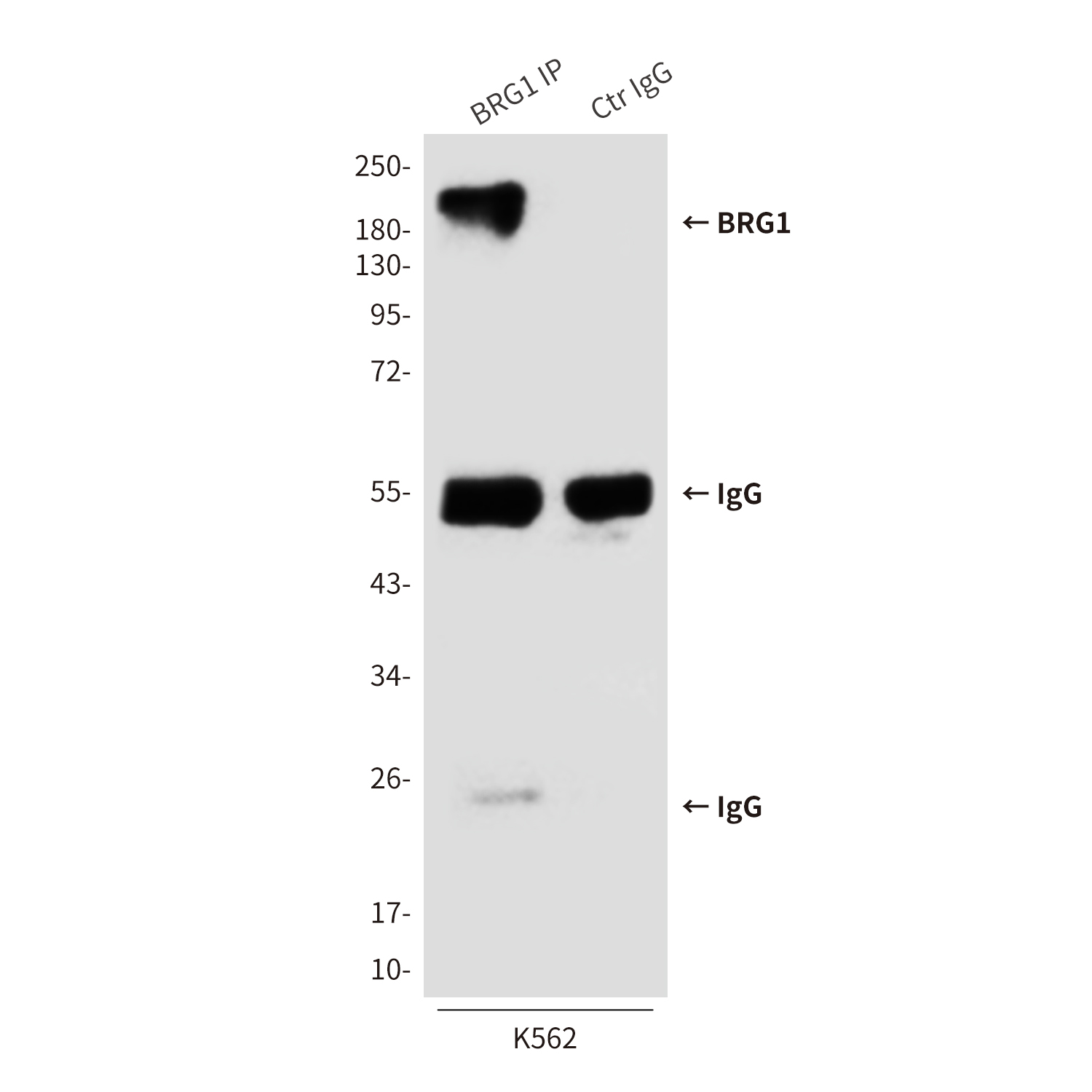

Anti-BRG1 antibody [6D7-F7-B6] (STJA0032463)
SPECIFICATIONS
ClonalityMonoclonal
HostMouse
ConjugationUnconjugated
IsotypeIgG1
ImmunogenPurified recombinant human BRG1 protein fragments expressed in E.coli.
General Information
| Short Description | Mouse monoclonal anti-BRG1 for use in WB, ICC, IF and IP in Human and Mouse samples. Datasheet included with dilution recommendations, and related reagents. |
| Applications | WB/ICC/IF/IP |
| Host | Mouse |
| Reactivity | Human/Mouse |
| Note | STRICTLY FOR FURTHER SCIENTIFIC RESEARCH USE ONLY (RUO). MUST NOT TO BE USED IN DIAGNOSTIC OR THERAPEUTIC APPLICATIONS. |
Product Properties
| Clonality | Monoclonal |
| Clone ID | 6D7-F7-B6 |
| Isotype | IgG1 |
| Conjugation | Unconjugated |
| Concentration | 1.7 mg/mL |
| Purification | Affinity Purified |
| Dilution Range | WB 1:500-1:1000IF 1:50-1:200IP 1:20 |
| Formulation | Liquid in PBS containing 50% glycerol, 0.5% BSA and 0.02% sodium azide, pH 7.3. |
| Storage Instruction | Store at 4°C short term. Aliquot and store at-20°C long term. Avoid freeze/thaw cycles. |
Target Information
| Gene Symbol | SMARCA4 |
| Gene ID | 6597 |
| Uniprot ID | SMCA4_HUMAN |
| Immunogen | Purified recombinant human BRG1 protein fragments expressed in E.coli. |
Additional Info
| Tissue Specificity | Colocalizes with ZEB1 in E-cadherin-negative cells from established lines, and stroma of normal colon as well as in de-differentiated epithelial cells at the invasion front of colorectal carcinomas (at protein level). |
| Function | ATPase involved in transcriptional activation and repression of select genes by chromatin remodeling (alteration of DNA-nucleosome topology). Component of SWI/SNF chromatin remodeling complexes that carry out key enzymatic activities, changing chromatin structure by altering DNA-histone contacts within a nucleosome in an ATP-dependent manner. Component of the CREST-BRG1 complex, a multiprotein complex that regulates promoter activation by orchestrating the calcium-dependent release of a repressor complex and the recruitment of an activator complex. In resting neurons, transcription of the c-FOS promoter is inhibited by SMARCA4-dependent recruitment of a phospho-RB1-HDAC repressor complex. Upon calcium influx, RB1 is dephosphorylated by calcineurin, which leads to release of the repressor complex. At the same time, there is increased recruitment of CREBBP to the promoter by a CREST-dependent mechanism, which leads to transcriptional activation. The CREST-BRG1 complex also binds to the NR2B promoter, and activity-dependent induction of NR2B expression involves the release of HDAC1 and recruitment of CREBBP. Belongs to the neural progenitors-specific chromatin remodeling complex (npBAF complex) and the neuron-specific chromatin remodeling complex (nBAF complex). During neural development, a switch from a stem/progenitor to a postmitotic chromatin remodeling mechanism occurs as neurons exit the cell cycle and become committed to their adult state. The transition from proliferating neural stem/progenitor cells to postmitotic neurons requires a switch in subunit composition of the npBAF and nBAF complexes. As neural progenitors exit mitosis and differentiate into neurons, npBAF complexes which contain ACTL6A/BAF53A and PHF10/BAF45A, are exchanged for homologous alternative ACTL6B/BAF53B and DPF1/BAF45B or DPF3/BAF45C subunits in neuron-specific complexes (nBAF). The npBAF complex is essential for the self-renewal/proliferative capacity of the multipotent neural stem cells. The nBAF complex along with CREST plays a role regulating the activity of genes essential for dendrite growth. SMARCA4/BAF190A may promote neural stem cell self-renewal/proliferation by enhancing Notch-dependent proliferative signals, while concurrently making the neural stem cell insensitive to SHH-dependent differentiating cues. Acts as a corepressor of ZEB1 to regulate E-cadherin transcription and is required for induction of epithelial-mesenchymal transition (EMT) by ZEB1. Binds via DLX1 to enhancers located in the intergenic region between DLX5 and DLX6 and this binding is stabilized by the long non-coding RNA (lncRNA) Evf2. Binds to RNA in a promiscuous manner. In brown adipose tissue, involved in the regulation of thermogenic genes expression. |
| Protein Name | Swi/Snf-Related Matrix-Associated Actin-Dependent Regulator Of Chromatin Subfamily A Member 4Smarca4Brg1-Associated Factor 190aBaf190aMitotic Growth And Transcription ActivatorProtein Brg-1Protein Brahma Homolog 1Snf2-BetaTranscription Activator Brg1 |
| Database Links | Reactome: R-HSA-1266695Reactome: R-HSA-201722Reactome: R-HSA-3214858Reactome: R-HSA-3247509Reactome: R-HSA-8939243Reactome: R-HSA-9619665Reactome: R-HSA-9824585Reactome: R-HSA-9845323 |
| Cellular Localisation | NucleusColocalizes With Long Non-Coding Rna Evf2 In Nuclear Rna CloudsLocalizes To Sites Of Dna Damage |
| Alternative Antibody Names | Anti-Swi/Snf-Related Matrix-Associated Actin-Dependent Regulator Of Chromatin Subfamily A Member 4 antibodyAnti-Smarca4 antibodyAnti-Brg1-Associated Factor 190a antibodyAnti-Baf190a antibodyAnti-Mitotic Growth And Transcription Activator antibodyAnti-Protein Brg-1 antibodyAnti-Protein Brahma Homolog 1 antibodyAnti-Snf2-Beta antibodyAnti-Transcription Activator Brg1 antibodyAnti-SMARCA4 antibodyAnti-BAF190A antibodyAnti-BRG1 antibodyAnti-SNF2B antibodyAnti-SNF2L4 antibody |
Information sourced from Uniprot.org