
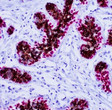


Anti-Breast cocktail antibody (C-Term) [P63 (ZR439) + CK8/18 (B22.1/23.1)] (STJ180693)
SPECIFICATIONS
ClonalityMonoclonal
HostRabbit/Mouse
ConjugationUnconjugated
IsotypeIgG+ IgG1k+ IgG1k
ImmunogenRecombinant fragment corresponding to the C-terminus of human TP63 protein; Cytokeratins purified from breast cancer MCF-7 cells
General Information
| Short Description | Rabbit/Mouse monoclonal Breast cocktail (C-Term) antibody for use in IHC-P in human samples. Datasheet included with dilution recommendations, and related reagents. |
| Applications | IHC-P |
| Host | Rabbit/Mouse |
| Reactivity | Human |
| Note | STRICTLY FOR FURTHER SCIENTIFIC RESEARCH USE ONLY (RUO). MUST NOT TO BE USED IN DIAGNOSTIC OR THERAPEUTIC APPLICATIONS. |
Product Properties
| Clonality | Monoclonal |
| Clone ID | P63 (ZR439) + CK8/18 (B22.1/23.1) |
| Isotype | IgG+ IgG1k+ IgG1k |
| Conjugation | Unconjugated |
| Purification | Affinity purified |
| Dilution Range | 1:100-200 |
| Formulation | Tris-HCI buffer containing stabilizing protein (BSA) and <0.1% ProClin |
| Storage Instruction | Store at 2‐8°C for up to 24 months. Predilute: Ready to use, no reconstitution necessary. Concentrate: Use dilution range and appropriate lab‐standardized diluent. Stability after dilution: 7 days at 24°C, 3 months at 2‐8°C, 6months at ‐20°C. |
Target Information
| Immunogen | Recombinant fragment corresponding to the C-terminus of human TP63 protein; Cytokeratins purified from breast cancer MCF-7 cells |
| Immunogen Region | C-Term |
| Specificity | Positive Control: Breast |
Additional Info
| Background | Zeta s Breast Cocktail – DUAL STAIN. Zeta s Breast Cocktail provides dual staining of p63 and Cytokeratin 8/18 (CK8/18) in breast pathology, which plays an important role in distinguishing between benign and malignant breast lesions, particularly in evaluating the myoepithelial versus luminal epithelial cell populations. These two markers are complementary: p63 helps determine whether a structure is benign or invasive, while CK8/18 confirms epithelial identity. Zeta s recombinant rabbit antibody cocktail recognizes p63 and Cytokeratin 8/18. p63 is a homolog of the tumor suppressor p53. It is identified in basal cells in the epithelial layers of a variety of tissues, including the epidermis, cervix, urothelium, breast, and prostate. p63 was detected in nuclei of the basal epithelium in normal breast tissue. Cytokeratin clone B22.1/B23.1 antibody recognizes all simple epithelia including glandular epithelium, for example thyroid, breast, gastrointestinal tract, respiratory tract, and urogenital tract including transitional epithelium. Combination of p63 (red) and CK8/18 (brown) immunohistochemical stain is used to identify breast invasive ductal and lobular carcinoma (CK8/18 positive, P63 negative) against normal breast tissue or in situ breast carcinoma (CK8/18 positive, P63 positive). Zeta s Dual Stain Breast Cocktail helps differentiate invasive from non-invasive lesions. Non-invasive ductal structures (e.g., usual ductal hyperplasia, DCIS) are typically surrounded by an intact layer of myoepithelial cells (p63⁺) while invasive carcinomas lack a surrounding myoepithelial layer—p63 is negative, but CK8/18⁺ epithelial tumor cells are present. Dual staining allows for simultaneous evaluation of both compartments. Zeta s Breast Cocktail can help identify residual carcinoma in treated tissues. In neoadjuvant chemotherapy specimens, dual staining helps distinguish residual tumor (CK8/18⁺) from fibrosis or benign glands (with p63⁺ cells). Additionally, the Breast Cocktail can evaluate sclerosing lesions. Sclerosing adenosis and radial scars can mimic invasive carcinoma. Dual stain helps verify myoepithelial layer integrity (p63⁺) , ruling out malignancy even in distorted glandular patterns. Finally, Zeta s Breast Cocktail could be useful for interpretation of core needle biopsies. In limited biopsy material, dual staining conserves tissue and avoids the need for serial sections and offers clarity in small, fragmented, or ambiguous specimens. Zeta s DUAL STAIN products provide more information from limited tissues, by seeing two related markers on the same slide while also allowing pathologists to see cellular localization and interaction within the tumor environment. Zeta uses one mouse and one rabbit recombinant monoclonal in each cocktail to allow for differential color results. Zeta Corporation is a leader in recombinant monoclonal IVD antibodies for immunohistochemistry (IHC) offering 400+ tumor and tissue specific relevant products developed by a pathologist for pathologists. Visit Precision Recombinant Antibodies – IVD Antibodies – About Zeta Corporation (zeta-corp.com) to learn more about Zeta Corporation. |
Information sourced from Uniprot.org