

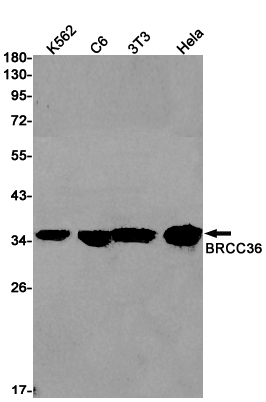

Anti-BRCC36 antibody [R01-7E5] (STJA0034090)
SPECIFICATIONS
ClonalityMonoclonal
HostRabbit
ConjugationUnconjugated
IsotypeIgG
ImmunogenA synthetic peptide of human BRCC36
General Information
| Short Description | Rabbit monoclonal anti-BRCC36 for use in WB and IP in Human, Mouse and Rat samples. Datasheet included with dilution recommendations, and related reagents. |
| Applications | WB/IP |
| Host | Rabbit |
| Reactivity | Human/Mouse/Rat |
| Note | STRICTLY FOR FURTHER SCIENTIFIC RESEARCH USE ONLY (RUO). MUST NOT TO BE USED IN DIAGNOSTIC OR THERAPEUTIC APPLICATIONS. |
Product Properties
| Clonality | Monoclonal |
| Clone ID | R01-7E5 |
| Isotype | IgG |
| Conjugation | Unconjugated |
| Concentration | 0.3 mg/mL |
| Purification | Affinity Purified |
| Dilution Range | WB 1:500-1:1000IP 1:20 |
| Formulation | 50mM Tris-Glycine (pH 7.4) , 0.15M NaCl, 40% Glycerol, 0.01% Sodium azide and 0.05% BSA |
| Storage Instruction | Store at 4°C short term. Aliquot and store at-20°C long term. Avoid freeze/thaw cycles. |
Target Information
| Gene Symbol | BRCC3 |
| Gene ID | 79184 |
| Uniprot ID | BRCC3_HUMAN |
| Immunogen | A synthetic peptide of human BRCC36 |
Additional Info
| Tissue Specificity | Heart, brain, placenta, lung, liver, skeletal muscle, kidney and pancreas. Aberrantly expressed in the vast majority of breast tumors. |
| Function | Metalloprotease that specifically cleaves 'Lys-63'-linked polyubiquitin chains. Does not have activity toward 'Lys-48'-linked polyubiquitin chains. Component of the BRCA1-A complex, a complex that specifically recognizes 'Lys-63'-linked ubiquitinated histones H2A and H2AX at DNA lesions sites, leading to target the BRCA1-BARD1 heterodimer to sites of DNA damage at double-strand breaks (DSBs). In the BRCA1-A complex, it specifically removes 'Lys-63'-linked ubiquitin on histones H2A and H2AX, antagonizing the RNF8-dependent ubiquitination at double-strand breaks (DSBs). Catalytic subunit of the BRISC complex, a multiprotein complex that specifically cleaves 'Lys-63'-linked ubiquitin in various substrates. Mediates the specific 'Lys-63'-specific deubiquitination associated with the COP9 signalosome complex (CSN), via the interaction of the BRISC complex with the CSN complex. The BRISC complex is required for normal mitotic spindle assembly and microtubule attachment to kinetochores via its role in deubiquitinating NUMA1. Plays a role in interferon signaling via its role in the deubiquitination of the interferon receptor IFNAR1.deubiquitination increases IFNAR1 activity by enhancing its stability and cell surface expression. Acts as a regulator of the NLRP3 inflammasome by mediating deubiquitination of NLRP3, leading to NLRP3 inflammasome assembly. Down-regulates the response to bacterial lipopolysaccharide (LPS) via its role in IFNAR1 deubiquitination. Deubiquitinates HDAC1 and PWWP2B leading to their stabilization. |
| Protein Name | Lys-63-Specific Deubiquitinase Brcc36Brca1-A Complex Subunit Brcc36Brca1/Brca2-Containing Complex Subunit 3Brca1/Brca2-Containing Complex Subunit 36Brisc Complex Subunit Brcc36 |
| Database Links | Reactome: R-HSA-5689901Reactome: R-HSA-5693565Reactome: R-HSA-5693571Reactome: R-HSA-5693607Reactome: R-HSA-69473 |
| Cellular Localisation | NucleusCytoplasmCytoskeletonSpindle PoleLocalizes At Sites Of Dna Damage At Double-Strand Breaks (Dsbs)Interaction With Abraxas2 Retains Brcc3 In The Cytoplasm |
| Alternative Antibody Names | Anti-Lys-63-Specific Deubiquitinase Brcc36 antibodyAnti-Brca1-A Complex Subunit Brcc36 antibodyAnti-Brca1/Brca2-Containing Complex Subunit 3 antibodyAnti-Brca1/Brca2-Containing Complex Subunit 36 antibodyAnti-Brisc Complex Subunit Brcc36 antibodyAnti-BRCC3 antibodyAnti-BRCC36 antibodyAnti-C6.1A antibodyAnti-CXorf53 antibody |
Information sourced from Uniprot.org