


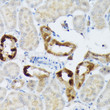


Anti-BMP2 antibody (283-396) (STJ22811)
SPECIFICATIONS
ClonalityPolyclonal
HostRabbit
ConjugationUnconjugated
IsotypeIgG
General Information
| Short Description | Rabbit polyclonal BMP2 (283-396) antibody for use in WB, IHC-P, IF, ICC and ELISA in human, mouse and rat samples. Datasheet included with dilution recommendations, and related reagents. |
| Applications | WB/IHC-P/IF/ICC/ELISA |
| Host | Rabbit |
| Reactivity | Human/Mouse/Rat |
| Note | STRICTLY FOR FURTHER SCIENTIFIC RESEARCH USE ONLY (RUO). MUST NOT TO BE USED IN DIAGNOSTIC OR THERAPEUTIC APPLICATIONS. |
Product Properties
| Clonality | Polyclonal |
| Isotype | IgG |
| Conjugation | Unconjugated |
| Concentration | Lot specific |
| Purification | Affinity purification |
| Dilution Range | WB:1:500-1:1000IHC-P:1:50-1:200IF/ICC:1:50-1:200ELISA:Recommended starting concentration is 1 Mu g/mL. Please optimize the concentration based on your specific assay requirements. |
| Formulation | PBS with 0.09% Sodium Azide, 50% Glycerol, pH7.3. |
| Storage Instruction | Store at-20°C for up to 1 year from the date of receipt, and avoid repeat freeze-thaw cycles. |
Target Information
| Gene Symbol | BMP2 |
| Gene ID | 650 |
| Uniprot ID | BMP2_HUMAN |
| Immunogen Region | 283-396 |
| Immunogen Sequence | QAKHKQRKRLKSSCKRHPLY VDFSDVGWNDWIVAPPGYHA FYCHGECPFPLADHLNSTNH AIVQTLVNSVNSKIPKACCV PTELSAISMLYLDENEKVVL KNYQDMVVEGCGCR |
| Specificity | Recombinant fusion protein containing a sequence corresponding to amino acids 283-396 of human BMP2 (NP_001191.1). |
Additional Info
| Tissue Specificity | Particularly abundant in lung, spleen and colon and in low but significant levels in heart, brain, placenta, liver, skeletal muscle, kidney, pancreas, prostate, ovary and small intestine. |
| Function | Growth factor of the TGF-beta superfamily that plays essential roles in many developmental processes, including cardiogenesis, neurogenesis, and osteogenesis. Induces cartilage and bone formation. Initiates the canonical BMP signaling cascade by associating with type I receptor BMPR1A and type II receptor BMPR2. Once all three components are bound together in a complex at the cell surface, BMPR2 phosphorylates and activates BMPR1A. In turn, BMPR1A propagates signal by phosphorylating SMAD1/5/8 that travel to the nucleus and act as activators and repressors of transcription of target genes. Also acts to promote expression of HAMP, via the interaction with its receptor BMPR1A/ALK3. Can also signal through non-canonical pathways such as ERK/MAP kinase signaling cascade that regulates osteoblast differentiation. Also stimulates the differentiation of myoblasts into osteoblasts via the EIF2AK3-EIF2A-ATF4 pathway by stimulating EIF2A phosphorylation which leads to increased expression of ATF4 which plays a central role in osteoblast differentiation. Acts as a positive regulator of odontoblast differentiation during mesenchymal tooth germ formation, expression is repressed during the bell stage by MSX1-mediated inhibition of CTNNB1 signaling. |
| Protein Name | Bone Morphogenetic Protein 2Bmp-2Bone Morphogenetic Protein 2aBmp-2a |
| Database Links | Reactome: R-HSA-201451Reactome: R-HSA-2129379Reactome: R-HSA-8878166Reactome: R-HSA-8939902 |
| Cellular Localisation | Secreted |
| Alternative Antibody Names | Anti-Bone Morphogenetic Protein 2 antibodyAnti-Bmp-2 antibodyAnti-Bone Morphogenetic Protein 2a antibodyAnti-Bmp-2a antibodyAnti-BMP2 antibodyAnti-BMP2A antibody |
Information sourced from Uniprot.org