


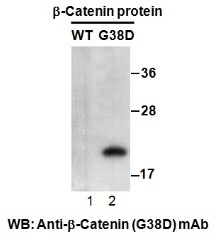


Anti-Beta-Catenin-G38D Mutant antibody (STJA0033678)
SPECIFICATIONS
ClonalityMonoclonal
HostMouse
ConjugationUnconjugated
IsotypeIgG
ImmunogenA synthetic peptide from the internal region of Beta-catenin which includes the mutation of G38D, human origin.
General Information
| Short Description | Mouse monoclonal anti-Beta-Catenin-G38D Mutant for use in WB, IHC-P, ICC, IF and ELISA in Vertebrates samples. Datasheet included with dilution recommendations, and related reagents. |
| Applications | WB/IHC-P/ICC/IF/ELISA |
| Host | Mouse |
| Reactivity | Vertebrates |
| Note | STRICTLY FOR FURTHER SCIENTIFIC RESEARCH USE ONLY (RUO). MUST NOT TO BE USED IN DIAGNOSTIC OR THERAPEUTIC APPLICATIONS. |
Product Properties
| Clonality | Monoclonal |
| Isotype | IgG |
| Conjugation | Unconjugated |
| Purification | Purified from ascites |
| Dilution Range | ELISA-1:1000-1:5000WB-1:500-1:2000IHC-P-1:50-100IF-1:50-1:200 |
| Formulation | Liquid in PBS (without Mg2+ and Ca2+) , pH 7.4, 150 mM NaCl, 50% glycerol |
| Storage Instruction | Store at-20°C. Avoid freeze/thaw cycles. |
Target Information
| Immunogen | A synthetic peptide from the internal region of Beta-catenin which includes the mutation of G38D, human origin. |
Additional Info
| Background | Beta-catenin (or Beta-catenin) is a protein that in humans is encoded by the CTNNB1 gene. Beta-catenin is a subunit of the cadherin protein complex and also acts as an intracellular signal transducer in the Wnt signaling pathway. Deregulation of beta-catenin signaling is an important event in the genesis of a number of malignancies, such as colon cancer, melanoma, hepatocellular carcinoma, ovarian cancer, endometrial cancer, medulloblastoma pilomatricomas, and prostate cancer. |
Information sourced from Uniprot.org