

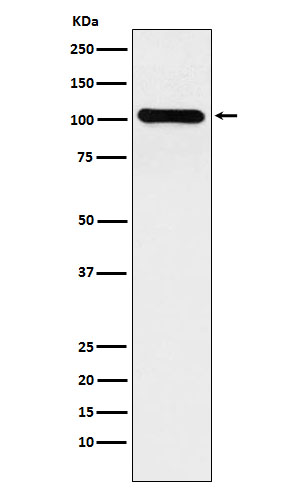

Anti-BACH1 antibody [R05-3L1] (STJA0037226)
SPECIFICATIONS
ClonalityMonoclonal
HostRabbit
ConjugationUnconjugated
IsotypeIgG
ImmunogenA synthesized peptide derived from human BACH1/BRIP1
General Information
| Short Description | Rabbit monoclonal anti-BACH1 for use in WB in Human samples. Datasheet included with dilution recommendations, and related reagents. |
| Applications | WB |
| Host | Rabbit |
| Reactivity | Human |
| Note | STRICTLY FOR FURTHER SCIENTIFIC RESEARCH USE ONLY (RUO). MUST NOT TO BE USED IN DIAGNOSTIC OR THERAPEUTIC APPLICATIONS. |
Product Properties
| Clonality | Monoclonal |
| Clone ID | R05-3L1 |
| Isotype | IgG |
| Conjugation | Unconjugated |
| Purification | Affinity Purified |
| Dilution Range | WB 1:500-1:1000 |
| Formulation | Rabbit IgG in phosphate buffered saline, pH 7.4, 150mM NaCl, 0.02% sodium azide and 50% glycerol. |
| Storage Instruction | Store at 4°C short term. Aliquot and store at-20°C long term. Avoid freeze/thaw cycles. |
Target Information
| Gene Symbol | BRIP1 |
| Gene ID | 83990 |
| Uniprot ID | FANCJ_HUMAN |
| Immunogen | A synthesized peptide derived from human BACH1/BRIP1 |
Additional Info
| Tissue Specificity | Ubiquitously expressed, with highest levels in testis. |
| Post Translational Modifications | Phosphorylated. Phosphorylation is necessary for interaction with BRCA1, and is cell-cycle regulated. Acetylation at Lys-1249 facilitates DNA end processing required for repair and checkpoint signaling. |
| Function | DNA-dependent ATPase and 5'-3' DNA helicase required for the maintenance of chromosomal stability. Acts late in the Fanconi anemia pathway, after FANCD2 ubiquitination. Involved in the repair of DNA double-strand breaks by homologous recombination in a manner that depends on its association with BRCA1. Involved in the repair of abasic sites at replication forks by promoting the degradation of DNA-protein cross-links: acts by catalyzing unfolding of HMCES DNA-protein cross-link via its helicase activity, exposing the underlying DNA and enabling cleavage of the DNA-protein adduct by the SPRTN metalloprotease. Can unwind RNA:DNA substrates. Unwinds G-quadruplex DNA.unwinding requires a 5'-single stranded tail. |
| Protein Name | Fanconi Anemia Group J ProteinBrca1-Associated C-Terminal Helicase 1Brca1-Interacting Protein C-Terminal Helicase 1Brca1-Interacting Protein 1Dna 5'-3' Helicase Fancj |
| Database Links | Reactome: R-HSA-2564830Reactome: R-HSA-5685938Reactome: R-HSA-5685942Reactome: R-HSA-5693554Reactome: R-HSA-5693568Reactome: R-HSA-5693579Reactome: R-HSA-5693607Reactome: R-HSA-5693616Reactome: R-HSA-6804756Reactome: R-HSA-69473Reactome: R-HSA-9701192Reactome: R-HSA-9704331Reactome: R-HSA-9704646Reactome: R-HSA-9709570Reactome: R-HSA-9709603 |
| Cellular Localisation | NucleusCytoplasm |
| Alternative Antibody Names | Anti-Fanconi Anemia Group J Protein antibodyAnti-Brca1-Associated C-Terminal Helicase 1 antibodyAnti-Brca1-Interacting Protein C-Terminal Helicase 1 antibodyAnti-Brca1-Interacting Protein 1 antibodyAnti-Dna 5'-3' Helicase Fancj antibodyAnti-BRIP1 antibodyAnti-BACH1 antibodyAnti-FANCJ antibody |
Information sourced from Uniprot.org