





Anti-ATG3 antibody (1-314aa) [AT15F6] (STJA0041866)
SPECIFICATIONS
ClonalityMonoclonal
HostMouse
ConjugationUnconjugated
IsotypeIgG1k
ImmunogenRecombinant human ATG3 (1-314aa) purified from E. coli.
General Information
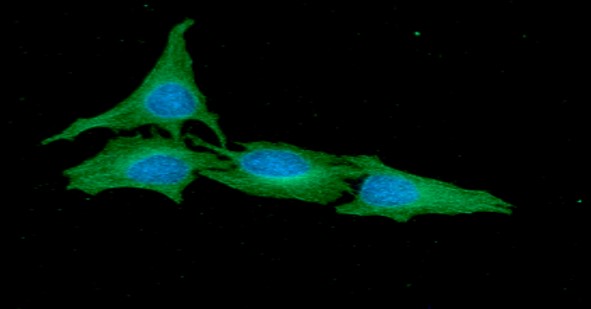
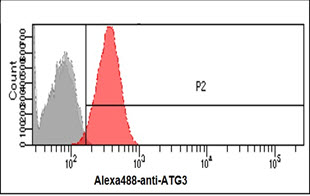
| Short Description | Mouse monoclonal anti-ATG3 (1-314aa) for use in ELISA, WB, FACS, ICC and IF in Human samples. Datasheet included with dilution recommendations, and related reagents. |
| Applications | ELISA/WB/FACS/ICC/IF |
| Host | Mouse |
| Reactivity | Human |
| Note | STRICTLY FOR FURTHER SCIENTIFIC RESEARCH USE ONLY (RUO). MUST NOT TO BE USED IN DIAGNOSTIC OR THERAPEUTIC APPLICATIONS. |
Product Properties
| Clonality | Monoclonal |
| Clone ID | AT15F6 |
| Isotype | IgG1k |
| Conjugation | Unconjugated |
| Concentration | 1 mg/mL |
| Purification | By protein-A affinity chromatography |
| Formulation | Liquid in phosphate-Buffered Saline (pH 7.4) with 0.02% Sodium Azide, 10% Glycerol |
| Storage Instruction | For short term storage, keep at +2C to +8C for up to 1 week. For long term storage, aliquot and store at-20C, and avoid repeat freeze-thaw cycles. |
Target Information
| Gene Symbol | ATG3 |
| Gene ID | 64422 |
| Uniprot ID | ATG3_HUMAN |
| Accession Number | NP_071933 |
| Immunogen | Recombinant human ATG3 (1-314aa) purified from E. coli. |
| Immunogen Region | 1-314aa |
Additional Info
| Tissue Specificity | Widely expressed, with a highest expression in heart, skeletal muscle, kidney, liver and placenta. |
| Post Translational Modifications | Cleaved by CASP8 upon death ligand binding such as tumor necrosis factor-alpha. CASP8 cleavage blocks survival-related autophagy and favors apoptosis. Conjugated to ATG12 at Lys-243. ATG12-conjugation plays a role in regulation of mitochondrial homeostasis and cell death, while it is not involved in phosphatidylethanolamine-conjugation to ATG8-like proteins and autophagy. |
| Function | E2 conjugating enzyme that catalyzes the covalent conjugation of the C-terminal Gly of ATG8-like proteins (GABARAP, GABARAPL1, GABARAPL2 or MAP1LC3A) to the amino group of phosphatidylethanolamine (PE)-containing lipids in the membrane resulting in membrane-bound ATG8-like proteins which is one of the key steps in the development of autophagic isolation membranes during autophagosome formation. Cycles back and forth between binding to ATG7 for loading with the ATG8-like proteins and binding to E3 enzyme, composed of ATG12, ATG5 and ATG16L1 to promote ATG8-like proteins lipidation. Also plays a role as a membrane curvature sensor that facilitates LC3/GABARAP lipidation by sensing local membrane stress associated with lipid-packing defects as occurs with high molar proportions of conical lipids or strident membrane curvature. Interacts with negatively-charged membranes promoting membrane tethering and enhancing LC3/GABARAP lipidation. Also acts as an autocatalytic E2-like enzyme by catalyzing the conjugation of ATG12 to itself in an ATG7-dependent manner, this complex thus formed, plays a role in mitochondrial homeostasis but not in autophagy. ATG12-ATG3 conjugation promotes late endosome to lysosome trafficking and basal autophagosome maturation via its interaction with PDCD6IP. ATG12-ATG3 conjugate is also formed upon viccina virus infection, leading to the disruption the cellular autophagy which is not necessary for vaccinia survival and proliferation. Promotes primary ciliogenesis by removing OFD1 from centriolar satellites via the autophagic pathway. |
| Protein Name | Ubiquitin-Like-Conjugating Enzyme Atg3Autophagy-Related Protein 3Apg3-LikeHapg3Protein Pc3-96 |
| Database Links | Reactome: R-HSA-1632852 |
| Cellular Localisation | Cytoplasm |
| Alternative Antibody Names | Anti-Ubiquitin-Like-Conjugating Enzyme Atg3 antibodyAnti-Autophagy-Related Protein 3 antibodyAnti-Apg3-Like antibodyAnti-Hapg3 antibodyAnti-Protein Pc3-96 antibodyAnti-ATG3 antibodyAnti-APG3 antibodyAnti-APG3L antibody |
Information sourced from Uniprot.org