

Anti-Argonaute 2 antibody (N-Term) [11A9] (STJA0041057)
SPECIFICATIONS
ClonalityMonoclonal
HostRat
ConjugationUnconjugated
IsotypeIgG2a
ImmunogenClone 11A9 was generated from an Ago2 synthetic peptide (coupled to KLH) corresponding to amino acids in the N-terminus of human Ago2. This sequence has low homology to other argonaute family members.
General Information
| Short Description | Rat monoclonal anti-Argonaute 2 (N-Term) for use in ELISA and WB in Bovine and Human samples. Datasheet included with dilution recommendations, and related reagents. |
| Applications | ELISA/WB |
| Host | Rat |
| Reactivity | Bovine/Human |
| Note | STRICTLY FOR FURTHER SCIENTIFIC RESEARCH USE ONLY (RUO). MUST NOT TO BE USED IN DIAGNOSTIC OR THERAPEUTIC APPLICATIONS. |
Product Properties
| Clonality | Monoclonal |
| Clone ID | 11A9 |
| Isotype | IgG2a |
| Conjugation | Unconjugated |
| Purification | Protein G Purified |
| Dilution Range | WB 1:250 |
| Formulation | PBS + 0.05% NaN3 |
| Storage Instruction | Recommended that the undiluted antibody be aliquoted into smaller working volumes (10-30 uL/vial depending on usage) upon arrival and stored long term at-20°C C or-80°C C, while keeping a working aliquot stored at 4°C C for short term. Avoid freeze/t |
Target Information
| Gene Symbol | AGO2 |
| Gene ID | 27161 |
| Uniprot ID | AGO2_HUMAN |
| Immunogen | Clone 11A9 was generated from an Ago2 synthetic peptide (coupled to KLH) corresponding to amino acids in the N-terminus of human Ago2. This sequence has low homology to other argonaute family members. |
| Immunogen Region | N-Term |
| Immunogen Sequence | Human |
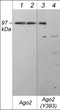
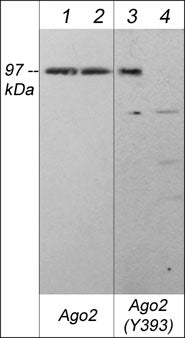
| Specificity | The antibody detects a 97 kDa* protein corresponding to the apparent molecular mass of Ago2 on SDS-PAGE immunoblots of several human cell lines, A431, HeLa, MCF-7, and K562. The antibody does not detect rat or mouse Ago2, but will detect bovine Ago2. |
Additional Info
| Post Translational Modifications | Hydroxylated. 4-hydroxylation appears to enhance protein stability but is not required for miRNA-binding or endonuclease activity. Ubiquitinated on surface-exposed lysines by a SCF-like E3 ubiquitin-protein ligase complex containing ZSWIM8 during target-directed microRNA degradation (TDMD), a process that mediates degradation of microRNAs (miRNAs). Ubiquitination by the SCF-like E3 ubiquitin-protein ligase complex containing ZSWIM8 leads to its subsequent degradation, thereby exposing miRNAs for degradation. ZSWIM8 recognizes and binds AGO2 when it is engaged with a TDMD target. Phosphorylated. A phosphorylation cycle of C-terminal serine cluster (Ser-824-Ser-834) regulates the release of target mRNAs. Target-binding leads to phosphorylation of these residues by CSNK1A1, which reduces the affinity of AGO2 for mRNA and enables target release. The ANKRD52-PPP6C phosphatase complex dephosphorylates the residues, which primes AGO2 for binding a new target. Phosphorylation at Ser-387 by AKT3.leads to up-regulate translational repression of microRNA target and down-regulate endonucleolytic cleavage. |
| Function | Required for RNA-mediated gene silencing (RNAi) by the RNA-induced silencing complex (RISC). The 'minimal RISC' appears to include AGO2 bound to a short guide RNA such as a microRNA (miRNA) or short interfering RNA (siRNA). These guide RNAs direct RISC to complementary mRNAs that are targets for RISC-mediated gene silencing. The precise mechanism of gene silencing depends on the degree of complementarity between the miRNA or siRNA and its target. Binding of RISC to a perfectly complementary mRNA generally results in silencing due to endonucleolytic cleavage of the mRNA specifically by AGO2. Binding of RISC to a partially complementary mRNA results in silencing through inhibition of translation, and this is independent of endonuclease activity. May inhibit translation initiation by binding to the 7-methylguanosine cap, thereby preventing the recruitment of the translation initiation factor eIF4-E. May also inhibit translation initiation via interaction with EIF6, which itself binds to the 60S ribosomal subunit and prevents its association with the 40S ribosomal subunit. The inhibition of translational initiation leads to the accumulation of the affected mRNA in cytoplasmic processing bodies (P-bodies), where mRNA degradation may subsequently occur. In some cases RISC-mediated translational repression is also observed for miRNAs that perfectly match the 3' untranslated region (3'-UTR). Can also up-regulate the translation of specific mRNAs under certain growth conditions. Binds to the AU element of the 3'-UTR of the TNF (TNF-alpha) mRNA and up-regulates translation under conditions of serum starvation. Also required for transcriptional gene silencing (TGS), in which short RNAs known as antigene RNAs or agRNAs direct the transcriptional repression of complementary promoter regions. (Microbial infection) Upon Sars-CoV-2 infection, associates with viral miRNA-like small RNA, CoV2-miR-O7a, and may repress mRNAs, such as BATF2, to evade the IFN response. |
| Protein Name | Protein Argonaute-2Argonaute2Hago2Argonaute Risc Catalytic Component 2Eukaryotic Translation Initiation Factor 2c 2Eif-2c 2Eif2c 2Paz Piwi Domain ProteinPpdProtein Slicer |
| Database Links | Reactome: R-HSA-1912408Reactome: R-HSA-203927Reactome: R-HSA-4086398Reactome: R-HSA-426486Reactome: R-HSA-426496Reactome: R-HSA-5578749Reactome: R-HSA-5628897Reactome: R-HSA-5687128Reactome: R-HSA-8934593Reactome: R-HSA-8943723Reactome: R-HSA-8948700Reactome: R-HSA-8986944Reactome: R-HSA-9018519Reactome: R-HSA-9022692Reactome: R-HSA-9029569Reactome: R-HSA-9725371Reactome: R-HSA-9759811Reactome: R-HSA-9768778Reactome: R-HSA-9820841Reactome: R-HSA-9824594Reactome: R-HSA-9839394 |
| Cellular Localisation | CytoplasmP-BodyNucleusTranslational Repression Of Mrnas Results In Their Recruitment To P-BodiesTranslocation To The Nucleus Requires Imp8 |
| Alternative Antibody Names | Anti-Protein Argonaute-2 antibodyAnti-Argonaute2 antibodyAnti-Hago2 antibodyAnti-Argonaute Risc Catalytic Component 2 antibodyAnti-Eukaryotic Translation Initiation Factor 2c 2 antibodyAnti-Eif-2c 2 antibodyAnti-Eif2c 2 antibodyAnti-Paz Piwi Domain Protein antibodyAnti-Ppd antibodyAnti-Protein Slicer antibodyAnti-AGO2 antibodyAnti-EIF2C2 antibody |
Information sourced from Uniprot.org