

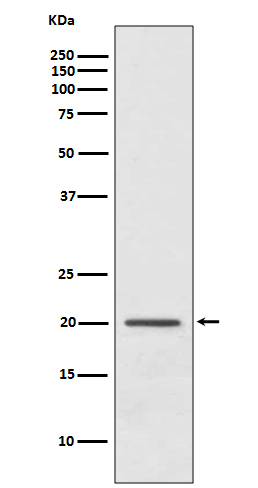

Anti-ARF1 antibody [R58-6M-8] (STJA0035444)
SPECIFICATIONS
ClonalityMonoclonal
HostRabbit
ConjugationUnconjugated
IsotypeIgG
ImmunogenA synthesized peptide derived from human ARF1
General Information
| Short Description | Rabbit monoclonal anti-ARF1 for use in WB, IHC-P and FC in Human, Mouse and Rat samples. Datasheet included with dilution recommendations, and related reagents. |
| Applications | WB/IHC-P/FC |
| Host | Rabbit |
| Reactivity | Human/Mouse/Rat |
| Note | STRICTLY FOR FURTHER SCIENTIFIC RESEARCH USE ONLY (RUO). MUST NOT TO BE USED IN DIAGNOSTIC OR THERAPEUTIC APPLICATIONS. |
Product Properties
| Clonality | Monoclonal |
| Clone ID | R58-6M-8 |
| Isotype | IgG |
| Conjugation | Unconjugated |
| Purification | Affinity Chromatography |
| Dilution Range | WB 1:500-1:1000IHC 1:100-1:200FC 1:50 |
| Formulation | Liquid in PBS, pH 7.4, 150mM NaCl, 0.02% sodium azide and 50% glycerol. |
| Storage Instruction | Store at 4°C short term. Aliquot and store at-20°C long term. Avoid freeze/thaw cycles. |
Target Information
| Gene Symbol | ARF1 |
| Gene ID | 375 |
| Uniprot ID | ARF1_HUMAN |
| Immunogen | A synthesized peptide derived from human ARF1 |
Additional Info
| Post Translational Modifications | (Microbial infection) Demyristoylated by S.flexneri cysteine protease IpaJ which cleaves the peptide bond between N-myristoylated Gly-2 and Asn-3. |
| Function | Small GTPase involved in protein trafficking between different compartments. Modulates vesicle budding and uncoating within the Golgi complex. In its GTP-bound form, triggers the recruitment of coatomer proteins to the Golgi membrane. The hydrolysis of ARF1-bound GTP, which is mediated by ARFGAPs proteins, is required for dissociation of coat proteins from Golgi membranes and vesicles. The GTP-bound form interacts with PICK1 to limit PICK1-mediated inhibition of Arp2/3 complex activity.the function is linked to AMPA receptor (AMPAR) trafficking, regulation of synaptic plasticity of excitatory synapses and spine shrinkage during long-term depression (LTD). Plays a key role in the regulation of intestinal stem cells and gut microbiota, and is essential for maintaining intestinal homeostasis. Also plays a critical role in mast cell expansion but not in mast cell maturation by facilitating optimal mTORC1 activation. (Microbial infection) Functions as an allosteric activator of the cholera toxin catalytic subunit, an ADP-ribosyltransferase. |
| Protein Name | Adp-Ribosylation Factor 1 |
| Database Links | Reactome: R-HSA-1660499Reactome: R-HSA-1660514Reactome: R-HSA-167590Reactome: R-HSA-199992Reactome: R-HSA-2132295Reactome: R-HSA-432720Reactome: R-HSA-432722Reactome: R-HSA-6807878Reactome: R-HSA-6811434Reactome: R-HSA-6811438Reactome: R-HSA-8950505Reactome: R-HSA-9845576 |
| Cellular Localisation | Golgi Apparatus MembraneLipid-AnchorCytoplasmic SideSynapseSynaptosomePostsynaptic DensityIn The Gdp-Bound FormAssociates Transiently With The Membranes Via Its Myristoylated N-Terminus Where Guanine Nucleotide-Exchange Factor (Gef)-Mediated Nucleotide Exchange OccursFollowing Nucleotide ExchangeThe Gtp-Bound Form Undergoes A Conformational ChangeLeading To The Exposure Of A Myristoylated N-Terminal Amphipathic Helix That Provides Stable Membrane Anchorage |
| Alternative Antibody Names | Anti-Adp-Ribosylation Factor 1 antibodyAnti-ARF1 antibody |
Information sourced from Uniprot.org