
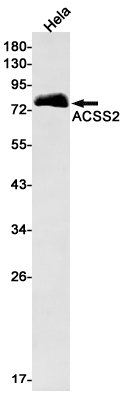

Anti-ACSS2 antibody [R01-7I6] (STJA0033975)
SPECIFICATIONS
ClonalityMonoclonal
HostRabbit
ConjugationUnconjugated
IsotypeIgG
ImmunogenA synthetic peptide of human ACSS2
General Information
| Short Description | Rabbit monoclonal anti-ACSS2 for use in WB in Human samples. Datasheet included with dilution recommendations, and related reagents. |
| Applications | WB |
| Host | Rabbit |
| Reactivity | Human |
| Note | STRICTLY FOR FURTHER SCIENTIFIC RESEARCH USE ONLY (RUO). MUST NOT TO BE USED IN DIAGNOSTIC OR THERAPEUTIC APPLICATIONS. |
Product Properties
| Clonality | Monoclonal |
| Clone ID | R01-7I6 |
| Isotype | IgG |
| Conjugation | Unconjugated |
| Concentration | 0.3 mg/mL |
| Purification | Affinity Purified |
| Dilution Range | WB 1:500-1:1000 |
| Formulation | 50mM Tris-Glycine (pH 7.4) , 0.15M NaCl, 40% Glycerol, 0.01% Sodium azide and 0.05% BSA |
| Storage Instruction | Store at 4°C short term. Aliquot and store at-20°C long term. Avoid freeze/thaw cycles. |
Target Information
| Gene Symbol | ACSS2 |
| Gene ID | 55902 |
| Uniprot ID | ACSA_HUMAN |
| Immunogen | A synthetic peptide of human ACSS2 |
Additional Info
| Post Translational Modifications | Reversibly acetylated at Lys-661. The acetyl-CoA synthase activity is inhibited by acetylation and activated by deacetylation mediated by the deacetylases SIRT1 and SIRT3. Glucose deprivation results in its AMPK-dependent phosphorylation at Ser-659, which leads to exposure of its nuclear localization signal, required for its interaction with KPNA1 and subsequent translocation to the nucleus. |
| Function | Catalyzes the synthesis of acetyl-CoA from short-chain fatty acids. Acetate is the preferred substrate. Can also utilize propionate with a much lower affinity. Nuclear ACSS2 promotes glucose deprivation-induced lysosomal biogenesis and autophagy, tumor cell survival and brain tumorigenesis. Glucose deprivation results in AMPK-mediated phosphorylation of ACSS2 leading to its translocation to the nucleus where it binds to TFEB and locally produces acetyl-CoA for histone acetylation in the promoter regions of TFEB target genes thereby activating their transcription. The regulation of genes associated with autophagy and lysosomal activity through ACSS2 is important for brain tumorigenesis and tumor survival. Acts as a chromatin-bound transcriptional coactivator that up-regulates histone acetylation and expression of neuronal genes. Can be recruited to the loci of memory-related neuronal genes to maintain a local acetyl-CoA pool, providing the substrate for histone acetylation and promoting the expression of specific genes, which is essential for maintaining long-term spatial memory. |
| Protein Name | Acetyl-Coenzyme A Synthetase - CytoplasmicAcetate--Coa LigaseAcetyl-Coa SynthetaseAcsAcecsAcetyl-Coa Synthetase 1Acecs1Acyl-Coa Synthetase Short-Chain Family Member 2Acyl-Activating EnzymePropionate--Coa Ligase |
| Database Links | Reactome: R-HSA-2151201Reactome: R-HSA-71384 |
| Cellular Localisation | CytoplasmCytosolNucleusGlucose Deprivation Results In Its Ampk-Dependent Phosphorylation And Subsequent Nuclear TranslocationPhosphorylation At Ser-659Leads To Exposure Of Its Nuclear Localization Signal Which Is Required For Its Interaction With Kpna1 And Subsequent Translocation To The NucleusFound In The Cytoplasm In Undifferentiated Neurons And Upon DifferentiationTranslocates To Nucleus |
| Alternative Antibody Names | Anti-Acetyl-Coenzyme A Synthetase - Cytoplasmic antibodyAnti-Acetate--Coa Ligase antibodyAnti-Acetyl-Coa Synthetase antibodyAnti-Acs antibodyAnti-Acecs antibodyAnti-Acetyl-Coa Synthetase 1 antibodyAnti-Acecs1 antibodyAnti-Acyl-Coa Synthetase Short-Chain Family Member 2 antibodyAnti-Acyl-Activating Enzyme antibodyAnti-Propionate--Coa Ligase antibodyAnti-ACSS2 antibodyAnti-ACAS2 antibody |
Information sourced from Uniprot.org