


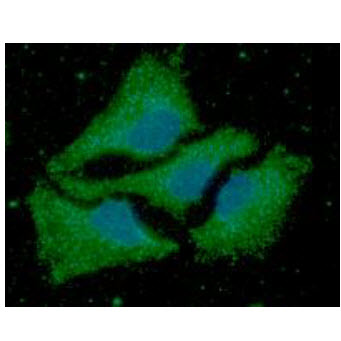
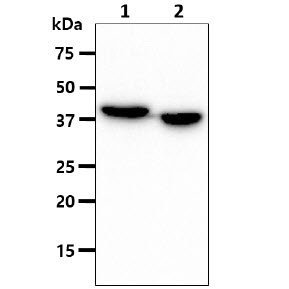

Anti-ACAA1 antibody (27-424aa) [AT9E5] (STJA0041803)
SPECIFICATIONS
ClonalityMonoclonal
HostMouse
ConjugationUnconjugated
IsotypeIgG2bk
ImmunogenRecombinant human ACAA1 (27-424aa) purified from E. coli
General Information
| Short Description | Mouse monoclonal anti-ACAA1 (27-424aa) for use in ELISA, WB, ICC and IF in Human samples. Datasheet included with dilution recommendations, and related reagents. |
| Applications | ELISA/WB/ICC/IF |
| Host | Mouse |
| Reactivity | Human |
| Note | STRICTLY FOR FURTHER SCIENTIFIC RESEARCH USE ONLY (RUO). MUST NOT TO BE USED IN DIAGNOSTIC OR THERAPEUTIC APPLICATIONS. |
Product Properties
| Clonality | Monoclonal |
| Clone ID | AT9E5 |
| Isotype | IgG2bk |
| Conjugation | Unconjugated |
| Concentration | 1 mg/mL |
| Purification | By protein-A affinity chromatography |
| Formulation | Liquid in phosphate-Buffered Saline (pH 7.4) with 0.02% Sodium Azide, 10% Glycerol |
| Storage Instruction | For short term storage, keep at +2C to +8C for up to 1 week. For long term storage, aliquot and store at-20C, and avoid repeat freeze-thaw cycles. |
Target Information
| Gene Symbol | ACAA1 |
| Gene ID | 30 |
| Uniprot ID | THIK_HUMAN |
| Accession Number | NP_001598 |
| Immunogen | Recombinant human ACAA1 (27-424aa) purified from E. coli |
| Immunogen Region | 27-424aa |
Additional Info
| Function | Responsible for the thiolytic cleavage of straight chain 3-keto fatty acyl-CoAs (3-oxoacyl-CoAs). Plays an important role in fatty acid peroxisomal beta-oxidation. Catalyzes the cleavage of short, medium, long, and very long straight chain 3-oxoacyl-CoAs. |
| Protein Name | 3-Ketoacyl-Coa Thiolase - PeroxisomalAcetyl-Coa C-MyristoyltransferaseAcetyl-Coa AcyltransferaseBeta-KetothiolasePeroxisomal 3-Oxoacyl-Coa Thiolase |
| Database Links | Reactome: R-HSA-2046106Reactome: R-HSA-390247Reactome: R-HSA-6798695Reactome: R-HSA-9033241Reactome: R-HSA-9033500 |
| Cellular Localisation | PeroxisomeTransported Into Peroxisomes Following Association With Pex7 |
| Alternative Antibody Names | Anti-3-Ketoacyl-Coa Thiolase - Peroxisomal antibodyAnti-Acetyl-Coa C-Myristoyltransferase antibodyAnti-Acetyl-Coa Acyltransferase antibodyAnti-Beta-Ketothiolase antibodyAnti-Peroxisomal 3-Oxoacyl-Coa Thiolase antibodyAnti-ACAA1 antibodyAnti-ACAA antibodyAnti-PTHIO antibody |
Information sourced from Uniprot.org