

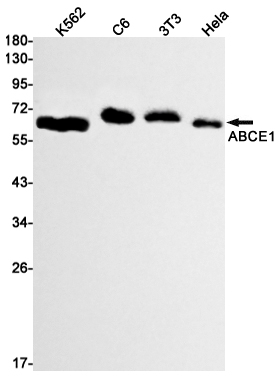

Anti-ABCE1 antibody [R09-8C3] (STJA0033825)
SPECIFICATIONS
ClonalityMonoclonal
HostRabbit
ConjugationUnconjugated
IsotypeIgG
ImmunogenA synthetic peptide of human ABCE1
General Information
| Short Description | Rabbit monoclonal anti-ABCE1 for use in WB and IP in Human, Mouse and Rat samples. Datasheet included with dilution recommendations, and related reagents. |
| Applications | WB/IP |
| Host | Rabbit |
| Reactivity | Human/Mouse/Rat |
| Note | STRICTLY FOR FURTHER SCIENTIFIC RESEARCH USE ONLY (RUO). MUST NOT TO BE USED IN DIAGNOSTIC OR THERAPEUTIC APPLICATIONS. |
Product Properties
| Clonality | Monoclonal |
| Clone ID | R09-8C3 |
| Isotype | IgG |
| Conjugation | Unconjugated |
| Concentration | 0.3 mg/mL |
| Purification | Affinity Purified |
| Dilution Range | WB 1:500-1:1000IP 1:20 |
| Formulation | 50mM Tris-Glycine (pH 7.4) , 0.15M NaCl, 40% Glycerol, 0.01% Sodium azide and 0.05% BSA |
| Storage Instruction | Store at 4°C short term. Aliquot and store at-20°C long term. Avoid freeze/thaw cycles. |
Target Information
| Gene Symbol | ABCE1 |
| Gene ID | 6059 |
| Uniprot ID | ABCE1_HUMAN |
| Immunogen | A synthetic peptide of human ABCE1 |
Additional Info
| Post Translational Modifications | Ubiquitinated by CNOT4. Ubiquitination mediates the recruitment of autophagy receptors to the mitochondrial outer membrane and initiates mitophagy. |
| Function | Nucleoside-triphosphatase (NTPase) involved in ribosome recycling by mediating ribosome disassembly. Able to hydrolyze ATP, GTP, UTP and CTP. Splits ribosomes into free 60S subunits and tRNA- and mRNA-bound 40S subunits. Acts either after canonical termination facilitated by release factors (ETF1/eRF1) or after recognition of stalled and vacant ribosomes by mRNA surveillance factors (PELO/Pelota). Involved in the No-Go Decay (NGD) pathway: recruited to stalled ribosomes by the Pelota-HBS1L complex, and drives the disassembly of stalled ribosomes, followed by degradation of damaged mRNAs as part of the NGD pathway. Also plays a role in quality control of translation of mitochondrial outer membrane-localized mRNA. As part of the PINK1-regulated signaling, ubiquitinated by CNOT4 upon mitochondria damage.this modification generates polyubiquitin signals that recruit autophagy receptors to the mitochondrial outer membrane and initiate mitophagy. RNASEL-specific protein inhibitor which antagonizes the binding of 2-5A (5'-phosphorylated 2',5'-linked oligoadenylates) to RNASEL. Negative regulator of the anti-viral effect of the interferon-regulated 2-5A/RNASEL pathway. (Microbial infection) May act as a chaperone for post-translational events during HIV-1 capsid assembly. (Microbial infection) Plays a role in the down-regulation of the 2-5A/RNASEL pathway during encephalomyocarditis virus (EMCV) and HIV-1 infections. |
| Protein Name | Atp-Binding Cassette Sub-Family E Member 12'-5'-Oligoadenylate-Binding ProteinHuhp68Rnase L InhibitorRibonuclease 4 InhibitorRns4i |
| Database Links | Reactome: R-HSA-8983711Reactome: R-HSA-909733 |
| Cellular Localisation | CytoplasmMitochondrion |
| Alternative Antibody Names | Anti-Atp-Binding Cassette Sub-Family E Member 1 antibodyAnti-2'-5'-Oligoadenylate-Binding Protein antibodyAnti-Huhp68 antibodyAnti-Rnase L Inhibitor antibodyAnti-Ribonuclease 4 Inhibitor antibodyAnti-Rns4i antibodyAnti-ABCE1 antibodyAnti-RLI antibodyAnti-RNASEL1 antibodyAnti-RNASELI antibodyAnti-RNS4I antibodyAnti-OK antibodyAnti-SW-cl.40 antibody |
Information sourced from Uniprot.org