Mouse Galectin-3/LGALS3 protein (Recombinant) (His-Tag) (STJP019247)

SKU:
STJP019247
$185.61 - $1,644.27
Processing The item has been added

Short Description :Recombinant-Mouse Galectin-3/LGALS3-His-Tag protein was developed from e.coli and has a target region of His-Tag. For use in research applications.
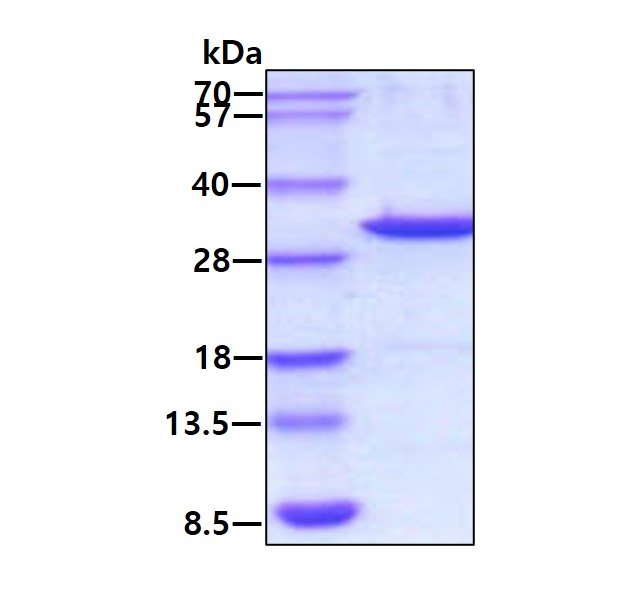
Applications:SDS-PAGE/Bioactivity
Host:E.coli
Note:STRICTLY FOR FURTHER SCIENTIFIC RESEARCH USE ONLY (RUO). MUST NOT TO BE USED IN DIAGNOSTIC OR THERAPEUTIC APPLICATIONS.
Concentration:0.5 mg/mL
Formulation:Liquid in 20mM Tris-HCl buffer (pH 8.0) containing 0.15M NaCl, 50% Glycerol, 1mM DTT, 2mM EDTA
Storage Instruction:For short term storage, keep at +2C to +8C for up to 1 week. For long term storage, aliquot and store at-20C, and avoid repeat freeze-thaw cycles.
Immunoreactivity:The ED50 for this effect is equal or higher than 25ug/ml. Measured by its ability to agglutinate human red blood cells.
Accession Number:NP_034835.1
Immunogen:Mouse
Immunogen Region:1-264aa
Immunogen Sequence:MADSFSL NDALAGSGNP NPQGYPGAWG NQPGAGGYPG AAYPGAYPGQ APPGAYPGQA PPGAYPGQAP PSAYPGPTAP GAYPGPTAPG AYPGSTAPGA FPGQPGAPGA YPSAPGGYPA AGPYGVPAGP LTVPYDLPLP GGVMPRMLIT IMGTVKPNAN RIVLDFRRGN DVAFHFNPRF NENNRRVIVC NTKQDNNWGK EERQSA
Background LGALS3, also known as galectin 3, is a member of the family of animal lectins, which selectively binds beta-galactoside residues. This protein is secreted from cells by ectocytosis, which is independent of the classical secretory pathway through the endoplasmic reticulum/Golgi network. LGALS3 has been associated with the inhibition of apoptosis and the progression of cancer. It is normally distributed in epithelia of many organs, in various inflammatory cells, including macrophages, as well as dendritic cells and Kupffer cells. The expression of this lectin is up-regulated during inflammation, cell proliferation, cell differentiation and through trans-activation by viral proteins. Recombinant mouse LGALS3 protein, used to His-tag at N-terminus, was expressed in E. coli and purified by using conventional chromatography techniques.

Information sourced from Uniprot.org