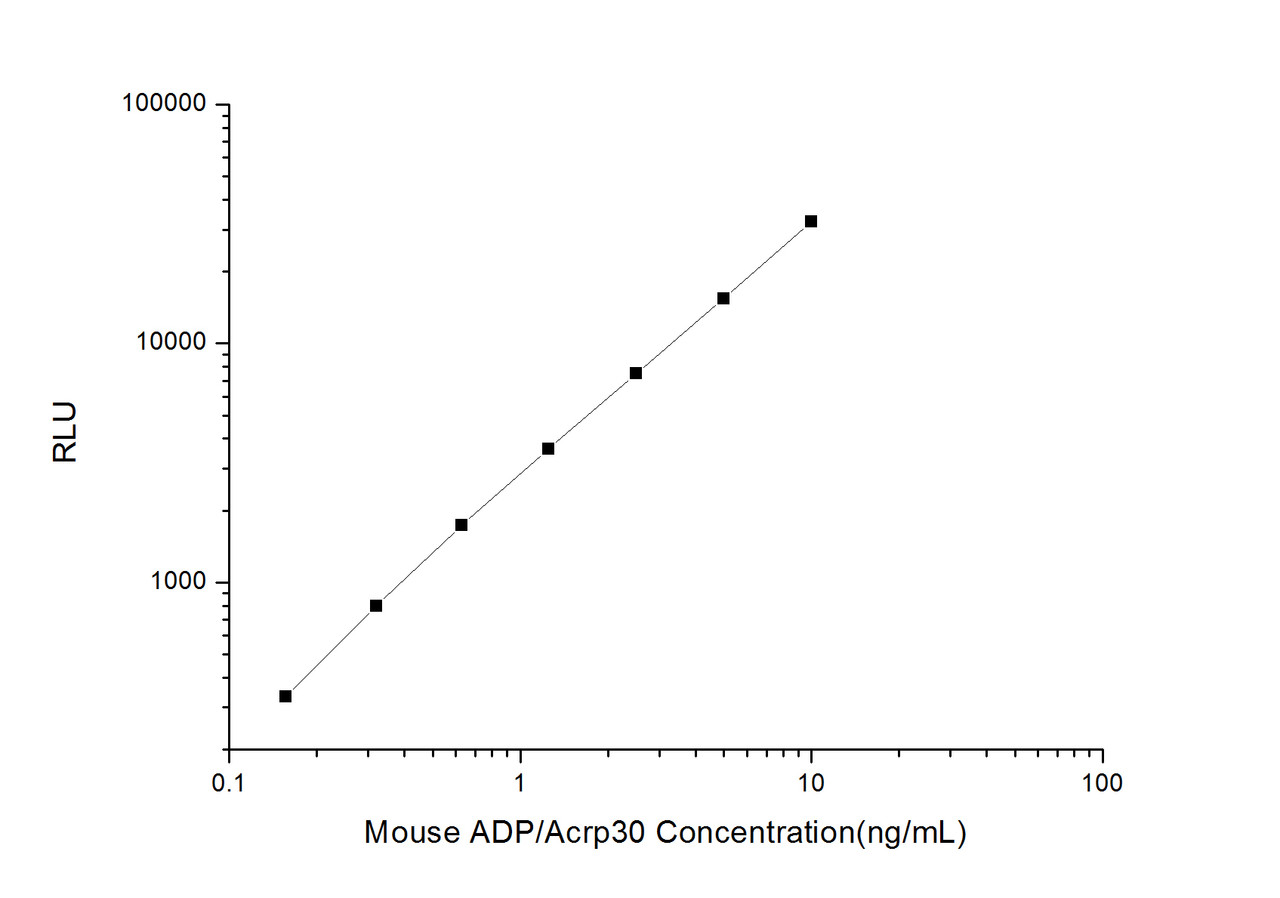
This mouse ADP/Acrp30 kit is a highly sensitive in-vitro chemiluminescent immunoassay for the measurement of trace amounts of analytes in serum, plasma and other biological fluids.
Applications
CLIA
Reactivity
Mouse
Sensitivity
0.09ng/mL
Detection Limit
0.16~10ng/mL
Note
FOR SCIENTIFIC EDUCATIONAL RESEARCH USE ONLY (RUO). MUST NOT BE USED IN DIAGNOSTIC OR OTHER MEDICAL APPLICATIONS.
Product Properties
Storage Instruction
If unopened the kit may be stored at 2-8°C for up to 1 month. If the kit will not be used within 1 month, store the components separately, according to the component table in the manual.
This kit recognizes Mouse ADP/Acrp30 in samples. No significant cross-reactivity or interference between Mouse ADP/Acrp30 and analogues was observed.
Sample Type
Serum, plasma and other biological fluids
Additional Info
Tissue Specificity
Synthesized exclusively by adipocytes and secreted into plasma.
Post Translational Modifications
HMW complexes are more extensively glycosylated than smaller oligomers. Hydroxylation and glycosylation of the lysine residues within the collagen-like domain of adiponectin seem to be critically involved in regulating the formation and/or secretion of HMW complexes and consequently contribute to the insulin-sensitizing activity of adiponectin in hepatocytes. O-glycosylated. Not N-glycosylated O-linked glycans on hydroxylysine residues consist of Glc-Gal disaccharides bound to the oxygen atom of post-translationally added hydroxyl groups. O-linked glycosylation in the N-terminal is disialylated with the structure Neu5Acalpha2->8Neu5Acalpha2->3Gal. Sialylated by alpha 2,8-sialyltransferase III. Succination of Cys-39 by the Krebs cycle intermediate fumarate, which leads to S-(2-succinyl)cysteine residues, inhibits polymerization and secretion of adiponectin. Adiponectin is a major target for succination in both adipocytes and adipose tissue of diabetic mice. It was proposed that succination of proteins is a biomarker of mitochondrial stress and accumulation of Krebs cycle intermediates in adipose tissue in diabetes and that succination of adiponectin may contribute to the decrease in plasma adiponectin in diabetes.
Function
Important adipokine involved in the control of fat metabolism and insulin sensitivity, with direct anti-diabetic, anti-atherogenic and anti-inflammatory activities. Stimulates AMPK phosphorylation and activation in the liver and the skeletal muscle, enhancing glucose utilization and fatty-acid combustion. Antagonizes TNF-alpha by negatively regulating its expression in various tissues such as liver and macrophages, and also by counteracting its effects. Inhibits endothelial NF-kappa-B signaling through a cAMP-dependent pathway. May play a role in cell growth, angiogenesis and tissue remodeling by binding and sequestering various growth factors with distinct binding affinities, depending on the type of complex, LMW, MMW or HMW.
Protein Name
Adiponectin30 Kda Adipocyte Complement-Related ProteinAdipocyte Complement-Related 30 Kda ProteinAcrp30Adipocyte - C1q And Collagen Domain-Containing ProteinAdipocyte-Specific Protein Adipoq