

Human UbcH10/UBE2C protein (Recombinant) (His-Tag) (STJP017790)
SPECIFICATIONS
HostE.coli
ImmunogenHuman
General Information
| Short Description | Recombinant-Human UbcH10/UBE2C-His-Tag protein was developed from e.coli and has a target region of His-Tag. For use in research applications. |
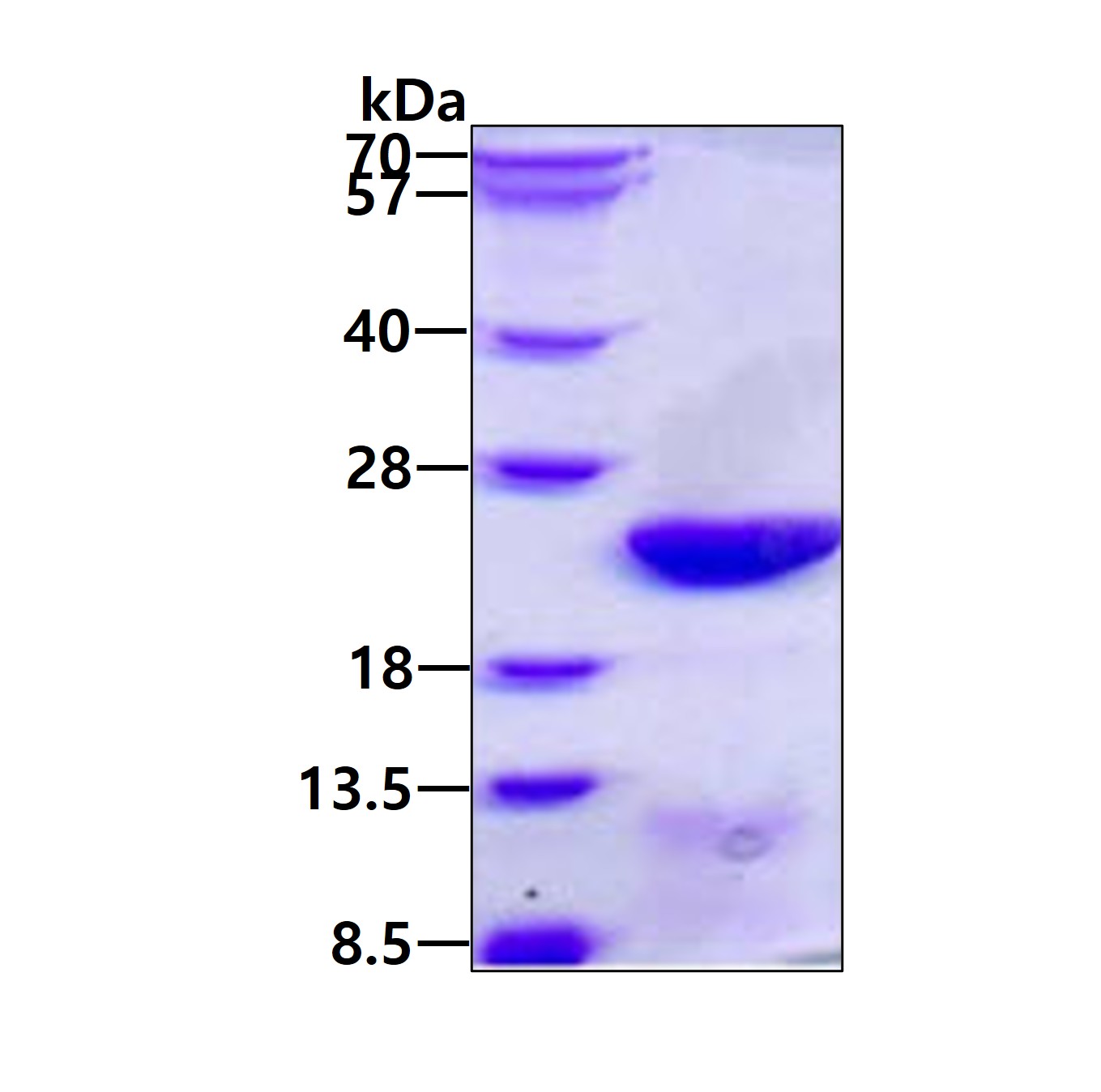
| Applications | SDS-PAGE |
| Host | E.coli |
| Note | STRICTLY FOR FURTHER SCIENTIFIC RESEARCH USE ONLY (RUO). MUST NOT TO BE USED IN DIAGNOSTIC OR THERAPEUTIC APPLICATIONS. |
Product Properties
| Concentration | 1 mg/mL |
| Formulation | Liquid in 20mM Tris-HCl buffer (pH 8.0) containing 0.15M NaCl, 10% Glycerol, 1mM DTT |
| Storage Instruction | For short term storage, keep at +2C to +8C for up to 1 week. For long term storage, aliquot and store at-20C, and avoid repeat freeze-thaw cycles. |
Target Information
| Gene Symbol | UBE2C |
| Gene ID | 11065 |
| Uniprot ID | UBE2C_HUMAN |
| Accession Number | NP_008950 |
| Immunogen | Human |
| Immunogen Region | 1-179aa |
| Immunogen Sequence |
Additional Info
| Post Translational Modifications | Autoubiquitinated by the APC/C complex, leading to its degradation by the proteasome. Its degradation plays a central role in APC/C regulation, allowing cyclin-A accumulation before S phase entry. APC/C substrates inhibit the autoubiquitination of UBE2C/UBCH10 but not its E2 function, hence APC/C remaining active until its substrates have been destroyed. |
| Function | Accepts ubiquitin from the E1 complex and catalyzes its covalent attachment to other proteins. In vitro catalyzes 'Lys-11'- and 'Lys-48'-linked polyubiquitination. Acts as an essential factor of the anaphase promoting complex/cyclosome (APC/C), a cell cycle-regulated ubiquitin ligase that controls progression through mitosis. Acts by initiating 'Lys-11'-linked polyubiquitin chains on APC/C substrates, leading to the degradation of APC/C substrates by the proteasome and promoting mitotic exit. |
| Protein Name | Ubiquitin-Conjugating Enzyme E2 C(E3-Independent E2 Ubiquitin-Conjugating Enzyme CE2 Ubiquitin-Conjugating Enzyme CUbch10Ubiquitin Carrier Protein CUbiquitin-Protein Ligase C |
| Database Links | Reactome: R-HSA-141430Reactome: R-HSA-174048Reactome: R-HSA-174084Reactome: R-HSA-174154Reactome: R-HSA-174178Reactome: R-HSA-174184Reactome: R-HSA-176407Reactome: R-HSA-176408Reactome: R-HSA-176409Reactome: R-HSA-176412Reactome: R-HSA-179409Reactome: R-HSA-2467813Reactome: R-HSA-2559582Reactome: R-HSA-68867Reactome: R-HSA-69017Reactome: R-HSA-8853884Reactome: R-HSA-8866652Reactome: R-HSA-9687136Reactome: R-HSA-983168 |
| Cellular Localisation | |
| Alternative Protein Names | Ubiquitin-Conjugating Enzyme E2 C protein(E3-Independent E2 Ubiquitin-Conjugating Enzyme C proteinE2 Ubiquitin-Conjugating Enzyme C proteinUbch10 proteinUbiquitin Carrier Protein C proteinUbiquitin-Protein Ligase C proteinUBE2C proteinUBCH10 protein |
Information sourced from Uniprot.org