

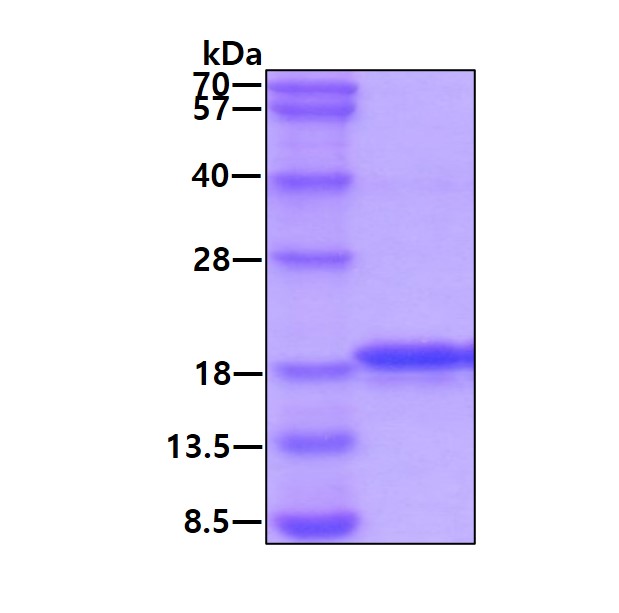

Human Ubc16/UBE2W protein (Recombinant) (His-Tag) (STJP017214)
SPECIFICATIONS
HostE.coli
ImmunogenHuman
General Information
| Short Description | Recombinant-Human Ubc16/UBE2W-His-Tag protein was developed from e.coli and has a target region of His-Tag. For use in research applications. |
| Applications | SDS-PAGE |
| Host | E.coli |
| Note | STRICTLY FOR FURTHER SCIENTIFIC RESEARCH USE ONLY (RUO). MUST NOT TO BE USED IN DIAGNOSTIC OR THERAPEUTIC APPLICATIONS. |
Product Properties
| Concentration | 1 mg/mL |
| Formulation | Liquid In Phosphate-Buffered Saline (pH 7.4) containing 10% Glycerol |
| Storage Instruction | For short term storage, keep at +2C to +8C for up to 1 week. For long term storage, aliquot and store at-20C, and avoid repeat freeze-thaw cycles. |
Target Information
| Gene Symbol | UBE2W |
| Gene ID | 55284 |
| Uniprot ID | UBE2W_HUMAN |
| Accession Number | NP_060769.5 |
| Immunogen | Human |
| Immunogen Region | 1-151aa |
| Immunogen Sequence |
Additional Info
| Tissue Specificity | Widely expressed, with highest expression in brain, liver, pancreas and heart. |
| Post Translational Modifications | Autoubiquitinated at Met-1. |
| Function | Accepts ubiquitin from the E1 complex and catalyzes its covalent attachment to other proteins. Specifically monoubiquitinates the N-terminus of various substrates, including ATXN3, MAPT/TAU, POLR2H/RPB8 and STUB1/CHIP, by recognizing backbone atoms of disordered N-termini. Involved in degradation of misfolded chaperone substrates by mediating monoubiquitination of STUB1/CHIP, leading to recruitment of ATXN3 to monoubiquitinated STUB1/CHIP, and restriction of the length of ubiquitin chain attached to STUB1/CHIP substrates by ATXN3. After UV irradiation, but not after mitomycin-C (MMC) treatment, acts as a specific E2 ubiquitin-conjugating enzyme for the Fanconi anemia complex by associating with E3 ubiquitin-protein ligase FANCL and catalyzing monoubiquitination of FANCD2, a key step in the DNA damage pathway. In vitro catalyzes 'Lys-11'-linked polyubiquitination. UBE2W-catalyzed ubiquitination also occurs in the presence of inactive RING/U-box type E3s, i.e. lacking the active site cysteine residues to form thioester bonds with ubiquitin, or even in the absence of E3, albeit at a slower rate. |
| Protein Name | Ubiquitin-Conjugating Enzyme E2 WE2 Ubiquitin-Conjugating Enzyme WN-Terminal E2 Ubiquitin-Conjugating EnzymeN-Terminus-Conjugating E2Ubiquitin Carrier Protein WUbiquitin-Conjugating Enzyme 16Ubc-16Ubiquitin-Protein Ligase W |
| Database Links | Reactome: R-HSA-8866652Reactome: R-HSA-983168 |
| Cellular Localisation | NucleusIn The NucleusColocalizes With Fancl |
| Alternative Protein Names | Ubiquitin-Conjugating Enzyme E2 W proteinE2 Ubiquitin-Conjugating Enzyme W proteinN-Terminal E2 Ubiquitin-Conjugating Enzyme proteinN-Terminus-Conjugating E2 proteinUbiquitin Carrier Protein W proteinUbiquitin-Conjugating Enzyme 16 proteinUbc-16 proteinUbiquitin-Protein Ligase W proteinUBE2W proteinUBC16 protein |
Information sourced from Uniprot.org