

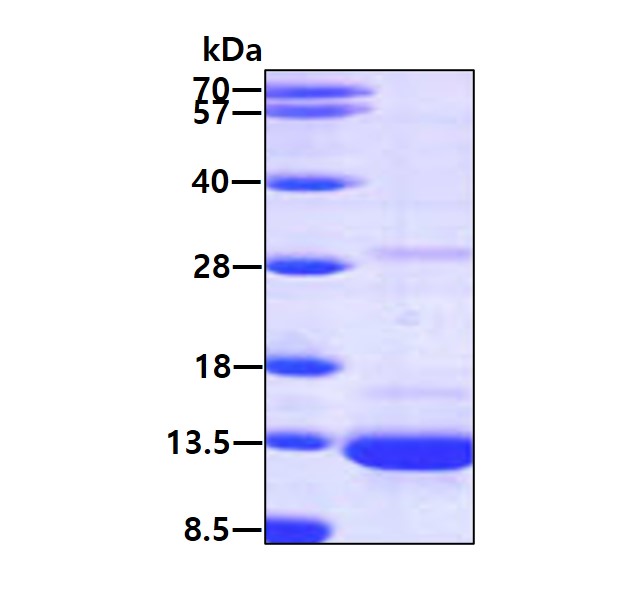

Human PIN/DYNLL1 protein (Recombinant) (His-Tag) (STJP016884)
SPECIFICATIONS
HostE.coli
ImmunogenHuman
General Information
| Short Description | Recombinant-Human PIN/DYNLL1-His-Tag protein was developed from e.coli and has a target region of His-Tag. For use in research applications. |
| Applications | SDS-PAGE |
| Host | E.coli |
| Note | STRICTLY FOR FURTHER SCIENTIFIC RESEARCH USE ONLY (RUO). MUST NOT TO BE USED IN DIAGNOSTIC OR THERAPEUTIC APPLICATIONS. |
Product Properties
| Concentration | 1 mg/mL |
| Formulation | Liquid in 20mM Tris-HCl buffer (pH 8.0) containing 0.2M NaCl, 1mM DTT, 10% Glycerol |
| Storage Instruction | For short term storage, keep at +2C to +8C for up to 1 week. For long term storage, aliquot and store at-20C, and avoid repeat freeze-thaw cycles. |
Target Information
| Gene Symbol | DYNLL1 |
| Gene ID | 8655 |
| Uniprot ID | DYL1_HUMAN |
| Accession Number | NP_003737.1 |
| Immunogen | Human |
| Immunogen Region | 1-89aa |
| Immunogen Sequence |
Additional Info
| Tissue Specificity | Ubiquitous. Expressed in testis. |
| Post Translational Modifications | Phosphorylation at Ser-88 promotes recruitment to DNA double-strand breaks (DSBs) by TP53BP1 and ability to inhibit MRE11. Phosphorylation at Ser-88 appears to control the dimer-monomer transition. it is phosphorylated at Ser-88 by PAK1, however, the DYNLL1 dimer is not accessible for PAK1 and the phosphorylation could not be demonstrated in vitro. |
| Function | Acts as one of several non-catalytic accessory components of the cytoplasmic dynein 1 complex that are thought to be involved in linking dynein to cargos and to adapter proteins that regulate dynein function. Cytoplasmic dynein 1 acts as a motor for the intracellular retrograde motility of vesicles and organelles along microtubules. May play a role in changing or maintaining the spatial distribution of cytoskeletal structures. In addition to its role in cytoskeleton and transport, acts as a protein-protein adapter, which inhibits and/or sequesters target proteins. Involved in the response to DNA damage by acting as a key regulator of DNA end resection: when phosphorylated at Ser-88, recruited to DNA double-strand breaks (DSBs) by TP53BP1 and acts by disrupting MRE11 dimerization, thereby inhibiting DNA end resection. In a subset of DSBs, DYNLL1 remains unphosphorylated and promotes the recruitment of the Shieldin complex. Binds and inhibits the catalytic activity of neuronal nitric oxide synthase/NOS1. Promotes transactivation functions of ESR1 and plays a role in the nuclear localization of ESR1. Regulates apoptotic activities of BCL2L11 by sequestering it to microtubules. Upon apoptotic stimuli the BCL2L11-DYNLL1 complex dissociates from cytoplasmic dynein and translocates to mitochondria and sequesters BCL2 thus neutralizing its antiapoptotic activity. |
| Protein Name | Dynein Light Chain 1 - Cytoplasmic8 Kda Dynein Light ChainDlc8Dynein Light Chain Lc8-Type 1Protein Inhibitor Of Neuronal Nitric Oxide SynthasePin |
| Database Links | Reactome: R-HSA-111446Reactome: R-HSA-141444Reactome: R-HSA-1632852Reactome: R-HSA-2132295Reactome: R-HSA-2467813Reactome: R-HSA-2500257Reactome: R-HSA-2565942Reactome: R-HSA-3371497Reactome: R-HSA-380259Reactome: R-HSA-380270Reactome: R-HSA-380284Reactome: R-HSA-380320Reactome: R-HSA-5620912Reactome: R-HSA-5620924Reactome: R-HSA-5663220Reactome: R-HSA-6798695Reactome: R-HSA-6807878Reactome: R-HSA-6811436Reactome: R-HSA-68877Reactome: R-HSA-8854518Reactome: R-HSA-9609690Reactome: R-HSA-9646399Reactome: R-HSA-9648025 |
| Cellular Localisation | CytoplasmCytoskeletonMicrotubule Organizing CenterCentrosomeChromosomeNucleusMitochondrionUpon Induction Of Apoptosis Translocates Together With Bcl2l11 To MitochondriaRecruited To Dna Double-Strand Breaks (Dsbs) By Tp53bp1 When Phosphorylated At Ser-88 |
| Alternative Protein Names | Dynein Light Chain 1 - Cytoplasmic protein8 Kda Dynein Light Chain proteinDlc8 proteinDynein Light Chain Lc8-Type 1 proteinProtein Inhibitor Of Neuronal Nitric Oxide Synthase proteinPin proteinDYNLL1 proteinDLC1 proteinDNCL1 proteinDNCLC1 proteinHDLC1 protein |
Information sourced from Uniprot.org