

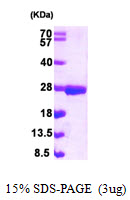

Human NUDT3/DIPP1 protein (Recombinant) (His-Tag) (STJP017059)
SPECIFICATIONS
HostE.coli
ImmunogenHuman
General Information
| Short Description | Recombinant-Human NUDT3/DIPP1-His-Tag protein was developed from e.coli and has a target region of His-Tag. For use in research applications. |
| Applications | SDS-PAGE |
| Host | E.coli |
| Note | STRICTLY FOR FURTHER SCIENTIFIC RESEARCH USE ONLY (RUO). MUST NOT TO BE USED IN DIAGNOSTIC OR THERAPEUTIC APPLICATIONS. |
Product Properties
| Concentration | 0.5 mg/mL |
| Formulation | Liquid in 20mM Tris-HCl buffer (pH 8.0) containing 0.2M NaCl, 5mM DTT, 20% Glycerol |
| Storage Instruction | For short term storage, keep at +2C to +8C for up to 1 week. For long term storage, aliquot and store at-20C, and avoid repeat freeze-thaw cycles. |
Target Information
| Gene Symbol | NUDT3 |
| Gene ID | 11165 |
| Uniprot ID | NUDT3_HUMAN |
| Accession Number | NP_006694 |
| Immunogen | Human |
| Immunogen Region | 1-172aa |
| Immunogen Sequence | MGSSHHHHHH SSGLVPRGSH MMKLKSNQTR TYDGDGYKKR AACLCFRSES EEEVLLVSSS RHPDRWIVPG GGMEPEEEPS VAAVREVCEE AGVKGTLGRL VGIFENQERK HRTYVYVLIV TEVLEDWEDS VNIGRKREWF KIEDAIKVLQ YHKPVQASYF ETLRQGYSAN NGTPVVATTY SVSAQSSMSG IR |
Additional Info
| Tissue Specificity | Widely expressed. Expressed at higher level in brain, heart, pancreas and liver. Also expressed in placenta, lung and kidney. |
| Function | Cleaves a beta-phosphate from the diphosphate groups in PP-InsP5 (diphosphoinositol pentakisphosphate) and PP2-InsP4 (bisdiphosphoinositol tetrakisphosphate), suggesting that it may play a role in signal transduction. InsP6 (inositol hexakisphosphate) is not a substrate. Acts as a negative regulator of the ERK1/2 pathway. Also able to catalyze the hydrolysis of dinucleoside oligophosphates, with diadenosine 5',5'''-P1,P6-hexaphosphate (Ap6A) and diadenosine 5',5'''- P1,P5-pentaphosphate (Ap5A) being the preferred substrates. The major reaction products are ADP and p4a from Ap6A and ADP and ATP from Ap5A. Also able to hydrolyze 5-phosphoribose 1-diphosphate. Acts as a decapping enzyme that modulates the stability of a subset of mRNAs implicated in cell motility. Hydrolyzes monomethylated capped RNA after both the alpha- and beta-phosphates generating m7GMP + ppRNA and m7GDP + pRNA. Can hydrolyze unmethylated capped RNAs. Divalent cations zinc, magnesium and manganese determine its substrate specificity. Exhibits diphosphoinositol polyphosphate phosphohydrolase in the presence of magnesium ions, diadenosine hexaphosphate hydrolase activity in the presence of manganese ions and endopolyphosphatase activity in the presence of zinc ions. Plays an important role in limiting DNA damage and maintaining cell survival upon oxidative stress via its endopolyphosphatase activity. |
| Protein Name | Diphosphoinositol Polyphosphate Phosphohydrolase 1Dipp-1Diadenosine Hexaphosphate HydrolaseAp6a HydrolaseEndopolyphosphataseNucleoside Diphosphate-Linked Moiety X Motif 3Nudix Motif 3M7gpppn-Mrna HydrolaseM7gpppx Diphosphatase |
| Database Links | Reactome: R-HSA-1855167 |
| Cellular Localisation | CytoplasmNucleus |
| Alternative Protein Names | Diphosphoinositol Polyphosphate Phosphohydrolase 1 proteinDipp-1 proteinDiadenosine Hexaphosphate Hydrolase proteinAp6a Hydrolase proteinEndopolyphosphatase proteinNucleoside Diphosphate-Linked Moiety X Motif 3 proteinNudix Motif 3 proteinM7gpppn-Mrna Hydrolase proteinM7gpppx Diphosphatase proteinNUDT3 proteinDIPP proteinDIPP1 protein |
Information sourced from Uniprot.org