

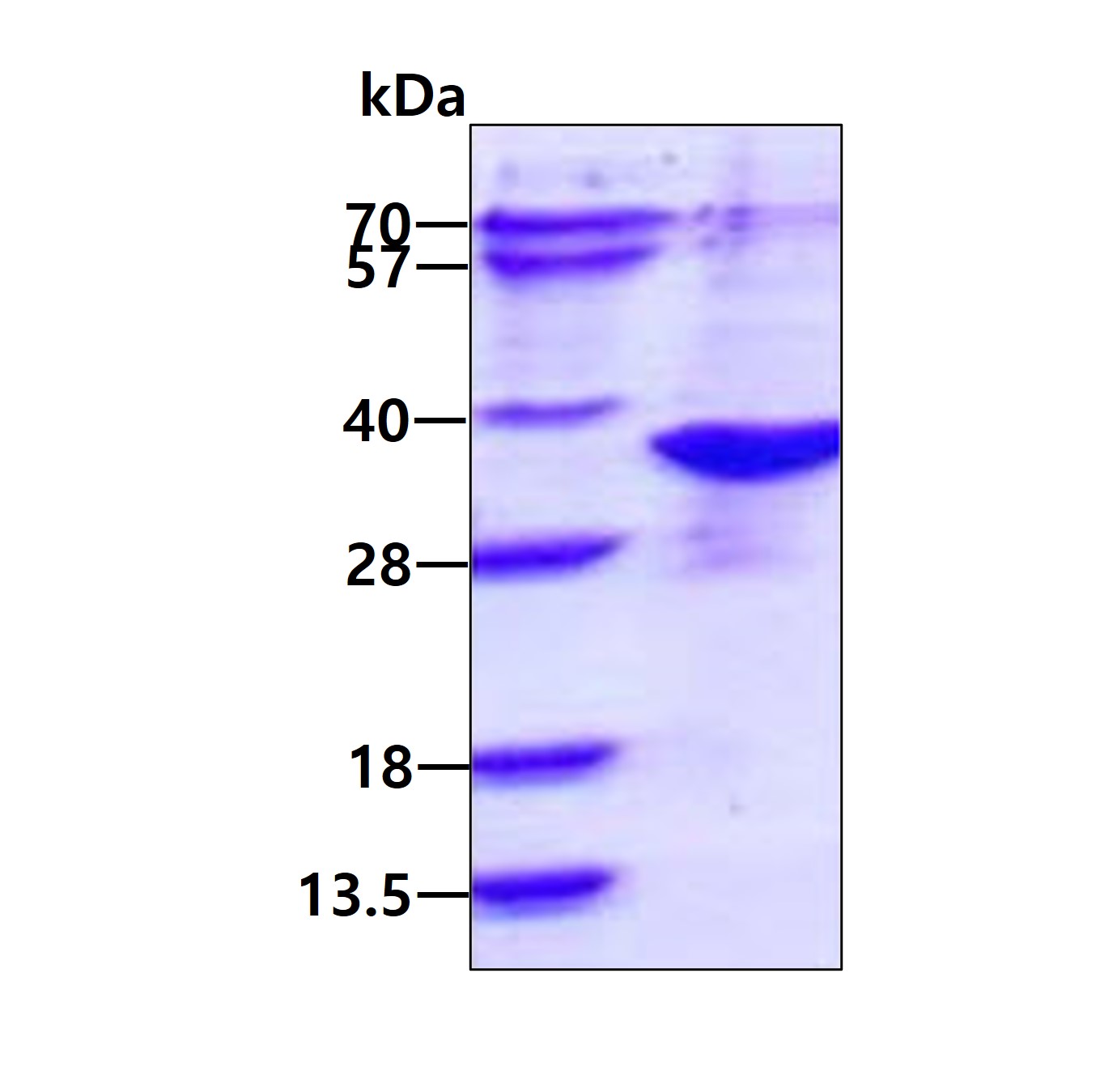

Human NAA10 protein (Recombinant) (His-Tag) (STJP017289)
SPECIFICATIONS
HostE.coli
ImmunogenHuman
General Information
| Short Description | Recombinant-Human NAA10-His-Tag protein was developed from e.coli and has a target region of His-Tag. For use in research applications. |
| Applications | SDS-PAGE |
| Host | E.coli |
| Note | STRICTLY FOR FURTHER SCIENTIFIC RESEARCH USE ONLY (RUO). MUST NOT TO BE USED IN DIAGNOSTIC OR THERAPEUTIC APPLICATIONS. |
Product Properties
| Concentration | 1 mg/mL |
| Formulation | Liquid in 20mM Tris-HCl buffer (pH 8.0) containing 5mM DTT, 10% Glycerol, 200mM NaCl |
| Storage Instruction | For short term storage, keep at +2C to +8C for up to 1 week. For long term storage, aliquot and store at-20C, and avoid repeat freeze-thaw cycles. |
Target Information
| Gene Symbol | NAA10 |
| Gene ID | 8260 |
| Uniprot ID | NAA10_HUMAN |
| Accession Number | NP_003482 |
| Immunogen | Human |
| Immunogen Region | 1-235aa |
| Immunogen Sequence |
Additional Info
| Tissue Specificity | Ubiquitous. |
| Post Translational Modifications | Cleaved by caspases during apoptosis. Phosphorylation by IKBKB/IKKB at Ser-209 promotes its proteasome-mediated degradation. Autoacetylated at Lys-136 which stimulates its catalytic activity. |
| Function | Catalytic subunit of N-terminal acetyltransferase complexes which display alpha (N-terminal) acetyltransferase activity. Acetylates amino termini that are devoid of initiator methionine. The alpha (N-terminal) acetyltransferase activity may be important for vascular, hematopoietic and neuronal growth and development. Without NAA15, displays epsilon (internal) acetyltransferase activity towards HIF1A, thereby promoting its degradation. Represses MYLK kinase activity by acetylation, and thus represses tumor cell migration. Acetylates, and stabilizes TSC2, thereby repressing mTOR activity and suppressing cancer development. Acetylates HSPA1A and HSPA1B at 'Lys-77' which enhances its chaperone activity and leads to preferential binding to co-chaperone HOPX. Acetylates HIST1H4A. Acts as a negative regulator of sister chromatid cohesion during mitosis. |
| Protein Name | N-Alpha-Acetyltransferase 10N-Terminal Acetyltransferase Complex Ard1 Subunit Homolog AHard1Nata Catalytic Subunit Naa10 |
| Database Links | |
| Cellular Localisation | CytoplasmNucleusAlso Present In The Free Cytosolic And Cytoskeleton-Bound Polysomes |
| Alternative Protein Names | N-Alpha-Acetyltransferase 10 proteinN-Terminal Acetyltransferase Complex Ard1 Subunit Homolog A proteinHard1 proteinNata Catalytic Subunit Naa10 proteinNAA10 proteinARD1 proteinARD1A proteinTE2 protein |
Information sourced from Uniprot.org