

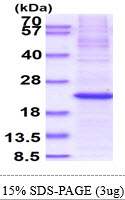

Human MafK protein (Recombinant) (His-Tag) (STJP018038)
SPECIFICATIONS
HostE.coli
ImmunogenHuman
General Information
| Short Description | Recombinant-Human MafK-His-Tag protein was developed from e.coli and has a target region of His-Tag. For use in research applications. |
| Applications | SDS-PAGE/Denatured |
| Host | E.coli |
| Note | STRICTLY FOR FURTHER SCIENTIFIC RESEARCH USE ONLY (RUO). MUST NOT TO BE USED IN DIAGNOSTIC OR THERAPEUTIC APPLICATIONS. |
Product Properties
| Concentration | 0.5 mg/mL |
| Formulation | Liquid in 20mM Tris-HCl buffer (pH 8.0) containing 0.4M urea, 10% Glycerol |
| Storage Instruction | For short term storage, keep at +2C to +8C for up to 1 week. For long term storage, aliquot and store at-20C, and avoid repeat freeze-thaw cycles. |
Target Information
| Gene Symbol | MAFK |
| Gene ID | 7975 |
| Uniprot ID | MAFK_HUMAN |
| Accession Number | NP_002351 |
| Immunogen | Human |
| Immunogen Region | 1-156aa |
| Immunogen Sequence | MGSSHHHHHH SSGLVPRGSH MTTNPKPNKA LKVKKEAGEN APVLSDDELV SMSVRELNQH LRGLTKEEVT RLKQRRRTLK NRGYAASCRI KRVTQKEELE RQRVELQQEV EKLARENSSM RLELDALRSK YEALQTFART VARGPVAPSK VATTSVITIV KSTELSSTSV PFSAAS |
Additional Info
| Function | Since they lack a putative transactivation domain, the small Mafs behave as transcriptional repressors when they dimerize among themselves. However, they act as transcriptional activators by dimerizing with other (usually larger) basic-zipper proteins, such as NFE2, NFE2L1/NRF1, NFE2L2/NRF2 and NFE2L3/NRF3, and recruiting them to specific DNA-binding sites. Small Maf proteins heterodimerize with Fos and may act as competitive repressors of the NF-E2 transcription factor. |
| Protein Name | Transcription Factor MafkErythroid Transcription Factor Nf-E2 P18 Subunit |
| Database Links | Reactome: R-HSA-9707587Reactome: R-HSA-9707616Reactome: R-HSA-9708530Reactome: R-HSA-9759194Reactome: R-HSA-9818026Reactome: R-HSA-9818027Reactome: R-HSA-9818030Reactome: R-HSA-9818032Reactome: R-HSA-9818035Reactome: R-HSA-9818749Reactome: R-HSA-983231 |
| Cellular Localisation | Nucleus |
| Alternative Protein Names | Transcription Factor Mafk proteinErythroid Transcription Factor Nf-E2 P18 Subunit proteinMAFK protein |
Information sourced from Uniprot.org