

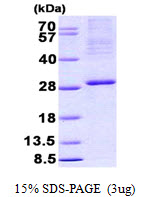

Human ITGB3BP protein (Recombinant) (His-Tag) (STJP018165)
SPECIFICATIONS
HostE.coli
ImmunogenHuman
General Information
| Short Description | Recombinant-Human ITGB3BP-His-Tag protein was developed from e.coli and has a target region of His-Tag. For use in research applications. |
| Applications | SDS-PAGE/Denatured |
| Host | E.coli |
| Note | STRICTLY FOR FURTHER SCIENTIFIC RESEARCH USE ONLY (RUO). MUST NOT TO BE USED IN DIAGNOSTIC OR THERAPEUTIC APPLICATIONS. |
Product Properties
| Concentration | 0.5 mg/mL |
| Formulation | Liquid in 20mM Tris-HCl buffer (pH 8.0) containing 0.4M urea, 10% Glycerol |
| Storage Instruction | For short term storage, keep at +2C to +8C for up to 1 week. For long term storage, aliquot and store at-20C, and avoid repeat freeze-thaw cycles. |
Target Information
| Gene Symbol | ITGB3BP |
| Gene ID | 23421 |
| Uniprot ID | CENPR_HUMAN |
| Accession Number | NP_001193668 |
| Immunogen | Human |
| Immunogen Region | 1-216aa |
| Immunogen Sequence | MGSSHHHHHH SSGLVPRGSH MGSMPFAPVA QARVQWHDFR SLQHLLPAFK RFSCLSLGSS WDYSVKRSLK LDGLLEENSF DPSKITRKKS VITYSPTTGT CQMSLFASPT SSEEQKHRNG LSNEKRKKLN HPSLTESKES TTKDNDEFMM LLSKVEKLSE EIMEIMQNLS SIQALEGSRE LENLIGISCA SHFLKREMQK TKELMTKVNK QKLFEKSTGL PHKASRHL |
Additional Info
| Tissue Specificity | Widely expressed. Expressed in spleen, thymus, prostate, ovary, small intestine and white blood cells. Highly expressed in testis and colon. Isoform 4 is expressed in platelets, lymphocytes and granulocytes. |
| Function | Transcription coregulator that can have both coactivator and corepressor functions. Isoform 1, but not other isoforms, is involved in the coactivation of nuclear receptors for retinoid X (RXRs) and thyroid hormone (TRs) in a ligand-dependent fashion. In contrast, it does not coactivate nuclear receptors for retinoic acid, vitamin D, progesterone receptor, nor glucocorticoid. Acts as a coactivator for estrogen receptor alpha. Acts as a transcriptional corepressor via its interaction with the NFKB1 NF-kappa-B subunit, possibly by interfering with the transactivation domain of NFKB1. Induces apoptosis in breast cancer cells, but not in other cancer cells, via a caspase-2 mediated pathway that involves mitochondrial membrane permeabilization but does not require other caspases. May also act as an inhibitor of cyclin A-associated kinase. Also acts a component of the CENPA-CAD (nucleosome distal) complex, a complex recruited to centromeres which is involved in assembly of kinetochore proteins, mitotic progression and chromosome segregation. May be involved in incorporation of newly synthesized CENPA into centromeres via its interaction with the CENPA-NAC complex. |
| Protein Name | Centromere Protein RCenp-RBeta-3-EndonexinIntegrin Beta-3-Binding ProteinNuclear Receptor-Interacting Factor 3 |
| Database Links | Reactome: R-HSA-141444Reactome: R-HSA-205043Reactome: R-HSA-2467813Reactome: R-HSA-2500257Reactome: R-HSA-5663220Reactome: R-HSA-606279Reactome: R-HSA-68877Reactome: R-HSA-9648025 |
| Cellular Localisation | Isoform 1: NucleusChromosomeCentromereKinetochoreIsoform 2: NucleusIsoform 3: NucleusCytoplasmIsoform 3 Is Predominantly Nuclear And Weakly CytoplasmicIsoform 4: Cytoplasm |
| Alternative Protein Names | Centromere Protein R proteinCenp-R proteinBeta-3-Endonexin proteinIntegrin Beta-3-Binding Protein proteinNuclear Receptor-Interacting Factor 3 proteinITGB3BP proteinCENPR proteinNRIF3 protein |
Information sourced from Uniprot.org