
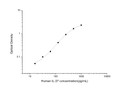


Human IL37 (Interleukin-37) Sandwich ELISA Kit (STJE0003787)
SPECIFICATIONS
General Information
| Short Description | This IL37 Sandwich ELISA is an in-vitro enzyme-linked immunosorbent assay for the measurement of samples in human serum, plasma and other biological fluids. |
| Applications | ELISA |
| Reactivity | Human |
| Sensitivity | 9.38pg/mL |
| Detection Limit | 15.63~1000pg/mL |
| Note | FOR SCIENTIFIC EDUCATIONAL RESEARCH USE ONLY (RUO). MUST NOT BE USED IN DIAGNOSTIC OR OTHER MEDICAL APPLICATIONS. |
Product Properties
| Storage Instruction | If unopened the kit may be stored at 2-8°C for up to 1 month. If the kit will not be used within 1 month, store the components separately, according to the component table in the manual. |
| Assay Time | 3.5h |
| Detection | Colormetric |
Target Information
| Gene Symbol | IL37 |
| Gene ID | 27178 |
| Uniprot ID | IL37_HUMAN |
| Specificity | This kit recognizes Human IL-37 in samples. No significant cross-reactivity or interference between Human IL-37 and analogues was observed. |
| Sample Type | Serum, plasma and other biological fluids |
Additional Info
| Post Translational Modifications | Proteolytically converted to the mature form by CASP1. |
| Function | Immune regulatory cytokine that acts as a suppressor of innate inflammatory and immune responses involved in curbing excessive inflammation. Signaling can occur via two mechanisms, intracellularly through nuclear translocation with SMAD3 and extracellularly after secretion and binding to its receptor composed of IL18R1 and IL18RAP. Suppresses, or reduces, pro-inflammatory cytokine production, including IL1A and IL6, as well as CCL12, CSF1, CSF2, CXCL13, IL1B, IL23A and IL1RN, but spares anti-inflammatory cytokines. Inhibits dendritic cell activation. |
| Protein Name | Interleukin-37Il-37Fil1 ZetaIl-1xInterleukin-1 Family Member 7Il-1f7Interleukin-1 Homolog 4Il-1hIl-1h4Interleukin-1 ZetaIl-1 ZetaInterleukin-1-Related ProteinIl-1rp1 |
| Database Links | Reactome: R-HSA-9008059Reactome: R-HSA-9012546 |
| Cellular Localisation | CytoplasmCytosolNucleusSecretedStimulation With Il1b Leads To Colocalization With Smad3 Mostly In Perinuclear RegionsOnly The Casp1-Cleaved Mature Form Translocates Into The Nucleus Upon Lps StimulationThe Secretion Is Dependent On Protein Unfolding And Facilitated By The Cargo Receptor Tmed10It Results In Protein Translocation From The Cytoplasm Into The Ergic (Endoplasmic Reticulum-Golgi Intermediate Compartment) Followed By Vesicle Entry And Secretion |
| Alternative ELISA Names | Interleukin-37 ELISA kitIl-37 ELISA kitFil1 Zeta ELISA kitIl-1x ELISA kitInterleukin-1 Family Member 7 ELISA kitIl-1f7 ELISA kitInterleukin-1 Homolog 4 ELISA kitIl-1h ELISA kitIl-1h4 ELISA kitInterleukin-1 Zeta ELISA kitIl-1 Zeta ELISA kitInterleukin-1-Related Protein ELISA kitIl-1rp1 ELISA kitIL37 ELISA kitFIL1Z ELISA kitIL1F7 ELISA kitIL1H4 ELISA kitIL1RP1 ELISA kit |
| Specificity | This kit recognizes Human IL-37 in samples. No significant cross-reactivity or interference between Human IL-37 and analogues was observed. |
| Reproducibility | Both intra-CV and inter-CV are |
Information sourced from Uniprot.org
| Item | Specifications | Storage |
|---|---|---|
| Micro ELISA Plate (Dismountable) | 96T: 8 wells ×12 strips strips | -20℃, 6 months |
| Reference Standard | 96T: 2 vials 48T: 1 vial | -20℃, 6 months |
| Concentrated Biotinylated Detection Ab (100×) | 96T: 1 vial, 120 μL 60 μL | -20℃, 6 months |
| Concentrated HRP Conjugate (100×) | 96T: 1 vial, 120 μL 60 μL | -20℃ (Protect from light), 6 months |
| Reference Standard & Sample Diluent | 1 vial, 20 mL | 2-8°C, 6 months |
| Biotinylated Detection Ab Diluent | 1 vial, 14 mL | 2-8°C, 6 months |
| HRP Conjugate Diluent | 1 vial, 14 mL | 2-8°C, 6 months |
| Concentrated Wash Buffer (25×) | 1 vial, 30 mL | 2-8°C, 6 months |
| Substrate Reagent | 1 vial, 10 mL | 2-8℃ (Protect from light) |
| Stop Solution | 1 vial, 10 mL | 2-8°C |
| Plate Sealer | 5 pieces | |
| Manual | 1 copy | |
| Certificate of Analysis | 1 copy |
| Sample Type | Range (%) | Average Recovery (%) |
|---|---|---|
| Serum(n=8) | 93-106 | 99 |
| EDTA plasma (n=8) | 96-108 | 102 |
| Cell culture media (n=8) | 85-98 | 92 |
| Intra-assay Precision | Intra-assay Precision | Intra-assay Precision | Inter-assay Precision | Inter-assay Precision | Inter-assay Precision | |
|---|---|---|---|---|---|---|
| Sample | 1.00 | 2.00 | 3.00 | 1.00 | 2.00 | 3.00 |
| n | 20.00 | 20.00 | 20.00 | 20.00 | 20.00 | 20.00 |
| Mean (pg/mL) | 52.90 | 83.90 | 344.58 | 56.16 | 87.97 | 362.59 |
| Standard deviation | 3.18 | 4.04 | 10.75 | 3.32 | 3.66 | 11.13 |
| CV (%) | 6.01 | 4.82 | 3.12 | 5.91 | 4.16 | 3.07 |