

Human GRP75/HSPA9B protein (Recombinant) (His-Tag) (STJP019666)
SPECIFICATIONS
HostE.coli
ImmunogenHuman
General Information
| Short Description | Recombinant-Human GRP75/HSPA9B-His-Tag protein was developed from e.coli and has a target region of His-Tag. For use in research applications. |
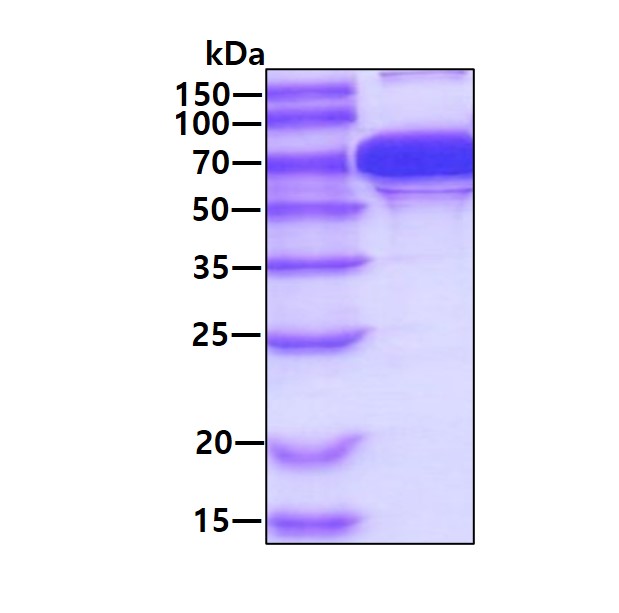
| Applications | SDS-PAGE |
| Host | E.coli |
| Note | STRICTLY FOR FURTHER SCIENTIFIC RESEARCH USE ONLY (RUO). MUST NOT TO BE USED IN DIAGNOSTIC OR THERAPEUTIC APPLICATIONS. |
Product Properties
| Concentration | 1 mg/mL |
| Formulation | Liquid in 20mM Tris-HCl buffer (pH 8.0) containing 0.5mM DTT, 10% Glycerol |
| Storage Instruction | For short term storage, keep at +2C to +8C for up to 1 week. For long term storage, aliquot and store at-20C, and avoid repeat freeze-thaw cycles. |
Target Information
| Gene Symbol | HSPA9 |
| Gene ID | 3313 |
| Uniprot ID | HSPA9_HUMAN |
| Accession Number | NP_004125.3 |
| Immunogen | Human |
| Immunogen Region | 47-679aa |
| Immunogen Sequence |
Additional Info
| Function | Mitochondrial chaperone that plays a key role in mitochondrial protein import, folding, and assembly. Plays an essential role in the protein quality control system, the correct folding of proteins, the re-folding of misfolded proteins, and the targeting of proteins for subsequent degradation. These processes are achieved through cycles of ATP binding, ATP hydrolysis, and ADP release, mediated by co-chaperones. In mitochondria, it associates with the TIM (translocase of the inner membrane) protein complex to assist in the import and folding of mitochondrial proteins. Plays an important role in mitochondrial iron-sulfur cluster (ISC) biogenesis, interacts with and stabilizes ISC cluster assembly proteins FXN, NFU1, NFS1 and ISCU. Regulates erythropoiesis via stabilization of ISC assembly. Regulates mitochondrial calcium-dependent apoptosis by coupling two calcium channels, ITPR1 and VDAC1, at the mitochondria-associated endoplasmic reticulum (ER) membrane to facilitate calcium transport from the ER lumen to the mitochondria intermembrane space, providing calcium for the downstream calcium channel MCU, which releases it into the mitochondrial matrix. Although primarily located in the mitochondria, it is also found in other cellular compartments. In the cytosol, it associates with proteins involved in signaling, apoptosis, or senescence. It may play a role in cell cycle regulation via its interaction with and promotion of degradation of TP53. May play a role in the control of cell proliferation and cellular aging. Protects against reactive oxygen species (ROS). Extracellular HSPA9 plays a cytoprotective role by preventing cell lysis following immune attack by the membrane attack complex by disrupting formation of the complex. |
| Protein Name | Stress-70 Protein - Mitochondrial75 Kda Glucose-Regulated ProteinGrp-75Heat Shock 70 Kda Protein 9Heat Shock Protein Family A Member 9MortalinMotPeptide-Binding Protein 74Pbp74 |
| Database Links | Reactome: R-HSA-1268020Reactome: R-HSA-3371453Reactome: R-HSA-6799198Reactome: R-HSA-8949613Reactome: R-HSA-8950505Reactome: R-HSA-9837999Reactome: R-HSA-9841251Reactome: R-HSA-9865881 |
| Cellular Localisation | MitochondrionNucleusNucleolusCytoplasmMitochondrion MatrixFound In A Complex With Hspa9 And Vdac1 At The Endoplasmic Reticulum-Mitochondria Contact Sites |
| Alternative Protein Names | Stress-70 Protein - Mitochondrial protein75 Kda Glucose-Regulated Protein proteinGrp-75 proteinHeat Shock 70 Kda Protein 9 proteinHeat Shock Protein Family A Member 9 proteinMortalin proteinMot proteinPeptide-Binding Protein 74 proteinPbp74 proteinHSPA9 proteinGRP75 proteinHSPA9B proteinmt-HSP70 protein |
Information sourced from Uniprot.org