

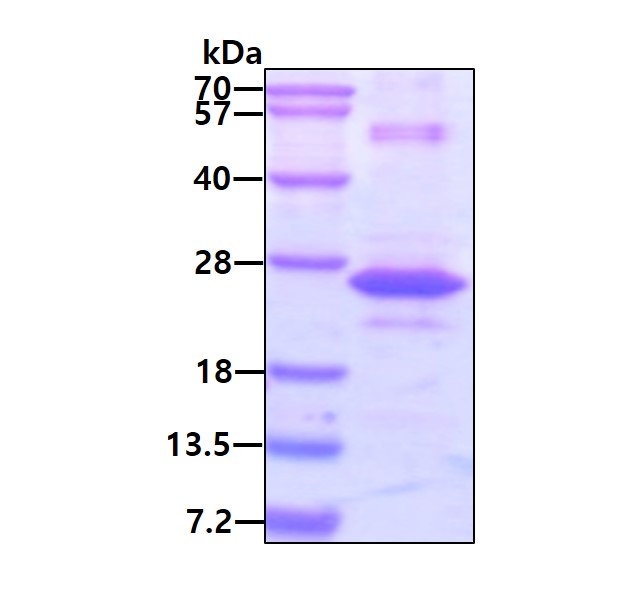

Human Gremlin protein (Recombinant) (His-Tag) (STJP018068)
SPECIFICATIONS
HostE.coli
ImmunogenHuman
General Information
| Short Description | Recombinant-Human Gremlin-His-Tag protein was developed from e.coli and has a target region of His-Tag. For use in research applications. |
| Applications | SDS-PAGE/Denatured |
| Host | E.coli |
| Note | STRICTLY FOR FURTHER SCIENTIFIC RESEARCH USE ONLY (RUO). MUST NOT TO BE USED IN DIAGNOSTIC OR THERAPEUTIC APPLICATIONS. |
Product Properties
| Concentration | 0.5 mg/mL |
| Formulation | Liquid in 20mM Tris-HCl buffer (pH 8.0) containing 0.4M urea, 10% Glycerol |
| Storage Instruction | For short term storage, keep at +2C to +8C for up to 1 week. For long term storage, aliquot and store at-20C, and avoid repeat freeze-thaw cycles. |
Target Information
| Gene Symbol | GREM1 |
| Gene ID | 26585 |
| Uniprot ID | GREM1_HUMAN |
| Accession Number | NP_037504.1 |
| Immunogen | Human |
| Immunogen Region | 25-184aa |
| Immunogen Sequence |
Additional Info
| Tissue Specificity | Highly expressed in small intestine, fetal brain and colon. Expression is restricted to intestinal subepithelial myofibroblasts (ISEMFs) at the crypt base. In subjects with HMPS1, by contrast, GREM1 is expressed, not only in basal ISEMFs, but also at very high levels in epithelial cells (predominantly colonocytes), with expression extending most of the way up the sides of the crypt. Weakly expressed in brain, ovary, prostate, pancreas and skeletal muscle. In brain found in the region localized around the internal capsule in the large subcortical nuclei, including caudate, putamen, substantia nigra, thalamus and subthalamus. Predominantly expressed in normal cells including neurons, astrocytes and fibroblasts. |
| Function | Cytokine that may play an important role during carcinogenesis and metanephric kidney organogenesis, as a BMP antagonist required for early limb outgrowth and patterning in maintaining the FGF4-SHH feedback loop. Down-regulates the BMP4 signaling in a dose-dependent manner. Antagonist of BMP2.inhibits BMP2-mediated differentiation of osteoblasts (in vitro). Acts as inhibitor of monocyte chemotaxis. Can inhibit the growth or viability of normal cells but not transformed cells when is overexpressed. |
| Protein Name | Gremlin-1Cell Proliferation-Inducing Gene 2 ProteinCysteine Knot Superfamily 1 - Bmp Antagonist 1Dan Domain Family Member 2Down-Regulated In Mos-Transformed Cells ProteinIncreased In High Glucose Protein 2Ihg-2 |
| Database Links | Reactome: R-HSA-9830674 |
| Cellular Localisation | Secreted |
| Alternative Protein Names | Gremlin-1 proteinCell Proliferation-Inducing Gene 2 Protein proteinCysteine Knot Superfamily 1 - Bmp Antagonist 1 proteinDan Domain Family Member 2 proteinDown-Regulated In Mos-Transformed Cells Protein proteinIncreased In High Glucose Protein 2 proteinIhg-2 proteinGREM1 proteinCKTSF1B1 proteinDAND2 proteinDRM proteinPIG2 protein |
Information sourced from Uniprot.org