



Human CTLA-4/CD152 protein (Recombinant) (C-His) (STJP002690)
SPECIFICATIONS
HostHEK293 cells
ConjugationUnconjugated
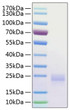
ImmunogenRecombinant Human CTLA-4/CD152 Protein is produced by HEK293 cells expression system. The target protein is expressed with sequence (Ala37-Phe162) of human CTLA-4 (Accession #NP_005205.2) fused with a 6×His tag at the C-terminus.
General Information
| Short Description | Recombinant-Human CTLA-4/CD152-C-His protein was developed in hek293 cells using the region Ala37-Phe162. For use in research applications. |
| Host | HEK293 cells |
| Note | STRICTLY FOR FURTHER SCIENTIFIC RESEARCH USE ONLY (RUO). MUST NOT TO BE USED IN DIAGNOSTIC OR THERAPEUTIC APPLICATIONS. |
Product Properties
| Conjugation | Unconjugated |
| Formulation | Lyophilised from a 0.22 Mu m filtered solution of PBS, pH 7.4. |
| Storage Instruction | Store at-20°C for up to 1 year from the date of receipt, and avoid repeat freeze-thaw cycles. |
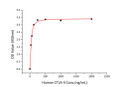
| Immunoreactivity | Measured by its binding ability in a functional ELISA. Immobilized lpilimumab at 1 Mu g/mL (100 Mu L/well) can bind Recombinant Human CTLA-4 with a linear range of 6-18 ng/mL.|2.Measured by its binding ability in a functional ELISA.Immobilized PE ant |
| Determination Method | < 1.0 EU/Mu g of the protein by LAL method. |
Target Information
| Gene Symbol | CTLA4 |
| Gene ID | 1493 |
| Uniprot ID | CTLA4_HUMAN |
| Immunogen | Recombinant Human CTLA-4/CD152 Protein is produced by HEK293 cells expression system. The target protein is expressed with sequence (Ala37-Phe162) of human CTLA-4 (Accession #NP_005205.2) fused with a 6×His tag at the C-terminus. |
| Immunogen Region | Ala37-Phe162 |
| Immunogen Sequence | AMHVAQPAVVLASSRGIASF VCEYASPGKATEVRVTVLRQ ADSQVTEVCAATYMMGNELT FLDDSICTGTSSGNQVNLTI QGLRAMDTGLYICKVELMYP PPYYLGIGNGTQIYVIDPEP CPDSDF |
Additional Info
| Post Translational Modifications | N-glycosylation is important for dimerization. Phosphorylation at Tyr-201 prevents binding to the AP-2 adapter complex, blocks endocytosis, and leads to retention of CTLA4 on the cell surface. |
| Function | Inhibitory receptor acting as a major negative regulator of T-cell responses. The affinity of CTLA4 for its natural B7 family ligands, CD80 and CD86, is considerably stronger than the affinity of their cognate stimulatory coreceptor CD28. |
| Protein Name | Cytotoxic T-Lymphocyte Protein 4Cytotoxic T-Lymphocyte-Associated Antigen 4Ctla-4Cd Antigen Cd152 |
| Database Links | Reactome: R-HSA-389356Reactome: R-HSA-389513Reactome: R-HSA-8877330 |
| Cellular Localisation | Cell MembraneSingle-Pass Type I Membrane ProteinExists Primarily An Intracellular Antigen Whose Surface Expression Is Tightly Regulated By Restricted Trafficking To The Cell Surface And Rapid Internalization |
| Alternative Protein Names | Cytotoxic T-Lymphocyte Protein 4 proteinCytotoxic T-Lymphocyte-Associated Antigen 4 proteinCtla-4 proteinCd Antigen Cd152 proteinCTLA4 proteinCD152 protein |
Information sourced from Uniprot.org