

Human CD8 beta protein (Recombinant) (His-Tag) (STJP018620)
SPECIFICATIONS
HostE.coli
ImmunogenHuman
General Information
| Short Description | Recombinant-Human CD8 beta-His-Tag protein was developed from e.coli and has a target region of His-Tag. For use in research applications. |
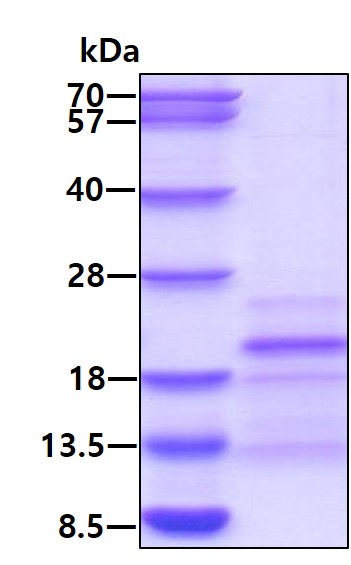
| Applications | SDS-PAGE/Denatured |
| Host | E.coli |
| Note | STRICTLY FOR FURTHER SCIENTIFIC RESEARCH USE ONLY (RUO). MUST NOT TO BE USED IN DIAGNOSTIC OR THERAPEUTIC APPLICATIONS. |
Product Properties
| Concentration | 0.5 mg/mL |
| Formulation | Liquid in 20mM Tris-HCl buffer (pH 8.0) containing, 0.4M Urea, 10% Glycerol |
| Storage Instruction | For short term storage, keep at +2C to +8C for up to 1 week. For long term storage, aliquot and store at-20C, and avoid repeat freeze-thaw cycles. |
Target Information
| Gene Symbol | CD8B |
| Gene ID | 926 |
| Uniprot ID | CD8B_HUMAN |
| Accession Number | NP_004922 |
| Immunogen | Human |
| Immunogen Region | 22-170aa |
| Immunogen Sequence |
Additional Info
| Tissue Specificity | Isoform 1, isoform 3, isoform 5, isoform 6, isoform 7 and isoform 8 are expressed in both thymus and peripheral CD8+ T-cells. Expression of isoform 1 is higher in thymus CD8+ T-cells than in peripheral CD8+ T-cells. Expression of isoform 6 is higher in peripheral CD8+ T-cells than in thymus CD8+ T-cells. |
| Post Translational Modifications | Phosphorylated as a consequence of T-cell activation. Palmitoylated at the cytoplasmic tail and thereby targets the heterodimer CD8A/CD8B to lipid rafts unlike CD8A homodimers. |
| Function | Integral membrane glycoprotein that plays an essential role in the immune response and serves multiple functions in responses against both external and internal offenses. In T-cells, functions primarily as a coreceptor for MHC class I molecule:peptide complex. The antigens presented by class I peptides are derived from cytosolic proteins while class II derived from extracellular proteins. Interacts simultaneously with the T-cell receptor (TCR) and the MHC class I proteins presented by antigen presenting cells (APCs). In turn, recruits the Src kinase LCK to the vicinity of the TCR-CD3 complex. A palmitoylation site in the cytoplasmic tail of CD8B chain contributes to partitioning of CD8 into the plasma membrane lipid rafts where signaling proteins are enriched. Once LCK recruited, it initiates different intracellular signaling pathways by phosphorylating various substrates ultimately leading to lymphokine production, motility, adhesion and activation of cytotoxic T-lymphocytes (CTLs). Additionally, plays a critical role in thymic selection of CD8+ T-cells. |
| Protein Name | T-Cell Surface Glycoprotein Cd8 Beta ChainCd Antigen Cd8b |
| Database Links | Reactome: R-HSA-182218Reactome: R-HSA-198933 |
| Cellular Localisation | Isoform 1: Cell MembraneSingle-Pass Type I Membrane ProteinRequires The Partner Cd8a For Efficient Cell Surface ExpressionThe Heterodimer Cd8a/Cd8b Localizes To Lipid Rafts Due To Cd8b Cytoplasmic Tail PalmitoylationIsoform 2: Cell MembraneIsoform 3: SecretedIsoform 4: Cell MembraneIsoform 5: Cell MembraneIsoform 6: SecretedIsoform 7: SecretedIsoform 8: Secreted |
| Alternative Protein Names | T-Cell Surface Glycoprotein Cd8 Beta Chain proteinCd Antigen Cd8b proteinCD8B proteinCD8B1 protein |
Information sourced from Uniprot.org