

Human CCL22/MDC protein (Recombinant) (His-Tag) (STJP016539)
SPECIFICATIONS
HostE.coli
ImmunogenHuman
General Information
| Short Description | Recombinant-Human CCL22/MDC-His-Tag protein was developed from e.coli and has a target region of His-Tag. For use in research applications. |
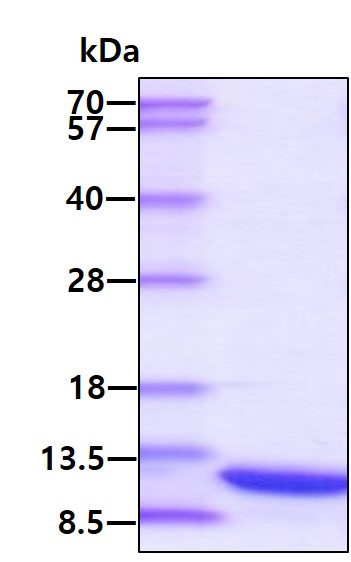
| Applications | SDS-PAGE |
| Host | E.coli |
| Note | STRICTLY FOR FURTHER SCIENTIFIC RESEARCH USE ONLY (RUO). MUST NOT TO BE USED IN DIAGNOSTIC OR THERAPEUTIC APPLICATIONS. |
Product Properties
| Concentration | 0.5 mg/mL |
| Formulation | Liquid in phosphate-Buffered Saline (pH 7.4) containing 10% Glycerol |
| Storage Instruction | For short term storage, keep at +2C to +8C for up to 1 week. For long term storage, aliquot and store at-20C, and avoid repeat freeze-thaw cycles. |
| Endotoxin | < 1 EU per 1ug of protein (determined by LAL method) |
Target Information
| Gene Symbol | CCL22 |
| Gene ID | 6367 |
| Uniprot ID | CCL22_HUMAN |
| Accession Number | NP_002981 |
| Immunogen | Human |
| Immunogen Region | 25-93aa |
| Immunogen Sequence | MGSSHHHHHH SSGLVPRGSH MGPYGANMED SVCCRDYVRY RLPLRVVKHF YWTSDSCPRP GVVLLTFRDK EICADPRVPW VKMILNKLSQ |
Additional Info
| Tissue Specificity | Highly expressed in macrophage and in monocyte-derived dendritic cells, and thymus. Also found in lymph node, appendix, activated monocytes, resting and activated macrophages. Lower expression in lung and spleen. Very weak expression in small intestine. In lymph node expressed in a mature subset of Langerhans' cells (CD1a+ and CD83+). Expressed in Langerhans' cell histiocytosis but not in dermatopathic lymphadenopathy. Expressed in atopic dermatitis, allergic contact dermatitis skin, and psoriasis, in both the epidermis and dermis. |
| Post Translational Modifications | The N-terminal processed forms MDC(3-69), MDC(5-69) and MDC(7-69) are produced by proteolytic cleavage after secretion from monocyte derived dendrocytes. |
| Function | May play a role in the trafficking of activated/effector T-lymphocytes to inflammatory sites and other aspects of activated T-lymphocyte physiology. Chemotactic for monocytes, dendritic cells and natural killer cells. Mild chemoattractant for primary activated T-lymphocytes and a potent chemoattractant for chronically activated T-lymphocytes but has no chemoattractant activity for neutrophils, eosinophils, and resting T-lymphocytes. Binds to CCR4. Processed forms MDC(3-69), MDC(5-69) and MDC(7-69) seem not be active. |
| Protein Name | C-C Motif Chemokine 22Cc Chemokine Stcp-1Mdc(1-69Macrophage-Derived ChemokineSmall-Inducible Cytokine A22Stimulated T-Cell Chemotactic Protein 1 Cleaved Into - Mdc(3-69 - Mdc(5-69 - Mdc(7-69 |
| Database Links | Reactome: R-HSA-380108Reactome: R-HSA-6783783Reactome: R-HSA-6785807 |
| Cellular Localisation | Secreted |
| Alternative Protein Names | C-C Motif Chemokine 22 proteinCc Chemokine Stcp-1 proteinMdc(1-69 proteinMacrophage-Derived Chemokine proteinSmall-Inducible Cytokine A22 proteinStimulated T-Cell Chemotactic Protein 1 Cleaved Into - Mdc(3-69 - Mdc(5-69 - Mdc(7-69 proteinCCL22 proteinMDC proteinSCYA22 proteinA-152E5.1 protein |
Information sourced from Uniprot.org