
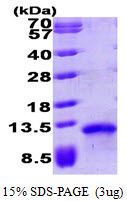

Human CCL17/TARC protein (Recombinant) (His-Tag) (STJP016509)
SPECIFICATIONS
HostE.coli
ImmunogenHuman
General Information
| Short Description | Recombinant-Human CCL17/TARC-His-Tag protein was developed from e.coli and has a target region of His-Tag. For use in research applications. |
| Applications | SDS-PAGE |
| Host | E.coli |
| Note | STRICTLY FOR FURTHER SCIENTIFIC RESEARCH USE ONLY (RUO). MUST NOT TO BE USED IN DIAGNOSTIC OR THERAPEUTIC APPLICATIONS. |
Product Properties
| Concentration | 0.5 mg/mL |
| Formulation | Liquid in phosphate-Buffered Saline (pH 7.4) containing 10% Glycerol |
| Storage Instruction | For short term storage, keep at +2C to +8C for up to 1 week. For long term storage, aliquot and store at-20C, and avoid repeat freeze-thaw cycles. |
| Endotoxin | < 1 EU per 1ug of protein (determined by LAL method) |
Target Information
| Gene Symbol | CCL17 |
| Gene ID | 6361 |
| Uniprot ID | CCL17_HUMAN |
| Accession Number | NP_002978 |
| Immunogen | Human |
| Immunogen Region | 24-94aa |
| Immunogen Sequence | MGSSHHHHHH SSGLVPRGSH MARGTNVGRE CCLEYFKGAI PLRKLKTWYQ TSEDCSRDAI VFVTVQGRAI CSDPNNKRVK NAVKYLQSLE RS |
Additional Info
| Tissue Specificity | Constitutively expressed in thymus. Detected at lower levels in the lung, colon and small intestine. Expressed in stimulated peripheral blood mononuclear cells, but not in resting cells. |
| Function | Chemokine, which displays chemotactic activity for T lymphocytes, preferentially Th2 cells, but not monocytes or granulocytes. Therefore plays an important role in a wide range of inflammatory and immunological processes. Acts by binding to CCR4 at T-cell surface. Mediates GM-CSF/CSF2-driven pain and inflammation. In the brain, required to maintain the typical, highly branched morphology of hippocampal microglia under homeostatic conditions. May be important for the appropriate adaptation of microglial morphology and synaptic plasticity to acute lipopolysaccharide (LPS)-induced neuroinflammation. Plays a role in wound healing, mainly by inducing fibroblast migration into the wound. |
| Protein Name | C-C Motif Chemokine 17Cc Chemokine TarcSmall-Inducible Cytokine A17Thymus And Activation-Regulated Chemokine |
| Database Links | Reactome: R-HSA-380108 |
| Cellular Localisation | Secreted |
| Alternative Protein Names | C-C Motif Chemokine 17 proteinCc Chemokine Tarc proteinSmall-Inducible Cytokine A17 proteinThymus And Activation-Regulated Chemokine proteinCCL17 proteinSCYA17 proteinTARC protein |
Information sourced from Uniprot.org