

Human BIGH3/TGFBI protein (Recombinant) (No-Tag) (STJP019573)
SPECIFICATIONS
HostE.coli
ImmunogenHuman
General Information
| Short Description | Recombinant-Human BIGH3/TGFBI-No-Tag protein was developed from e.coli and has a target region of No-Tag. For use in research applications. |
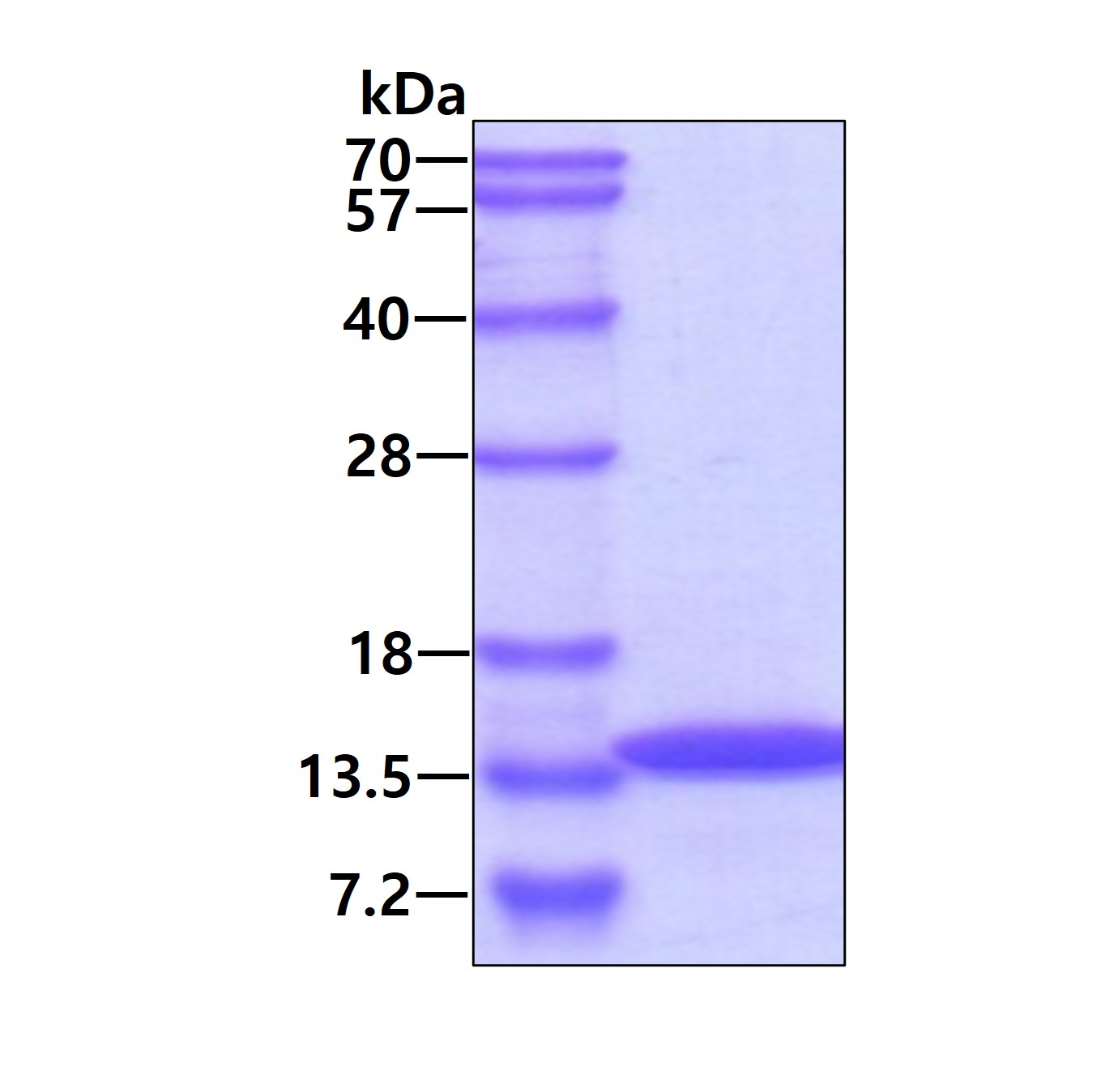
| Applications | SDS-PAGE |
| Host | E.coli |
| Note | STRICTLY FOR FURTHER SCIENTIFIC RESEARCH USE ONLY (RUO). MUST NOT TO BE USED IN DIAGNOSTIC OR THERAPEUTIC APPLICATIONS. |
Product Properties
| Concentration | 1 mg/mL |
| Formulation | Liquid in 20mM Tris-HCl buffer (pH 8.0) |
| Storage Instruction | For short term storage, keep at +2C to +8C for up to 1 week. For long term storage, aliquot and store at-20C, and avoid repeat freeze-thaw cycles. |
Target Information
| Gene Symbol | TGFBI |
| Gene ID | 7045 |
| Uniprot ID | BGH3_HUMAN |
| Accession Number | NP_000349.1 |
| Immunogen | Human |
| Immunogen Region | 502-636aa |
| Immunogen Sequence | MGTVMDVLKG DNRFSMLVAA IQSAGLTETL NREGVYTVFA PTNEAFRALP PRERSRLLGD AKELANILKY HIGDEILVSG GIGALVRLKS LQGDKLEVSL KNNVVSVNKE PVAEPDIMAT NGVVHVITNV LQPPA |
Additional Info
| Tissue Specificity | Highly expressed in the corneal epithelium. Expressed in heart, placenta, lung, liver, skeletal muscle, kidney and pancreas. |
| Post Translational Modifications | Gamma-carboxylation is controversial. Gamma-carboxyglutamated.gamma-carboxyglutamate residues are formed by vitamin K dependent carboxylation.these residues may be required for binding to calcium. According to a more recent report, does not contain vitamin K-dependent gamma-carboxyglutamate residues. The EMI domain contains 2 expected intradomain disulfide bridges (Cys-49-Cys85 and Cys-84-Cys-97) and one unusual interdomain disulfide bridge to the second FAS1 domain (Cys-74-Cys-339). This arrangement violates the predicted disulfide bridge pattern of an EMI domain. |
| Function | Plays a role in cell adhesion. May play a role in cell-collagen interactions. |
| Protein Name | Transforming Growth Factor-Beta-Induced Protein Ig-H3Beta Ig-H3Kerato-EpithelinRgd-Containing Collagen-Associated ProteinRgd-Cap |
| Database Links | Reactome: R-HSA-977225 |
| Cellular Localisation | SecretedExtracellular SpaceExtracellular MatrixMay Be Associated Both With Microfibrils And With The Cell Surface |
| Alternative Protein Names | Transforming Growth Factor-Beta-Induced Protein Ig-H3 proteinBeta Ig-H3 proteinKerato-Epithelin proteinRgd-Containing Collagen-Associated Protein proteinRgd-Cap proteinTGFBI proteinBIGH3 protein |
Information sourced from Uniprot.org