

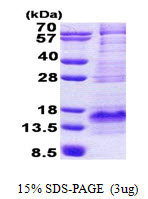

Human BEX1 protein (Recombinant) (His-Tag) (STJP018284)
SPECIFICATIONS
HostE.coli
ImmunogenHuman
General Information
| Short Description | Recombinant-Human BEX1-His-Tag protein was developed from e.coli and has a target region of His-Tag. For use in research applications. |
| Applications | SDS-PAGE |
| Host | E.coli |
| Note | STRICTLY FOR FURTHER SCIENTIFIC RESEARCH USE ONLY (RUO). MUST NOT TO BE USED IN DIAGNOSTIC OR THERAPEUTIC APPLICATIONS. |
Product Properties
| Concentration | 0.25 mg/mL |
| Formulation | Liquid in 20mM Tris-HCl buffer (pH 8.0) containing 0.15M NaCl, 30% Glycerol |
| Storage Instruction | For short term storage, keep at +2C to +8C for up to 1 week. For long term storage, aliquot and store at-20C, and avoid repeat freeze-thaw cycles. |
Target Information
| Gene Symbol | BEX1 |
| Gene ID | 55859 |
| Uniprot ID | BEX1_HUMAN |
| Accession Number | NP_060946 |
| Immunogen | Human |
| Immunogen Region | 1-125aa |
| Immunogen Sequence | MGSSHHHHHH SSGLVPRGSH MGSMESKEKR AVNSLSMENA NQENEEKEQV ANKGEPLALP LDAGEYCVPR GNRRRFRVRQ PILQYRWDMM HRLGEPQARM REENMERIGE EVRQLMEKLR EKQLSHSLRA VSTDPPHHDH HDEFCLMP |
Additional Info
| Tissue Specificity | Expressed in central nervous system, with high level in pituitary, cerebellum and temporal lobe. Expressed in lung, skeletal muscle, peripheral blood leukocyte, stomach, lymph node, trachea and bone marrow. Highly expressed in acute myeloid leukemia. |
| Post Translational Modifications | Phosphorylated. Phosphorylation of Ser-102 protects it from the proteasome. Ubiquitinated. Degraded by the proteasome. |
| Function | Signaling adapter molecule involved in p75NTR/NGFR signaling. Plays a role in cell cycle progression and neuronal differentiation. Inhibits neuronal differentiation in response to nerve growth factor (NGF). May act as a link between the cell cycle and neurotrophic factor signaling, possibly by functioning as an upstream modulator of receptor signaling, coordinating biological responses to external signals with internal cellular states. In absence of reductive stress, acts as a pseudosubstrate for the CRL2(FEM1B) complex: associates with FEM1B via zinc, thereby preventing association between FEM1B and its substrates. |
| Protein Name | Protein Bex1Brain-Expressed X-Linked Protein 1 |
| Database Links | |
| Cellular Localisation | NucleusCytoplasmShuttles Between The Cytoplasm And The NucleusPredominantly Nuclear |
| Alternative Protein Names | Protein Bex1 proteinBrain-Expressed X-Linked Protein 1 proteinBEX1 protein |
Information sourced from Uniprot.org