

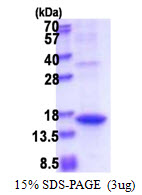

Human Angiogenin protein (Recombinant) (His-Tag) (STJP018703)
SPECIFICATIONS
HostE.coli
ImmunogenHuman
General Information
| Short Description | Recombinant-Human Angiogenin-His-Tag protein was developed from e.coli and has a target region of His-Tag. For use in research applications. |
| Applications | SDS-PAGE/Denatured |
| Host | E.coli |
| Note | STRICTLY FOR FURTHER SCIENTIFIC RESEARCH USE ONLY (RUO). MUST NOT TO BE USED IN DIAGNOSTIC OR THERAPEUTIC APPLICATIONS. |
Product Properties
| Concentration | 0.5 mg/mL |
| Formulation | Liquid in 20mM Tris-HCl buffer (pH 8.0) containing 10% Glycerol 0.4M urea |
| Storage Instruction | For short term storage, keep at +2C to +8C for up to 1 week. For long term storage, aliquot and store at-20C, and avoid repeat freeze-thaw cycles. |
Target Information
| Gene Symbol | ANG |
| Gene ID | 283 |
| Uniprot ID | ANGI_HUMAN |
| Accession Number | NP_001136 |
| Immunogen | Human |
| Immunogen Region | 25-147aa |
| Immunogen Sequence |
Additional Info
| Tissue Specificity | Expressed predominantly in the liver. Also detected in endothelial cells and spinal cord neurons. |
| Function | Secreted ribonuclease that can either promote or restrict cell proliferation of target cells, depending on the context. Endocytosed in target cells via its receptor PLXNB2 and translocates to the cytoplasm or nucleus. Under stress conditions, localizes to the cytoplasm and promotes the assembly of stress granules (SGs): specifically cleaves a subset of tRNAs within anticodon loops to produce tRNA-derived stress-induced fragments (tiRNAs), resulting in translation repression and inhibition of cell proliferation. tiRNas also prevent formation of apoptosome, thereby promoting cell survival. Preferentially cleaves RNAs between a pyrimidine and an adenosine residue, suggesting that it cleaves the anticodon loop of tRNA(Ala) (32-UUAGCAU-38) after positions 33 and 36. Cleaves a subset of tRNAs, including tRNA(Ala), tRNA(Glu), tRNA(Gly), tRNA(Lys), tRNA(Val), tRNA(His), tRNA(Asp) and tRNA(Sec). Under growth conditions and in differentiated cells, translocates to the nucleus and stimulates ribosomal RNA (rRNA) transcription, including that containing the initiation site sequences of 45S rRNA, thereby promoting cell growth and proliferation. Angiogenin induces vascularization of normal and malignant tissues via its ability to promote rRNA transcription. Involved in hematopoietic stem and progenitor cell (HSPC) growth and survival by promoting rRNA transcription in growth conditions and inhibiting translation in response to stress, respectively. Mediates the crosstalk between myeloid and intestinal epithelial cells to protect the intestinal epithelial barrier integrity: secreted by myeloid cells and promotes intestinal epithelial cells proliferation and survival. Also mediates osteoclast-endothelial cell crosstalk in growing bone: produced by osteoclasts and protects the neighboring vascular cells against senescence by promoting rRNA transcription. |
| Protein Name | AngiogeninRibonuclease 5Rnase 5 |
| Database Links | Reactome: R-HSA-418990Reactome: R-HSA-9708296 |
| Cellular Localisation | SecretedNucleusNucleolusCytoplasmStress GranuleThe Secreted Protein Is Rapidly Endocytosed By Target Cells Following Interaction With Plxnb2 Receptor And Translocated To The Cytoplasm And NucleusIn The NucleusAccumulates In The Nucleolus And Binds To Dna |
| Alternative Protein Names | Angiogenin proteinRibonuclease 5 proteinRnase 5 proteinANG proteinRNASE5 protein |
Information sourced from Uniprot.org