

Human ALKBH2 protein (Recombinant) (His-Tag) (STJP017152)
SPECIFICATIONS
HostE.coli
ImmunogenHuman
General Information
| Short Description | Recombinant-Human ALKBH2-His-Tag protein was developed from e.coli and has a target region of His-Tag. For use in research applications. |
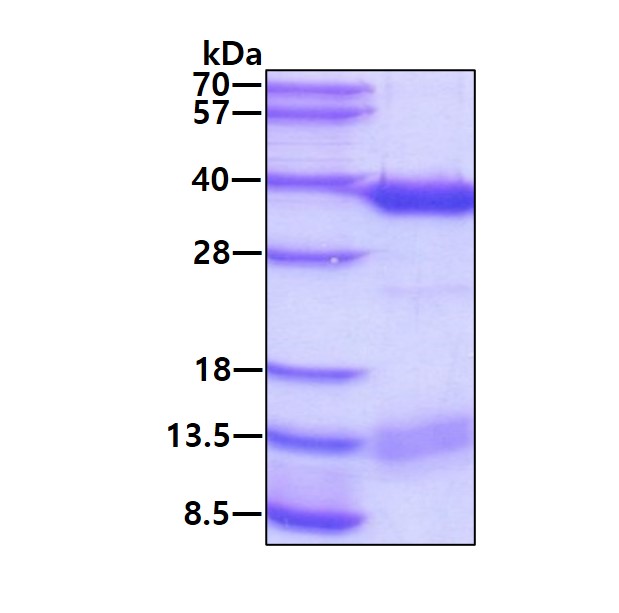
| Applications | SDS-PAGE |
| Host | E.coli |
| Note | STRICTLY FOR FURTHER SCIENTIFIC RESEARCH USE ONLY (RUO). MUST NOT TO BE USED IN DIAGNOSTIC OR THERAPEUTIC APPLICATIONS. |
Product Properties
| Concentration | 0.5 mg/mL |
| Formulation | Liquid in 20mM Tris-HCl buffer (pH 8.0) containing 1mM DTT, 30% Glycerol |
| Storage Instruction | For short term storage, keep at +2C to +8C for up to 1 week. For long term storage, aliquot and store at-20C, and avoid repeat freeze-thaw cycles. |
Target Information
| Gene Symbol | ALKBH2 |
| Gene ID | 121642 |
| Uniprot ID | ALKB2_HUMAN |
| Accession Number | NP_001138847.1 |
| Immunogen | Human |
| Immunogen Region | 1-261aa |
| Immunogen Sequence |
Additional Info
| Tissue Specificity | Detected in colon, small intestine, ovary, testis, prostate, skeletal muscle, heart, liver and urinary bladder. |
| Function | Dioxygenase that repairs alkylated nucleic acid bases by direct reversal oxidative dealkylation. Can process both double-stranded (ds) and single-stranded (ss) DNA substrates, with a strong preference for dsDNA. Uses molecular oxygen, 2-oxoglutarate and iron as cofactors to oxidize the alkyl groups that are subsequently released as aldehydes, regenerating the undamaged bases. Probes the base pair stability, locates a weakened base pair and flips the damaged base to accommodate the lesion in its active site for efficient catalysis. Repairs monoalkylated bases, specifically N1-methyladenine and N3-methylcytosine, as well as higher order alkyl adducts such as bases modified with exocyclic bridged adducts known as etheno adducts including 1,N6-ethenoadenine, 3,N4-ethenocytosine and 1,N2-ethenoguanine. Acts as a gatekeeper of genomic integrity under alkylation stress. Efficiently repairs alkylated lesions in ribosomal DNA (rDNA). These lesions can cause ss- and dsDNA strand breaks that severely impair rDNA transcription. In a response mechanism to DNA damage, associates with PCNA at replication forks to repair alkylated adducts prior to replication. |
| Protein Name | Dna Oxidative Demethylase Alkbh2Alkylated Dna Repair Protein Alkb Homolog 2Alpha-Ketoglutarate-Dependent Dioxygenase Alkb Homolog 2Oxy Dc1 |
| Database Links | Reactome: R-HSA-112122 |
| Cellular Localisation | NucleusNucleolusNucleoplasmRelocates To The Replication Foci During S-Phase |
| Alternative Protein Names | Dna Oxidative Demethylase Alkbh2 proteinAlkylated Dna Repair Protein Alkb Homolog 2 proteinAlpha-Ketoglutarate-Dependent Dioxygenase Alkb Homolog 2 proteinOxy Dc1 proteinALKBH2 proteinABH2 protein |
Information sourced from Uniprot.org