

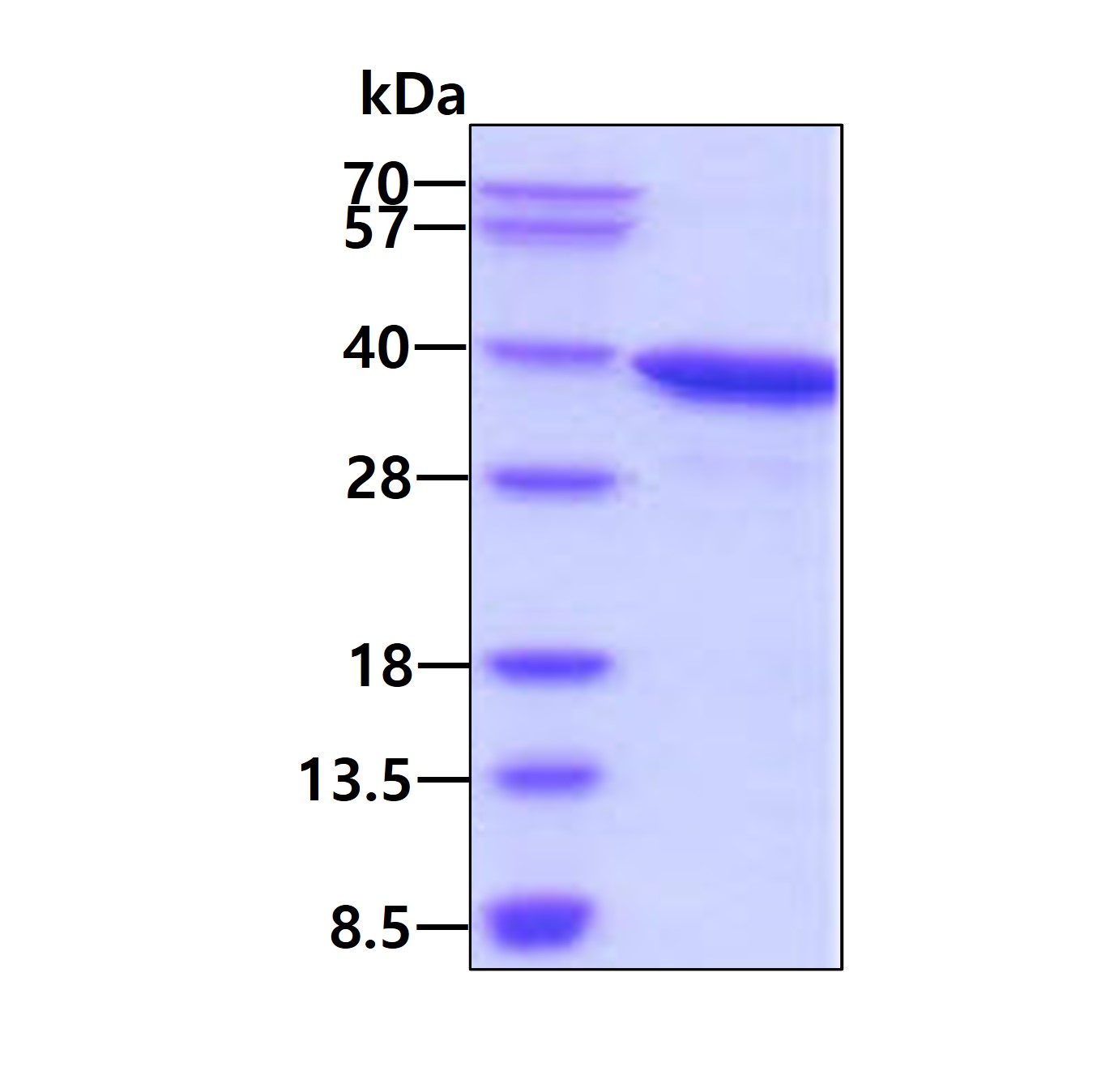

Human Aldo-keto Reductase 1C3/AKR1C3 protein (Recombinant) (No-Tag) (STJP019260)
SPECIFICATIONS
HostE.coli
ImmunogenHuman
General Information
| Short Description | Recombinant-Human Aldo-keto Reductase 1C3/AKR1C3-No-Tag protein was developed from e.coli and has a target region of No-Tag. For use in research applications. |
| Applications | SDS-PAGE/Enzyme Activity |
| Host | E.coli |
| Note | STRICTLY FOR FURTHER SCIENTIFIC RESEARCH USE ONLY (RUO). MUST NOT TO BE USED IN DIAGNOSTIC OR THERAPEUTIC APPLICATIONS. |
Product Properties
| Concentration | 1 mg/mL |
| Formulation | Liquid in 20mM Tris-HCl buffer (pH 8.5) containing 0.1M NaCl, 10% Glycerol, 1mM DTT |
| Storage Instruction | For short term storage, keep at +2C to +8C for up to 1 week. For long term storage, aliquot and store at-20C, and avoid repeat freeze-thaw cycles. |
| Endotoxin | < 1 EU per 1ug of protein (determined by LAL method) |
| Immunoreactivity | Specific activity is > 1, 000pmol/min/ug, and is defined as the amount of enzyme that catalyze the oxidation of 1.0pmole 1-Acenaphthenol in the presence of NADP per minute at pH 8.8 at 25C. |
Target Information
| Gene Symbol | AKR1C3 |
| Gene ID | 8644 |
| Uniprot ID | AK1C3_HUMAN |
| Accession Number | NP_003730.4 |
| Immunogen | Human |
| Immunogen Region | 1-323aa |
| Immunogen Sequence | MDSKHQCVKL NDGHFMPVLG FGTYAPPEVP RSKALEVTKL AIEAGFRHID SAHLYNNEEQ VGLAIRSKIA DGSVKREDIF YTSKLWSTFH RPELVRPALE NSLKKAQLDY VDLYLIHSPM SLKPGEELSP TDENGKVIFD IVDLCTTWEA MEKCKDAGLA KSIGVSNFNR RQLEMILNKP GLKYKPVCNQ VECHPYFNRS KLLDFCKSKD IVLVAYSALG SQRDKRWV |
Additional Info
| Tissue Specificity | Expressed in many tissues including adrenal gland, brain, kidney, liver, lung, mammary gland, placenta, small intestine, colon, spleen, prostate and testis. High expression in prostate and mammary gland. In the prostate, higher levels in epithelial cells than in stromal cells. In the brain, expressed in medulla, spinal cord, frontotemporal lobes, thalamus, subthalamic nuclei and amygdala. Weaker expression in the hippocampus, substantia nigra and caudate. |
| Function | Cytosolic aldo-keto reductase that catalyzes the NADH and NADPH-dependent reduction of ketosteroids to hydroxysteroids. Acts as a NAD(P)(H)-dependent 3-, 17- and 20-ketosteroid reductase on the steroid nucleus and side chain and regulates the metabolism of androgens, estrogens and progesterone. Displays the ability to catalyze both oxidation and reduction in vitro, but most probably acts as a reductase in vivo since the oxidase activity measured in vitro is inhibited by physiological concentration of NADPH. Acts preferentially as a 17-ketosteroid reductase and has the highest catalytic efficiency of the AKR1C enzyme for the reduction of delta4-androstenedione to form testosterone. Reduces prostaglandin (PG) D2 to 11beta-prostaglandin F2, progesterone to 20alpha-hydroxyprogesterone and estrone to 17beta-estradiol. Catalyzes the transformation of the potent androgen dihydrotestosterone (DHT) into the less active form, 5-alpha-androstan-3-alpha,17-beta-diol (3-alpha-diol). Also displays retinaldehyde reductase activity toward 9-cis-retinal. |
| Protein Name | Aldo-Keto Reductase Family 1 Member C3 17-Beta-Hydroxysteroid Dehydrogenase Type 517-Beta-Hsd 53-Alpha-Hsd Type Ii - Brain3-Alpha-Hydroxysteroid Dehydrogenase Type 23-Alpha-Hsd Type 2Chlordecone Reductase Homolog HakrbDihydrodiol Dehydrogenase 3Dd-3Dd3Dihydrodiol Dehydrogenase Type IHa1753Prostaglandin F SynthasePgfsTestosterone 17-Beta-Dehydrogenase 5 |
| Database Links | Reactome: R-HSA-193368Reactome: R-HSA-193775Reactome: R-HSA-193807Reactome: R-HSA-2162123Reactome: R-HSA-5365859Reactome: R-HSA-975634 |
| Cellular Localisation | Cytoplasm |
| Alternative Protein Names | Aldo-Keto Reductase Family 1 Member C3 protein17-Beta-Hydroxysteroid Dehydrogenase Type 5 protein17-Beta-Hsd 5 protein3-Alpha-Hsd Type Ii - Brain protein3-Alpha-Hydroxysteroid Dehydrogenase Type 2 protein3-Alpha-Hsd Type 2 proteinChlordecone Reductase Homolog Hakrb proteinDihydrodiol Dehydrogenase 3 proteinDd-3 proteinDd3 proteinDihydrodiol Dehydrogenase Type I proteinHa1753 proteinProstaglandin F Synthase proteinPgfs proteinTestosterone 17-Beta-Dehydrogenase 5 proteinAKR1C3 proteinDDH1 proteinHSD17B5 proteinKIAA0119 proteinPGFS protein |
Information sourced from Uniprot.org