

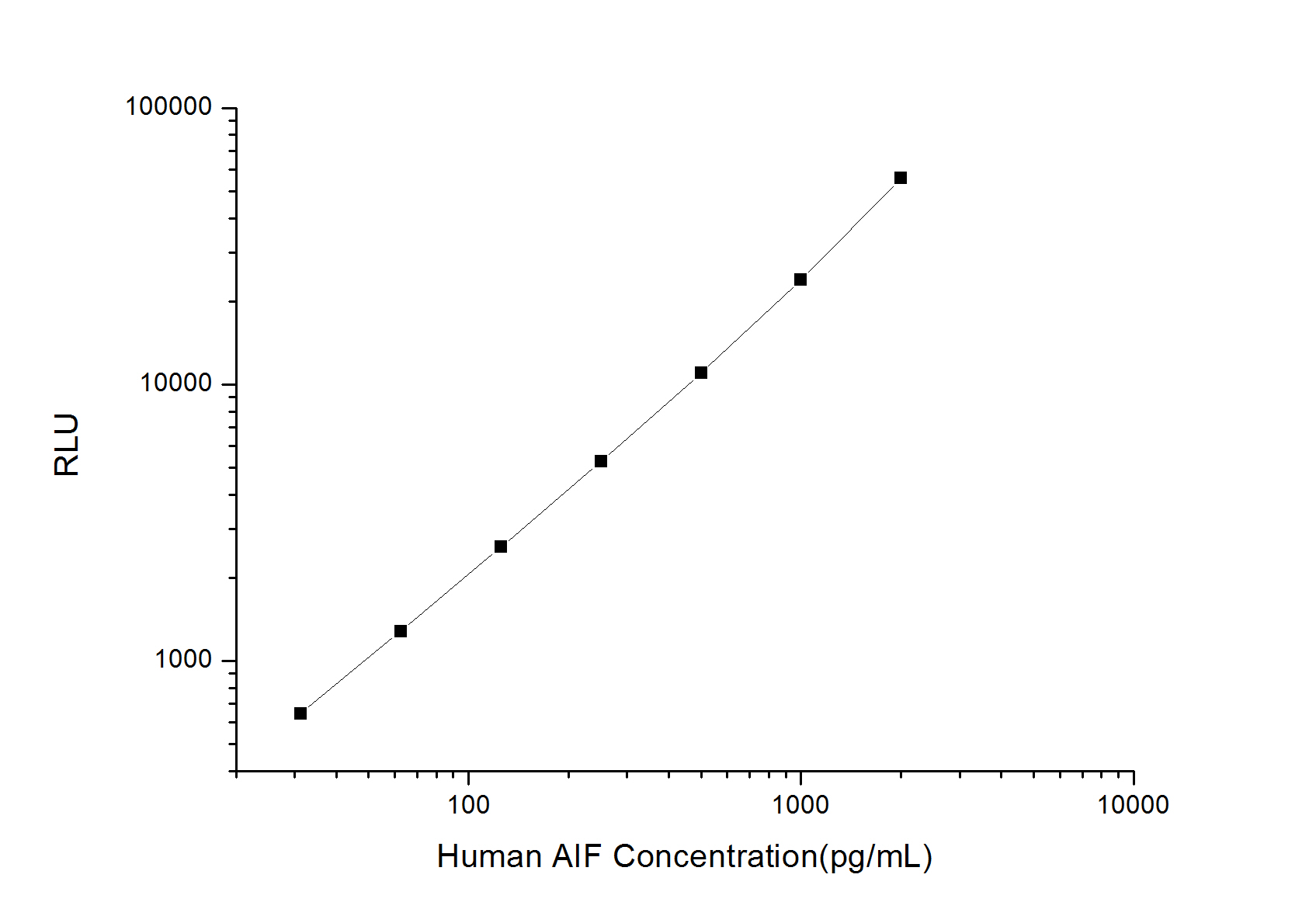

Human AIFM1 (Apoptosis-inducing factor 1, mitochondrial) CLIA Kit for Quantitative Detection
SPECIFICATIONS
General Information
| Short Description | This human AIFM1 kit is a highly sensitive in-vitro chemiluminescent immunoassay for the measurement of trace amounts of analytes in serum, plasma and other biological fluids. |
| Applications | CLIA |
| Reactivity | Human |
| Sensitivity | 18.75pg/mL |
| Detection Limit | 31.25~2000pg/mL |
| Note | FOR SCIENTIFIC EDUCATIONAL RESEARCH USE ONLY (RUO). MUST NOT BE USED IN DIAGNOSTIC OR OTHER MEDICAL APPLICATIONS. |
Product Properties
| Storage Instruction | If unopened the kit may be stored at 2-8°C for up to 1 month. If the kit will not be used within 1 month, store the components separately, according to the component table in the manual. |
| Assay Time | 3.5h |
| Detection | Chemiluminescence |
Target Information
| Gene Symbol | AIFM1 |
| Gene ID | 9131 |
| Uniprot ID | AIFM1_HUMAN |
| Specificity | This kit recognizes Human AIF in samples. No significant cross-reactivity or interference between Human AIF and analogues was observed. |
| Sample Type | Serum, plasma and other biological fluids |
Additional Info
| Tissue Specificity | Expressed in all tested tissues. Detected in muscle and skin fibroblasts (at protein level). Expressed in osteoblasts (at protein level). Isoform 3: Brain specific. Isoform 4: Expressed in all tested tissues except brain. Isoform 5: Isoform 5 is frequently down-regulated in human cancers. |
| Post Translational Modifications | Under normal conditions, a 54-residue N-terminal segment is first proteolytically removed during or just after translocation into the mitochondrial intermembrane space (IMS) by the mitochondrial processing peptidase (MPP) to form the inner-membrane-anchored mature form (AIFmit). During apoptosis, it is further proteolytically processed at amino-acid position 101 leading to the generation of the mature form, which is confined to the mitochondrial IMS in a soluble form (AIFsol). AIFsol is released to the cytoplasm in response to specific death signals, and translocated to the nucleus, where it induces nuclear apoptosis in a caspase-independent manner. Ubiquitination by XIAP/BIRC4 does not lead to proteasomal degradation. Ubiquitination at Lys-255 by XIAP/BIRC4 blocks its ability to bind DNA and induce chromatin degradation, thereby inhibiting its ability to induce cell death. |
| Function | Functions both as NADH oxidoreductase and as regulator of apoptosis. In response to apoptotic stimuli, it is released from the mitochondrion intermembrane space into the cytosol and to the nucleus, where it functions as a proapoptotic factor in a caspase-independent pathway. Release into the cytoplasm is mediated upon binding to poly-ADP-ribose chains. The soluble form (AIFsol) found in the nucleus induces 'parthanatos' i.e. caspase-independent fragmentation of chromosomal DNA. Binds to DNA in a sequence-independent manner. Interacts with EIF3G, and thereby inhibits the EIF3 machinery and protein synthesis, and activates caspase-7 to amplify apoptosis. Plays a critical role in caspase-independent, pyknotic cell death in hydrogen peroxide-exposed cells. In contrast, participates in normal mitochondrial metabolism. Plays an important role in the regulation of respiratory chain biogenesis by interacting with CHCHD4 and controlling CHCHD4 mitochondrial import. Isoform 4: Has NADH oxidoreductase activity. Does not induce nuclear apoptosis. Isoform 5: Pro-apoptotic isoform. |
| Protein Name | Apoptosis-Inducing Factor 1 - MitochondrialProgrammed Cell Death Protein 8 |
| Database Links | |
| Cellular Localisation | Mitochondrion Intermembrane SpaceMitochondrion Inner MembraneCytoplasmNucleusPerinuclear RegionProteolytic Cleavage During Or Just After Translocation Into The Mitochondrial Intermembrane Space (Ims) Results In The Formation Of An Inner-Membrane-Anchored Mature Form (Aifmit)During ApoptosisFurther Proteolytic Processing Leads To A Mature FormWhich Is Confined To The Mitochondrial Ims In A Soluble Form (Aifsol)Aifsol Is Released To The Cytoplasm In Response To Specific Death SignalsAnd Translocated To The NucleusWhere It Induces Nuclear ApoptosisRelease Into The Cytoplasm Is Mediated Upon Binding To Poly-Adp-Ribose ChainsTranslocation Into The Nucleus Is Promoted By Interaction With (Auto-Poly-Adp-Ribosylated) Processed Form Of Parp1Colocalizes With Eif3g In The Nucleus And Perinuclear RegionIsoform 3: Mitochondrion Intermembrane SpaceHas A Stronger Membrane Anchorage Than Isoform 1Isoform 4: MitochondrionCytosolIn Pro-Apoptotic ConditionsIs Released From Mitochondria To Cytosol In A Calpain/Cathepsin-Dependent MannerIsoform 5: Cytoplasm |
| Alternative CLIA Names | Apoptosis-Inducing Factor 1 - Mitochondrial CLIA kitProgrammed Cell Death Protein 8 CLIA kitAIFM1 CLIA kitAIF CLIA kitPDCD8 CLIA kit |
| Specificity | This kit recognizes Human AIF in samples. No significant cross-reactivity or interference between Human AIF and analogues was observed. |
| Reproducibility | Both intra-CV and inter-CV are |
Information sourced from Uniprot.org
| Item | Specifications | Storage |
|---|---|---|
| Micro CLIA Plate (Dismountable) | 96T: 8 wells ×12 strips strips | -20℃, 6 months |
| Reference Standard | 96T: 2 vials 48T: 1 vial | -20℃, 6 months |
| Concentrated Biotinylated Detection Ab (100×) | 96T: 1 vial, 120 μL 60 μL | -20℃, 6 months |
| Concentrated HRP Conjugate (100×) | 96T: 1 vial, 120 μL 60 μL | -20℃ (Protect from light), 6 months |
| Reference Standard & Sample Diluent | 1 vial, 20 mL | 2-8°C, 6 months |
| Biotinylated Detection Ab Diluent | 1 vial, 14 mL | 2-8°C, 6 months |
| HRP Conjugate Diluent | 1 vial, 14 mL | 2-8°C, 6 months |
| Concentrated Wash Buffer (25×) | 1 vial, 30 mL | 2-8°C, 6 months |
| Substrate Reagent A | 1 vial, 5 mL | 2-8℃ (Protect from light) |
| Substrate Reagent B | 1 vial, 5 mL | 2-8℃ (Protect from light) |
| Plate Sealer | 5 pieces | |
| Manual | 1 copy | |
| Certificate of Analysis | 1 copy |
| Sample Type | Range (%) | Average Recovery (%) |
|---|---|---|
| Serum(n=8) | 85-100 | 92 |
| EDTA plasma(n=8) | 93-104 | 98 |
| Cell culture media(n=8) | 85-97 | 91 |
| Intra-assay Precision | Intra-assay Precision | Intra-assay Precision | Inter-assay Precision | Inter-assay Precision | Inter-assay Precision | |
|---|---|---|---|---|---|---|
| Sample | 1.00 | 2.00 | 3.00 | 1.00 | 2.00 | 3.00 |
| n | 20.00 | 20.00 | 20.00 | 20.00 | 20.00 | 20.00 |
| Mean (pg/mL) | 95.60 | 250.84 | 948.15 | 102.82 | 227.58 | 911.56 |
| Standard deviation | 9.39 | 18.44 | 89.60 | 12.53 | 25.17 | 55.70 |
| CV (%) | 9.82 | 7.35 | 9.45 | 12.19 | 11.06 | 6.11 |