

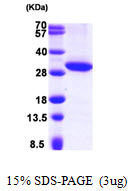

Human 17 beta-HSD11/HSD17B11 protein (Recombinant) (His-Tag) (STJP016986)
SPECIFICATIONS
HostE.coli
ImmunogenHuman
General Information
| Short Description | Recombinant-Human 17 beta-HSD11/HSD17B11-His-Tag protein was developed from e.coli and has a target region of His-Tag. For use in research applications. |
| Applications | SDS-PAGE |
| Host | E.coli |
| Note | STRICTLY FOR FURTHER SCIENTIFIC RESEARCH USE ONLY (RUO). MUST NOT TO BE USED IN DIAGNOSTIC OR THERAPEUTIC APPLICATIONS. |
Product Properties
| Concentration | 0.5 mg/mL |
| Formulation | Liquid in 20mM Tris-HCl buffer (pH 8.0) containing 0.2M NaCl, 5mM DTT, 20% Glycerol |
| Storage Instruction | For short term storage, keep at +2C to +8C for up to 1 week. For long term storage, aliquot and store at-20C, and avoid repeat freeze-thaw cycles. |
Target Information
| Gene Symbol | HSD17B11 |
| Gene ID | 51170 |
| Uniprot ID | DHB11_HUMAN |
| Accession Number | NP_057329 |
| Immunogen | Human |
| Immunogen Region | 20-285aa |
| Immunogen Sequence | MGSSHHHHHH SSGLVPRGSH MESFVKLFIP KRRKSVTGEI VLITGAGHGI GRLTAYEFAK LKSKLVLWDI NKHGLEETAA KCKGLGAKVH TFVVDCSNRE DIYSSAKKVK AEIGDVSILV NNAGVVYTSD LFATQDPQIE KTFEVNVLAH FWTTKAFLPA MTKNNHGHIV TVASAAGHVS VPFLLAYCSS KFAAVGFHKT LTDELAALQI TGVKTTCLCP NFVNTGFI |
Additional Info
| Tissue Specificity | Present at high level in steroidogenic cells such as syncytiotrophoblasts, sebaceous gland, Leydig cells, and granulosa cells of the dominant follicle and corpus luteum. In lung, it is detected in the ciliated epithelium and in acini of adult trachea, in bronchioles, but not in alveoli. In the eye, it is detected in the nonpigmented epithelium of the ciliary body and, at lower level, in the inner nuclear layer of the retina (at protein level). Widely expressed. Highly expressed in retina, pancreas, kidney, liver, lung, adrenal, small intestine, ovary and heart. |
| Function | Can convert androstan-3-alpha,17-beta-diol (3-alpha-diol) to androsterone in vitro, suggesting that it may participate in androgen metabolism during steroidogenesis. May act by metabolizing compounds that stimulate steroid synthesis and/or by generating metabolites that inhibit it. Has no activity toward DHEA (dehydroepiandrosterone), or A-dione (4-androste-3,17-dione), and only a slight activity toward testosterone to A-dione. Tumor-associated antigen in cutaneous T-cell lymphoma. |
| Protein Name | Estradiol 17-Beta-Dehydrogenase 1117-Beta-Hydroxysteroid Dehydrogenase 1117-Beta-Hsd 1117bhsd1117betahsd1117-Beta-Hydroxysteroid Dehydrogenase Xi17-Beta-Hsd Xi17betahsdxiCutaneous T-Cell Lymphoma-Associated Antigen Hd-Cl-03Ctcl-Associated Antigen Hd-Cl-03Dehydrogenase/Reductase Sdr Family Member 8Retinal Short-Chain Dehydrogenase/Reductase 2Retsdr2Short Chain Dehydrogenase/Reductase Family 16c Member 2 |
| Database Links | Reactome: R-HSA-193144 |
| Cellular Localisation | Endoplasmic ReticulumLipid DropletRedistributed From The Endoplasmic Reticulum To Lipids Droplets In The Cell Upon Induction Of Lipids Droplet Formation |
| Alternative Protein Names | Estradiol 17-Beta-Dehydrogenase 11 protein17-Beta-Hydroxysteroid Dehydrogenase 11 protein17-Beta-Hsd 11 protein17bhsd11 protein17betahsd11 protein17-Beta-Hydroxysteroid Dehydrogenase Xi protein17-Beta-Hsd Xi protein17betahsdxi proteinCutaneous T-Cell Lymphoma-Associated Antigen Hd-Cl-03 proteinCtcl-Associated Antigen Hd-Cl-03 proteinDehydrogenase/Reductase Sdr Family Member 8 proteinRetinal Short-Chain Dehydrogenase/Reductase 2 proteinRetsdr2 proteinShort Chain Dehydrogenase/Reductase Family 16c Member 2 proteinHSD17B11 proteinDHRS8 proteinPAN1B proteinSDR16C2 proteinPSEC0029 proteinUNQ207 proteinPRO233 protein |
Information sourced from Uniprot.org