

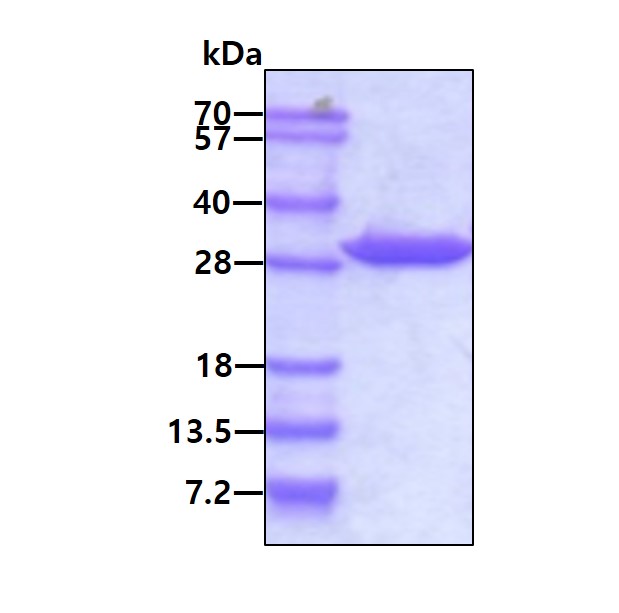

Human 14-3-3 gamma protein (Recombinant) (No-Tag) (STJP019809)
SPECIFICATIONS
HostE.coli
ImmunogenHuman
General Information
| Short Description | Recombinant-Human 14-3-3 gamma-No-Tag protein was developed from e.coli and has a target region of No-Tag. For use in research applications. |
| Applications | SDS-PAGE |
| Host | E.coli |
| Note | STRICTLY FOR FURTHER SCIENTIFIC RESEARCH USE ONLY (RUO). MUST NOT TO BE USED IN DIAGNOSTIC OR THERAPEUTIC APPLICATIONS. |
Product Properties
| Concentration | 1 mg/mL |
| Formulation | Liquid in phosphate-Buffered Saline (pH 7.4) containing 10% Glycerol |
| Storage Instruction | For short term storage, keep at +2C to +8C for up to 1 week. For long term storage, aliquot and store at-20C, and avoid repeat freeze-thaw cycles. |
| Endotoxin | < 1 EU per 1ug of protein (determined by LAL method) |
Target Information
| Gene Symbol | YWHAG |
| Gene ID | 7532 |
| Uniprot ID | 1433G_HUMAN |
| Accession Number | NP_036611 |
| Immunogen | Human |
| Immunogen Region | 1-247aa |
| Immunogen Sequence | MVDREQLVQK ARLAEQAERY DDMAAAMKNV TELNEPLSNE ERNLLSVAYK NVVGARRSSW RVISSIEQKT SADGNEKKIE MVRAYREKIE KELEAVCQDV LSLLDNYLIK NCSETQYESK VFYLKMKGDY YRYLAEVATG EKRATVVESS EKAYSEAHEI SKEHMQPTHP IRLGLALNYS VFYYEIQNAP EQACHLAKTA FDDAIAELDT LNEDSYKDST LIMQLLRD |
Additional Info
| Tissue Specificity | Highly expressed in brain, skeletal muscle, and heart. |
| Post Translational Modifications | Phosphorylated by various PKC isozymes. |
| Function | Adapter protein implicated in the regulation of a large spectrum of both general and specialized signaling pathways. Binds to a large number of partners, usually by recognition of a phosphoserine or phosphothreonine motif. Binding generally results in the modulation of the activity of the binding partner. Promotes inactivation of WDR24 component of the GATOR2 complex by binding to phosphorylated WDR24. Participates in the positive regulation of NMDA glutamate receptor activity by promoting the L-glutamate secretion through interaction with BEST1. Reduces keratinocyte intercellular adhesion, via interacting with PKP1 and sequestering it in the cytoplasm, thereby reducing its incorporation into desmosomes. Plays a role in mitochondrial protein catabolic process (also named MALM) that promotes the degradation of damaged proteins inside mitochondria. |
| Protein Name | 14-3-3 Protein GammaProtein Kinase C Inhibitor Protein 1Kcip-1 Cleaved Into - 14-3-3 Protein Gamma - N-Terminally Processed |
| Database Links | Reactome: R-HSA-111447Reactome: R-HSA-1445148Reactome: R-HSA-2565942Reactome: R-HSA-380259Reactome: R-HSA-380270Reactome: R-HSA-380284Reactome: R-HSA-380320Reactome: R-HSA-5620912Reactome: R-HSA-5625740Reactome: R-HSA-5628897Reactome: R-HSA-75035Reactome: R-HSA-8854518Reactome: R-HSA-9614399Reactome: R-HSA-9735871Reactome: R-HSA-9755779Reactome: R-HSA-9856649 |
| Cellular Localisation | CytoplasmCytosolMitochondrion MatrixTranslocates To The Mitochondrial Matrix Following Induction Of Malm (Mitochondrial Protein Catabolic Process) |
| Alternative Protein Names | 14-3-3 Protein Gamma proteinProtein Kinase C Inhibitor Protein 1 proteinKcip-1 Cleaved Into - 14-3-3 Protein Gamma - N-Terminally Processed proteinYWHAG protein |
Information sourced from Uniprot.org