

Human 14-3-3 beta/alpha protein (Recombinant) (His-Tag) (STJP019331)
SPECIFICATIONS
HostE.coli
ImmunogenHuman
General Information
| Short Description | Recombinant-Human 14-3-3 beta/alpha-His-Tag protein was developed from e.coli and has a target region of His-Tag. For use in research applications. |
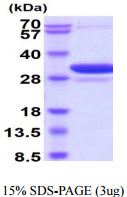
| Applications | SDS-PAGE |
| Host | E.coli |
| Note | STRICTLY FOR FURTHER SCIENTIFIC RESEARCH USE ONLY (RUO). MUST NOT TO BE USED IN DIAGNOSTIC OR THERAPEUTIC APPLICATIONS. |
Product Properties
| Concentration | 1 mg/mL |
| Formulation | Liquid in phosphate-Buffered Saline (pH 7.4) containing 10% Glycerol |
| Storage Instruction | For short term storage, keep at +2C to +8C for up to 1 week. For long term storage, aliquot and store at-20C, and avoid repeat freeze-thaw cycles. |
Target Information
| Gene Symbol | YWHAB |
| Gene ID | 7529 |
| Uniprot ID | 1433B_HUMAN |
| Accession Number | NP_003395 |
| Immunogen | Human |
| Immunogen Region | 1-246aa |
| Immunogen Sequence | MGSSHHHHHH SSGLVPRGSH MGSHMTMDKS ELVQKAKLAE QAERYDDMAA AMKAVTEQGH ELSNEERNLL SVAYKNVVGA RRSSWRVISS IEQKTERNEK KQQMGKEYRE KIEAELQDIC NDVLELLDKY LIPNATQPES KVFYLKMKGD YFRYLSEVAS GDNKQTTVSN SQQAYQEAFE ISKKEMQPTH PIRLGLALNF SVFYYEILNS PEKACSLAKT AFDEAIAE |
Additional Info
| Post Translational Modifications | The alpha, brain-specific form differs from the beta form in being phosphorylated. Phosphorylated on Ser-60 by protein kinase C delta type catalytic subunit in a sphingosine-dependent fashion. |
| Function | Adapter protein implicated in the regulation of a large spectrum of both general and specialized signaling pathways. Binds to a large number of partners, usually by recognition of a phosphoserine or phosphothreonine motif. Binding generally results in the modulation of the activity of the binding partner. Negative regulator of osteogenesis. Blocks the nuclear translocation of the phosphorylated form (by AKT1) of SRPK2 and antagonizes its stimulatory effect on cyclin D1 expression resulting in blockage of neuronal apoptosis elicited by SRPK2. Negative regulator of signaling cascades that mediate activation of MAP kinases via AKAP13. |
| Protein Name | 14-3-3 Protein Beta/AlphaProtein 1054Protein Kinase C Inhibitor Protein 1Kcip-1 Cleaved Into - 14-3-3 Protein Beta/Alpha - N-Terminally Processed |
| Database Links | Reactome: R-HSA-111447Reactome: R-HSA-1445148Reactome: R-HSA-165159Reactome: R-HSA-166208Reactome: R-HSA-170968Reactome: R-HSA-170984Reactome: R-HSA-2028269Reactome: R-HSA-392517Reactome: R-HSA-450385Reactome: R-HSA-450513Reactome: R-HSA-5625740Reactome: R-HSA-5628897Reactome: R-HSA-5673000Reactome: R-HSA-5674135Reactome: R-HSA-5675221Reactome: R-HSA-6802946Reactome: R-HSA-6802948Reactome: R-HSA-6802952Reactome: R-HSA-6802955Reactome: R-HSA-75035Reactome: R-HSA-9614399Reactome: R-HSA-9649948Reactome: R-HSA-9656223Reactome: R-HSA-9726840Reactome: R-HSA-9726842Reactome: R-HSA-9735871Reactome: R-HSA-9755779Reactome: R-HSA-9856649 |
| Cellular Localisation | CytoplasmMelanosomeIdentified By Mass Spectrometry In Melanosome Fractions From Stage I To Stage IvVacuole Membrane(Microbial Infection) Upon Infection With Chlamydia TrachomatisThis Protein Is Associated With The Pathogen-Containing Vacuole Membrane Where It Colocalizes With Incg |
| Alternative Protein Names | 14-3-3 Protein Beta/Alpha proteinProtein 1054 proteinProtein Kinase C Inhibitor Protein 1 proteinKcip-1 Cleaved Into - 14-3-3 Protein Beta/Alpha - N-Terminally Processed proteinYWHAB protein |
Information sourced from Uniprot.org