
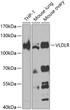


Anti-VLDLR antibody (833-869) (STJ11100936)
SPECIFICATIONS
ClonalityPolyclonal
HostRabbit
ConjugationUnconjugated
IsotypeIgG
General Information
| Short Description | Rabbit polyclonal VLDLR (833-869) antibody for use in WB and ELISA in human and mouse samples. Datasheet included with dilution recommendations, and related reagents. |
| Applications | WB/ELISA |
| Host | Rabbit |
| Reactivity | Human/Mouse |
| Note | STRICTLY FOR FURTHER SCIENTIFIC RESEARCH USE ONLY (RUO). MUST NOT TO BE USED IN DIAGNOSTIC OR THERAPEUTIC APPLICATIONS. |
Product Properties
| Clonality | Polyclonal |
| Isotype | IgG |
| Conjugation | Unconjugated |
| Concentration | Lot specific |
| Purification | Affinity purification |
| Dilution Range | WB:1:500-1:2000ELISA:Recommended starting concentration is 1 Mu g/mL. Please optimize the concentration based on your specific assay requirements. |
| Formulation | PBS with 0.05% Proclin300, 50% Glycerol, pH 7.3. |
| Storage Instruction | Store at-20°C for up to 1 year from the date of receipt, and avoid repeat freeze-thaw cycles. |
Target Information
| Gene Symbol | VLDLR |
| Gene ID | 7436 |
| Uniprot ID | VLDLR_HUMAN |
| Immunogen Region | 833-869 |
| Immunogen Sequence | DNPVYLKTTEEDLSIDIGRH SASVGHTYPAISVVSTD |
| Specificity | Recombinant fusion protein containing a sequence corresponding to amino acids 833-869 of human VLDLR (NP_003374.3). |
Additional Info
| Tissue Specificity | Abundant in heart and skeletal muscle.also ovary and kidney.not in liver. |
| Post Translational Modifications | Ubiquitinated at Lys-839 by MYLIP leading to degradation. Glycosylated. |
| Function | Multifunctional cell surface receptor that binds VLDL and transports it into cells by endocytosis and therefore plays an important role in energy metabolism. Also binds to a wide range of other molecules including Reelin/RELN or apolipoprotein E/APOE-containing ligands as well as clusterin/CLU. In the off-state of the pathway, forms homooligomers or heterooligomers with LRP8. Upon binding to ligands, homooligomers are rearranged to higher order receptor clusters that transmit the extracellular RELN signal to intracellular signaling processes by binding to DAB1. This interaction results in phosphorylation of DAB1 leading to the ultimate cell responses required for the correct positioning of newly generated neurons. Later, mediates a stop signal for migrating neurons, preventing them from entering the marginal zone. (Microbial infection) Acts as a receptor for Semliki Forest virus. |
| Protein Name | Very Low-Density Lipoprotein ReceptorVldl ReceptorVldl-R |
| Database Links | Reactome: R-HSA-8866376Reactome: R-HSA-8866427Reactome: R-HSA-8964046 |
| Cellular Localisation | Cell MembraneSingle-Pass Type I Membrane ProteinMembraneClathrin-Coated Pit |
| Alternative Antibody Names | Anti-Very Low-Density Lipoprotein Receptor antibodyAnti-Vldl Receptor antibodyAnti-Vldl-R antibodyAnti-VLDLR antibody |
Information sourced from Uniprot.org