
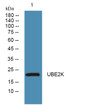


Anti-UBE2K antibody (STJ191605)
SPECIFICATIONS
ClonalityPolyclonal
HostRabbit
ConjugationUnconjugated
IsotypeIgG
ImmunogenSynthesized peptide derived from part of the human protein
General Information
| Short Description | Rabbit polyclonal anti-Ubiquitin-conjugating enzyme E2 K for use in WB and ELISA in Human and Mouse samples. Datasheet included with dilution recommendations, and related reagents. |
| Applications | WB/ELISA |
| Host | Rabbit |
| Reactivity | Human/Mouse |
| Note | STRICTLY FOR FURTHER SCIENTIFIC RESEARCH USE ONLY (RUO). MUST NOT TO BE USED IN DIAGNOSTIC OR THERAPEUTIC APPLICATIONS. |
Product Properties
| Clonality | Polyclonal |
| Isotype | IgG |
| Conjugation | Unconjugated |
| Concentration | 1 mg/mL |
| Purification | The antibody was affinity-purified from rabbit antiserum by affinity-chromatography using epitope-specific immunogen. |
| Dilution Range | WB 1:500-2000ELISA 1:5000-20000 |
| Formulation | Liquid in PBS containing 50% Glycerol and 0.02% Sodium Azide. |
| Storage Instruction | Store at-20°C for up to 1 year from the date of receipt, and avoid repeat freeze-thaw cycles. |
Target Information
| Gene Symbol | UBE2K |
| Gene ID | 3093 |
| Uniprot ID | UBE2K_HUMAN |
| Immunogen | Synthesized peptide derived from part of the human protein |
| Specificity | UBE2K Polyclonal Antibody detects endogenous levels of protein. |
Additional Info
| Post Translational Modifications | Sumoylation at Lys-14 impairs catalytic activity. |
| Function | Accepts ubiquitin from the E1 complex and catalyzes its covalent attachment to other proteins. In vitro, in the presence or in the absence of BRCA1-BARD1 E3 ubiquitin-protein ligase complex, catalyzes the synthesis of 'Lys-48'-linked polyubiquitin chains. Does not transfer ubiquitin directly to but elongates monoubiquitinated substrate protein. Mediates the selective degradation of short-lived and abnormal proteins, such as the endoplasmic reticulum-associated degradation (ERAD) of misfolded lumenal proteins. Ubiquitinates huntingtin. May mediate foam cell formation by the suppression of apoptosis of lipid-bearing macrophages through ubiquitination and subsequence degradation of p53/TP53. Proposed to be involved in ubiquitination and proteolytic processing of NF-kappa-B.in vitro supports ubiquitination of NFKB1. In case of infection by cytomegaloviruses may be involved in the US11-dependent degradation of MHC class I heavy chains following their export from the ER to the cytosol. In case of viral infections may be involved in the HPV E7 protein-dependent degradation of RB1. |
| Protein Name | Ubiquitin-Conjugating Enzyme E2 KE2 Ubiquitin-Conjugating Enzyme KHuntingtin-Interacting Protein 2Hip-2Ubiquitin Carrier ProteinUbiquitin-Conjugating Enzyme E2-25 KdaUbiquitin-Conjugating Enzyme E2(25kUbiquitin-Conjugating Enzyme E2-25kUbiquitin-Protein Ligase |
| Database Links | Reactome: R-HSA-8866652Reactome: R-HSA-936440Reactome: R-HSA-983168 |
| Cellular Localisation | Cytoplasm |
| Alternative Antibody Names | Anti-Ubiquitin-Conjugating Enzyme E2 K antibodyAnti-E2 Ubiquitin-Conjugating Enzyme K antibodyAnti-Huntingtin-Interacting Protein 2 antibodyAnti-Hip-2 antibodyAnti-Ubiquitin Carrier Protein antibodyAnti-Ubiquitin-Conjugating Enzyme E2-25 Kda antibodyAnti-Ubiquitin-Conjugating Enzyme E2(25k antibodyAnti-Ubiquitin-Conjugating Enzyme E2-25k antibodyAnti-Ubiquitin-Protein Ligase antibodyAnti-UBE2K antibodyAnti-HIP2 antibodyAnti-LIG antibody |
Information sourced from Uniprot.org