


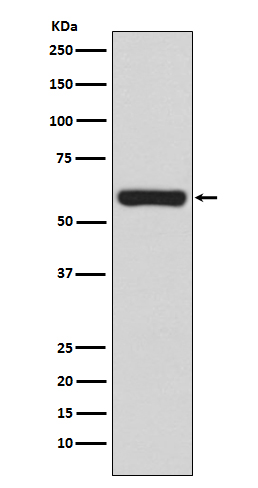
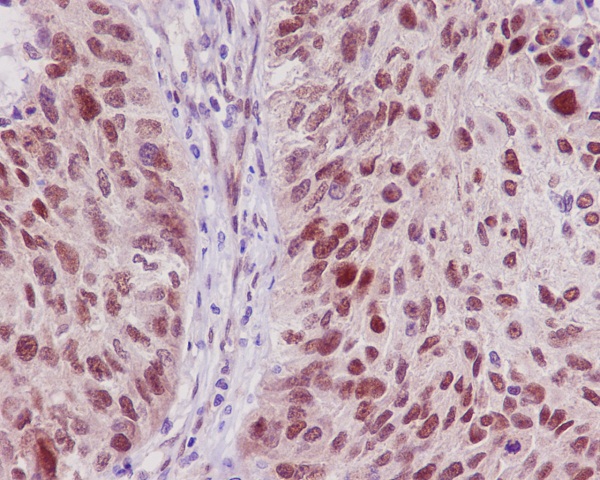

Anti-TRAF6 antibody [R09-7O1] (STJA0035812)
SPECIFICATIONS
ClonalityMonoclonal
HostRabbit
ConjugationUnconjugated
IsotypeIgG
ImmunogenA synthesized peptide derived from human TRAF6
General Information
| Short Description | Rabbit monoclonal anti-TRAF6 for use in WB, IHC-P, ICC and IF in Human, Mouse and Rat samples. Datasheet included with dilution recommendations, and related reagents. |
| Applications | WB/IHC-P/ICC/IF |
| Host | Rabbit |
| Reactivity | Human/Mouse/Rat |
| Note | STRICTLY FOR FURTHER SCIENTIFIC RESEARCH USE ONLY (RUO). MUST NOT TO BE USED IN DIAGNOSTIC OR THERAPEUTIC APPLICATIONS. |
Product Properties
| Clonality | Monoclonal |
| Clone ID | R09-7O1 |
| Isotype | IgG |
| Conjugation | Unconjugated |
| Purification | Affinity Chromatography |
| Dilution Range | WB 1:500-1:1000IHC 1:50-1:100IF 1:50-1:200 |
| Formulation | Rabbit IgG in phosphate buffered saline, pH 7.4, 150mM NaCl, 0.02% sodium azide and 50% glycerol. |
| Storage Instruction | Store at 4°C short term. Aliquot and store at-20°C long term. Avoid freeze/thaw cycles. |
Target Information
| Gene Symbol | TRAF6 |
| Gene ID | 7189 |
| Uniprot ID | TRAF6_HUMAN |
| Immunogen | A synthesized peptide derived from human TRAF6 |
Additional Info
| Tissue Specificity | Expressed in heart, brain, placenta, lung, liver, skeletal muscle, kidney and pancreas. |
| Post Translational Modifications | Sumoylated on Lys-124, Lys-142 and Lys-453 with SUMO1. Polyubiquitinated on Lys-124 by TRAF3IP2.after cell stimulation with IL17A. Polyubiquitinated on Lys-124.after cell stimulation with IL1B or TGFB. This ligand-induced cell stimulation leads to dimerization/oligomerization of TRAF6 molecules, followed by auto-ubiquitination which involves UBE2N and UBE2V1 and leads to TRAF6 activation. This 'Lys-63' site-specific poly-ubiquitination appears to be associated with the activation of signaling molecules. Endogenous autoubiquitination occurs only for the cytoplasmic form. Deubiquitinated by USP10 in a TANK-dependent manner, leading to the negative regulation of NF-kappaB signaling upon DNA damage. LRRC19 induces 'Lys-63' ubiquitination. Ubiquitinated at Lys-319 by the SCF(FBXL2) complex, leading to its degradation by the proteasome. (Microbial infection) Deubiquitinated by Epstein-Barr virus BPLF1 on both 'Lys-48' and 'Lys-63'-linked ubiquitin chains.leading to NF-kappa-B signaling inhibition. |
| Function | E3 ubiquitin ligase that, together with UBE2N and UBE2V1, mediates the synthesis of 'Lys-63'-linked-polyubiquitin chains conjugated to proteins, such as ECSIT, IKBKG, IRAK1, AKT1 and AKT2. Also mediates ubiquitination of free/unanchored polyubiquitin chain that leads to MAP3K7 activation. Leads to the activation of NF-kappa-B and JUN. Seems to also play a role in dendritic cells (DCs) maturation and/or activation. Represses c-Myb-mediated transactivation, in B-lymphocytes. Adapter protein that seems to play a role in signal transduction initiated via TNF receptor, IL-1 receptor and IL-17 receptor. Regulates osteoclast differentiation by mediating the activation of adapter protein complex 1 (AP-1) and NF-kappa-B, in response to RANK-L stimulation. Together with MAP3K8, mediates CD40 signals that activate ERK in B-cells and macrophages, and thus may play a role in the regulation of immunoglobulin production. Acts as a regulator of the JNK and NF-kappa-B signaling pathways by initiating assembly of heterotypic 'Lys-63'-/'Lys-48'-linked branched ubiquitin chains that are then recognized by TAB2: TRAF6 catalyzes initial 'Lys-63'-linked-polyubiquitin chains that are then branched via 'Lys-48'-linked polyubiquitin by HUWE1. 'Lys-63'-/'Lys-48'-linked branched ubiquitin chains protect 'Lys-63'-linkages from CYLD deubiquitination. Participates also in the TCR signaling by ubiquitinating LAT. |
| Protein Name | Tnf Receptor-Associated Factor 6E3 Ubiquitin-Protein Ligase Traf6Interleukin-1 Signal TransducerRing Finger Protein 85Ring-Type E3 Ubiquitin Transferase Traf6 |
| Database Links | Reactome: R-HSA-1257604Reactome: R-HSA-166058Reactome: R-HSA-168638Reactome: R-HSA-168927Reactome: R-HSA-193692Reactome: R-HSA-202424Reactome: R-HSA-205043Reactome: R-HSA-209543Reactome: R-HSA-209560Reactome: R-HSA-2871837Reactome: R-HSA-445989Reactome: R-HSA-450302Reactome: R-HSA-450321Reactome: R-HSA-5607764Reactome: R-HSA-5689880Reactome: R-HSA-5689896Reactome: R-HSA-6811558Reactome: R-HSA-9014325Reactome: R-HSA-9020702Reactome: R-HSA-933541Reactome: R-HSA-933542Reactome: R-HSA-937039Reactome: R-HSA-937041Reactome: R-HSA-937042Reactome: R-HSA-937072Reactome: R-HSA-9645460Reactome: R-HSA-9692916Reactome: R-HSA-9705671Reactome: R-HSA-975110Reactome: R-HSA-975138Reactome: R-HSA-975144Reactome: R-HSA-975155Reactome: R-HSA-975163Reactome: R-HSA-9758274Reactome: R-HSA-975871 |
| Cellular Localisation | CytoplasmCell CortexNucleusLipid DropletFound In The Nuclei Of Some Aggressive B-Cell Lymphoma Cell Lines As Well As In The Nuclei Of Both Resting And Activated T- And B-LymphocytesFound In Punctate Nuclear Body Protein ComplexesUbiquitination May Occur In The Cytoplasm And Sumoylation In The NucleusRsad2/Viperin Recruits It To The Lipid Droplet |
| Alternative Antibody Names | Anti-Tnf Receptor-Associated Factor 6 antibodyAnti-E3 Ubiquitin-Protein Ligase Traf6 antibodyAnti-Interleukin-1 Signal Transducer antibodyAnti-Ring Finger Protein 85 antibodyAnti-Ring-Type E3 Ubiquitin Transferase Traf6 antibodyAnti-TRAF6 antibodyAnti-RNF85 antibody |
Information sourced from Uniprot.org