


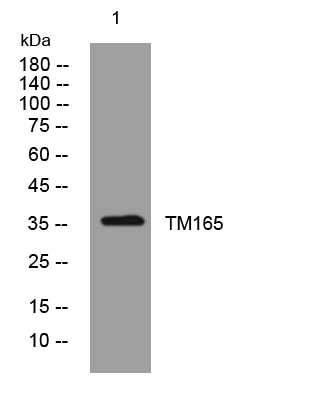
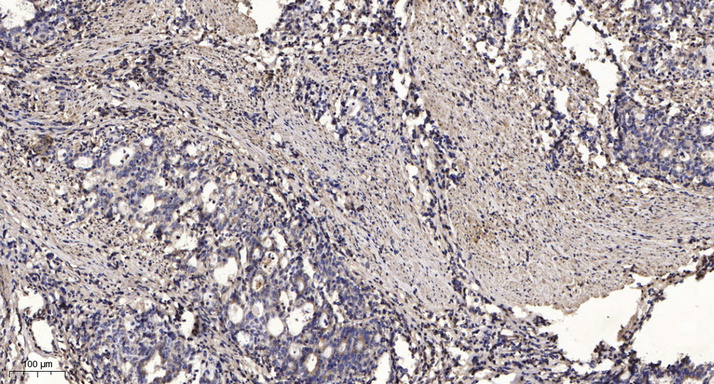

Anti-TMEM165 antibody (68-118 aa) (STJ194881)
SPECIFICATIONS
ClonalityPolyclonal
HostRabbit
ConjugationUnconjugated
IsotypeIgG
ImmunogenSynthesized peptide derived from the human TM165 at the amino acid range 68-118
General Information
| Short Description | Rabbit polyclonal anti-Putative divalent cation/proton antiporter TMEM165 (68-118 aa) for use in WB, ELISA and IHC in Human, Mouse and Rat samples. Datasheet included with dilution recommendations, and related reagents. |
| Applications | WB/ELISA/IHC |
| Host | Rabbit |
| Reactivity | Human/Mouse/Rat |
| Note | STRICTLY FOR FURTHER SCIENTIFIC RESEARCH USE ONLY (RUO). MUST NOT TO BE USED IN DIAGNOSTIC OR THERAPEUTIC APPLICATIONS. |
Product Properties
| Clonality | Polyclonal |
| Isotype | IgG |
| Conjugation | Unconjugated |
| Concentration | 1 mg/mL |
| Purification | The antibody was affinity-purified from rabbit antiserum by affinity-chromatography using epitope-specific immunogen. |
| Dilution Range | WB 1:500-2000IHC-P 1:50-300ELISA 2000-20000 |
| Formulation | Liquid in PBS containing 50% Glycerol, 0.5% BSA and 0.02% Sodium Azide. |
| Storage Instruction | Store at-20°C for up to 1 year from the date of receipt, and avoid repeat freeze-thaw cycles. |
Target Information
| Gene Symbol | TMEM165 |
| Gene ID | 55858 |
| Uniprot ID | TM165_HUMAN |
| Immunogen | Synthesized peptide derived from the human TM165 at the amino acid range 68-118 |
| Immunogen Region | 68-118 aa |
| Specificity | This antibody detects endogenous levels of TM165 at Human/Mouse/Rat |
Additional Info
| Function | Putative divalent cation:proton antiporter that exchanges calcium or manganese ions for protons across the Golgi membrane. Mediates the reversible transport of calcium or manganese to the Golgi lumen driven by the proton gradient and possibly the membrane potential generated by V-ATPase. Provides calcium or manganese cofactors to resident Golgi enzymes and contributes to the maintenance of an acidic luminal Golgi pH required for proper functioning of the secretory pathway. Promotes Ca(2+) storage within the Golgi lumen of the mammary epithelial cells to be then secreted into milk. The transport mechanism and stoichiometry remains to be elucidated. |
| Protein Name | Putative Divalent Cation/Proton Antiporter Tmem165Transmembrane Protein 165Transmembrane Protein Pt27Transmembrane Protein Tparl |
| Database Links | |
| Cellular Localisation | Golgi Apparatus MembraneMulti-Pass Membrane Protein |
| Alternative Antibody Names | Anti-Putative Divalent Cation/Proton Antiporter Tmem165 antibodyAnti-Transmembrane Protein 165 antibodyAnti-Transmembrane Protein Pt27 antibodyAnti-Transmembrane Protein Tparl antibodyAnti-TMEM165 antibodyAnti-TPARL antibody |
Information sourced from Uniprot.org